



A century of remarkable performances, world-class voices, and enduring passion for opera: The Beiruter explores Lebanon’s rich operatic legacy and, in an exclusive interview with conductor Harout Fazlian, the challenges and ambitions shaping its future.
Lebanon’s opera legacy… Still searching for a stage
Lebanon’s opera legacy… Still searching for a stage
By Michella Rizk | October 24, 2026

Reading time: 7 min

In October 1922, some 400 spectators gathered beneath the Roman columns as military searchlights illuminated the ruins. That evening, The Tragic Love of Astarte and Adonis came to life in a theatrical production that would foreshadow Baalbeck's transformation into an international destination for the performing arts.
Over the decades that followed, opera found its place in Lebanon. Beirut's theaters welcomed European productions, Lebanese singers rose to international prominence, and festivals including Baalbeck, Beiteddine, and Tyre brought internationally acclaimed opera singers and productions to Lebanese audiences.
In an exclusive interview with The Beiruter, Maestro Harout Fazlian, who has spent decades bringing operatic music to Lebanese audiences, emphasized the country's wealth of musical talent and continued interest in opera. The main challenge, he explains, is the absence of a dedicated opera house where singers can regularly perform full productions.
As the world marks International Opera Day on October 25, Lebanon's operatic journey tells a story of cultural ambition, remarkable musicians, lost stages, and an artistic tradition that continues to find ways to reach its audience.
When Beirut had a stage for opera
By the early twentieth century, Beirut's theaters and music schools were bringing European classical music into conversation with Arab artistic traditions. Lebanese composers and singers were beginning to make opera their own.
Among the pioneers was composer Wadih Sabra, best known for writing Lebanon's national anthem. His works included Les Deux Rois (The Two Kings), an Arabic-language opera completed in 1928.
Opened in 1929, the Grand Théâtre de Beyrouth, designed by architect Youssef Aftimos, became a major cultural venue. Its 630-seat auditorium welcomed international companies and celebrated Arab performers, including Oum Kalthoum and Mohammed Abdel Wahab, alongside operatic productions.
One of Lebanon's pioneering operatic voices was soprano Arlette El-Khoury. Born in Brazil to Lebanese parents in 1914, she moved to Beirut in 1932 to study at the National Conservatory.
In 1936, she performed in Sabra's L'Émigré at the Grand Théâtre. Two years later, she took the leading role in Charles Gounod's Mireille, reported as the first European opera staged in Lebanon.
By the time she graduated in 1939, El-Khoury had helped establish a place for Lebanese singers in the European operatic repertoire.
Baalbeck's golden years and the silence of war
Founded in 1956, the Baalbeck International Festival transformed the ancient Roman temples into one of the region's most celebrated open-air stages, welcoming opera companies, orchestras, ballet troupes, and theatrical productions.
A defining moment came in August 1965, when Mozart's Don Giovanni was staged at the festival. International performers were joined by young Lebanese singers recruited from local musical institutions and choirs.
Fazlian explained that
Opera in Lebanon has historically depended on festivals, particularly Baalbeck, with Beiteddine also presenting operatic performances in more recent years.
Rather than performing in purpose-built opera theaters, visiting companies adapted existing spaces to accommodate elaborate sets, orchestras, and singers.
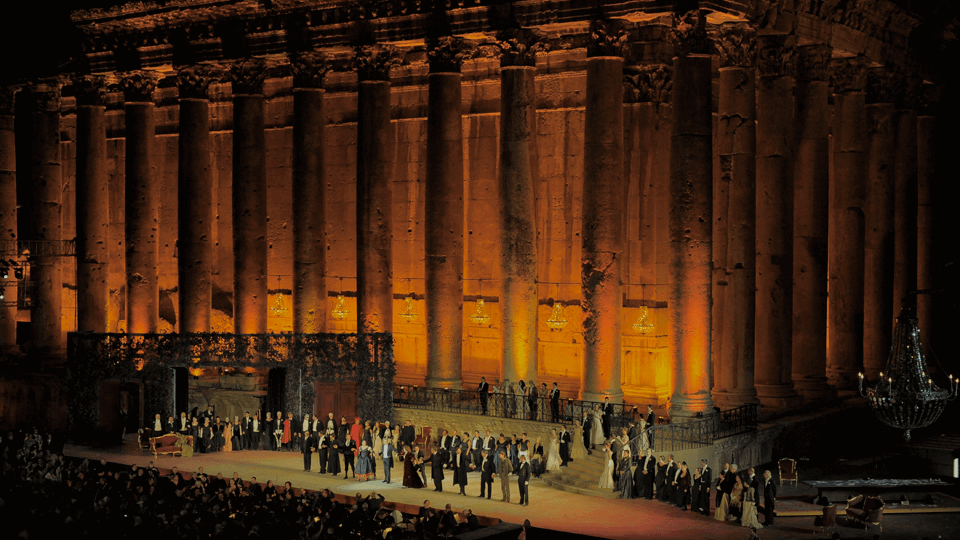 Source: Baalbeck International Festival
Such arrangements are not unique to Lebanon. “They kind of adapt to the opera scenes and the decor,” Fazlian noted, citing Italy’s Arena di Verona as an example of an outdoor venue.
However, he draws a distinction between productions suited to open-air settings and those requiring traditional theaters. “There are some operas that can be done outside,” he said, citing Verdi’s Aida and Nabucco. “But I personally don’t believe that those more intimate subjects can be done in open-air venues.”
The outbreak of Lebanon's Civil War in 1975 interrupted much of this cultural activity. Baalbeck suspended its performances for 22 years, while Beirut's historic venues suffered damage and closure.
The Grand Théâtre officially closed in 1990. Cinema Opera near Martyrs' Square, which operated primarily as a cinema despite its name, was later converted into a Virgin Megastore in 2001.
Nevertheless, Lebanese musicians continued performing, studying, and building careers, both at home and abroad.
Opera's revival: From international classics to Lebanese interpretations
The Baalbeck International Festival returned in 1997, reviving Lebanon’s tradition of major classical performances. In August 2000, Puccini’s Tosca brought Argentine tenor José Cura and Italian soprano Tiziana Fabbricini to the ancient temples, accompanied by a 60-member Italian orchestra and a 50-member choir from Milan.
Other highlights included Carl Orff’s scenic cantata Carmina Burana (2001), performances by opera stars Angela Gheorghiu and Roberto Alagna (2002), and Verdi’s La Traviata (2009).
Lebanese artists also brought their heritage to the operatic stage. In 2016, Antar and Abla, an Arabic-language opera composed by Maroun Rahi with a libretto by Antoine Maalouf, premiered at Casino du Liban. Starring Ghassan Saliba and soprano Lara Jokhadar, it retold the legendary Arab love story through classical singing, Arabic poetry, and regional musical influences before reaching Bahrain.
In July 2025, Baalbeck reimagined Bizet’s Carmen in nineteenth-century Mount Lebanon, drawing on the region’s silk industry. Directed by Jorge Takla and conducted by Lebanese maestro Toufic Maatouk, the production featured international soloists, the Romanian Radio Symphony Orchestra, and the Antonine University Choir, with costumes by Rabih Kayrouz and visual contributions from Nabil Nahas.
Bringing together more than 250 Lebanese and international artists, Carmen drew enough demand for a second performance, highlighting Lebanon’s enduring appreciation for opera and its ability to give international classics a distinctly local identity.
Creating an opera stage where none existed
The establishment of the Lebanese Philharmonic Orchestra in 2000 opened new opportunities for opera singers. Fazlian recalled being among the first conductors to introduce operatic arias into its programming, giving Lebanese vocalists the chance to perform with a full symphonic ensemble.
He later conducted Pietro Mascagni’s Cavalleria Rusticana at Saint Joseph Church, staging a complete opera with Lebanese soloists, choir, and orchestra, a production he considers pioneering.
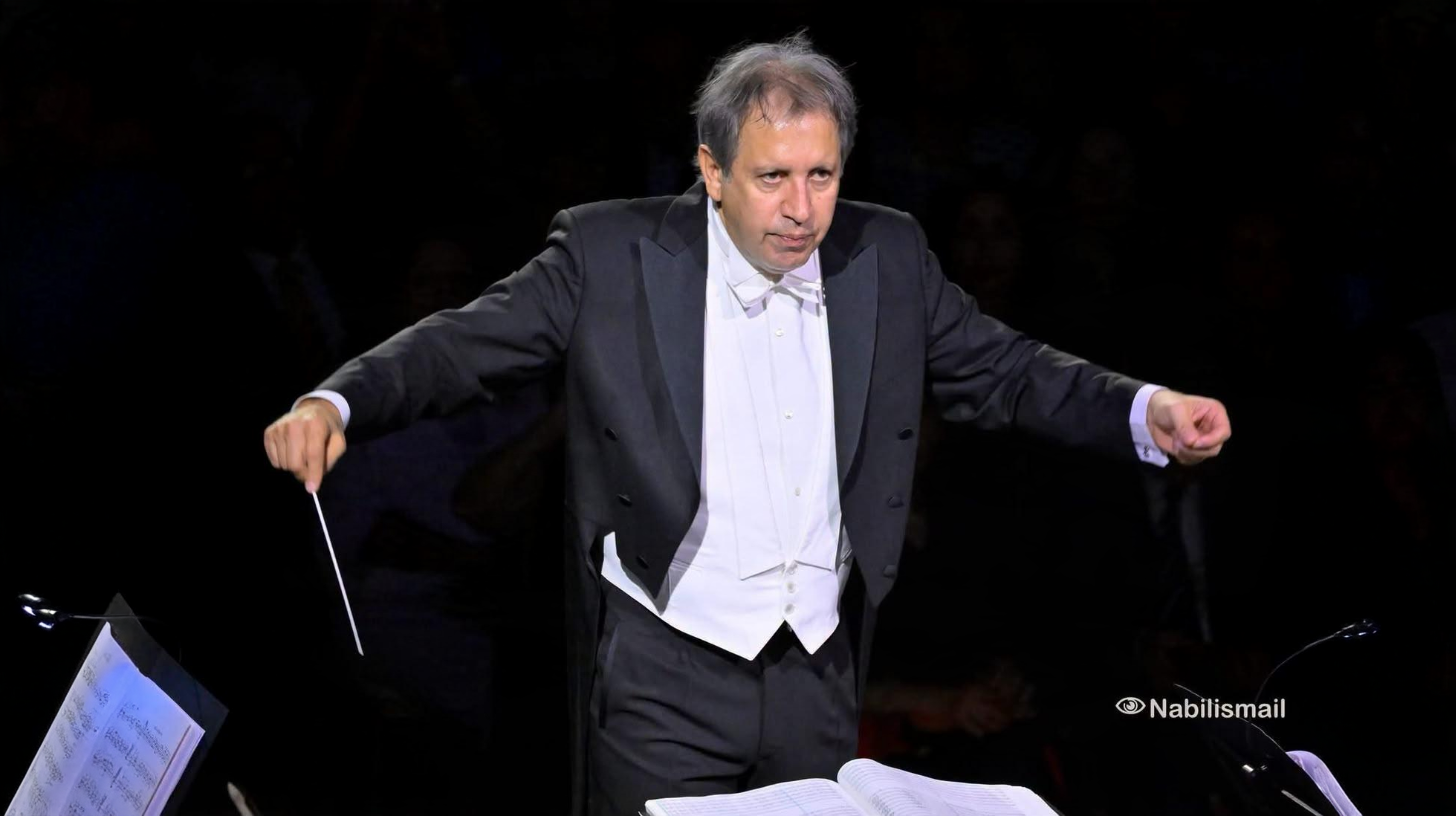 Maestro Harout Fazlian. Photo credit: Nabil Ismail.
At the same venue, he presented Opera Scenes, a 70-minute performance combining scenes, duets, and trios from different operas into a single theatrical concept. He even created a temporary orchestra pit and elevated stage to recreate the setting of an opera theater, an approach he describes as unprecedented in Lebanon to his knowledge.
Both productions demonstrated the talent and resourcefulness of Lebanese musicians, even without a dedicated opera house.
The missing opera house, not the missing talent
Despite the country's accomplished singers, composers, and conductors, Fazlian believes “Lebanon's greatest obstacle remains the absence of a dedicated opera theater”.
He distinguished between the concerts regularly presented in Lebanon and complete operatic productions, which require considerably more elaborate staging.
Many Lebanese opera singers, he explains, perform in private concerts or with orchestras, presenting individual arias and duets rather than complete works.
"It's a vicious circle," he said, describing how the absence of an opera house restricts professional opportunities for singers, while the lack of regular productions makes it difficult to develop a permanent opera scene.
A concert hall cannot fully replace an opera theater, which requires different acoustics, an orchestra pit, specialized stage equipment, and high ceilings to accommodate moving sets and curtains.
The Chinese-funded National Conservatory and concert hall project in Dbayeh represents an important investment in Lebanon's musical infrastructure, but “the complex is designed for concerts rather than fully staged opera”.
Without the proper facilities, staging an opera often means adapting a venue that was never intended for it.
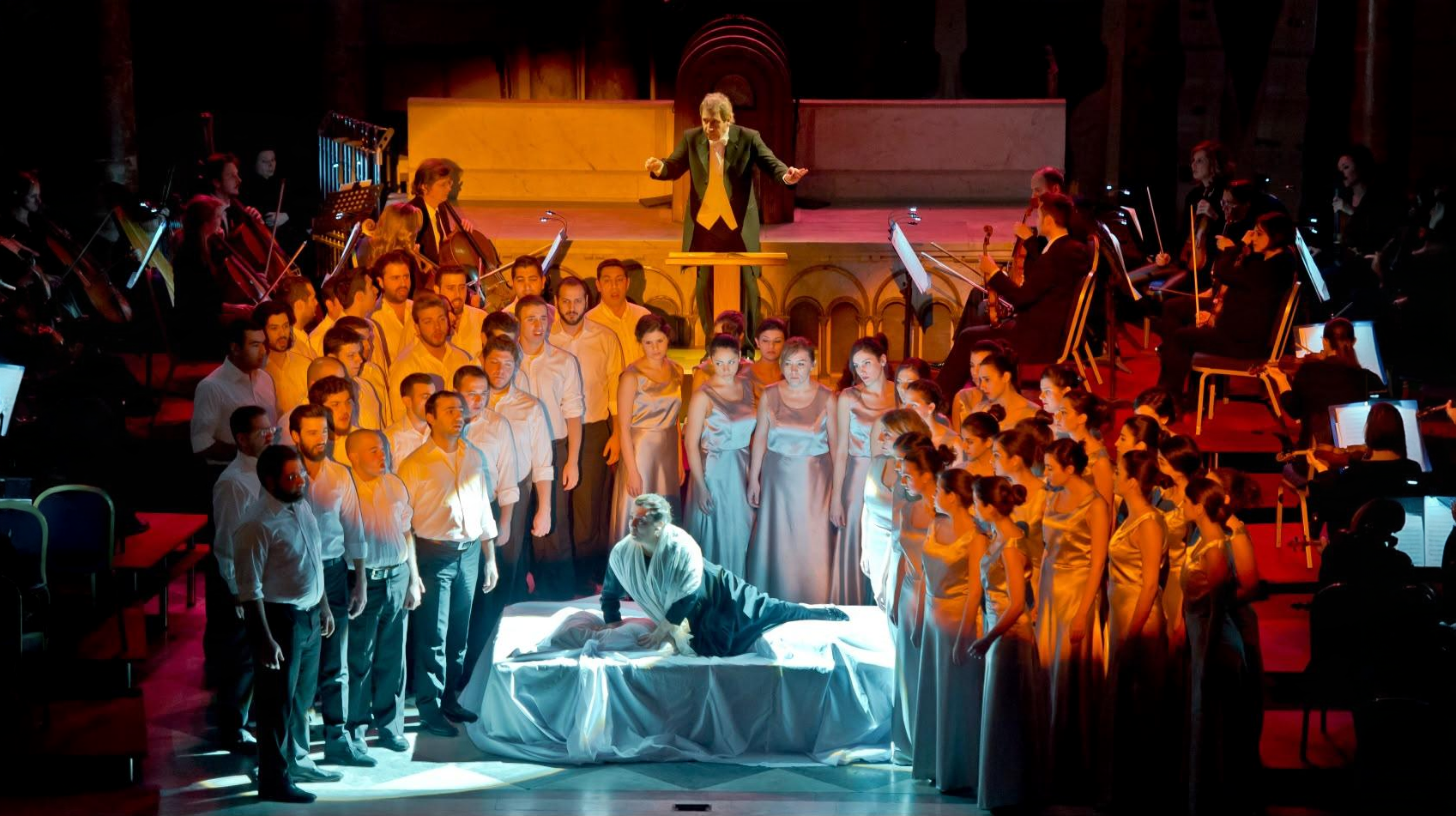 Maestro Harout Fazlian conducting Pietro Mascagni’s Cavalleria Rusticana at Saint Joseph Church.
Building the next chapter of Lebanese opera
For Fazalian, opera's future in Lebanon depends not only on building performance venues but also on attracting younger audiences. Educational talks and listening sessions already introduce audiences to operatic stories, characters, and famous arias, but he believes younger generations need more engaging, accessible productions.
Once you get hooked on opera, you're in love with it for the rest of your life.
He describes opera as an almost complete art form, combining music, literature, poetry, theater, dance, costumes, and visual arts in a single performance.
As for establishing a national opera company, Fazlian believes the ambition is achievable, although building a dedicated opera house would require millions of dollars and government investment.
"If there's a will, there's a way," he said.
Such an institution could also encourage Lebanese composers to develop original operas in Arabic or other languages. "We have to start from somewhere," he emphasizes, arguing that artists need opportunities to bring their compositions to the stage.
Lebanon already has much to build on. The Lebanese National Higher Conservatory of Music continues to train musicians, festivals bring international productions to local audiences, and Lebanese performers have demonstrated their talent at home and abroad.
Lebanese voices have found their way onto the world's stages. The next chapter could be about giving them a permanent stage to call home.
-
-
-
Michella RizkContent Manager/WriterFocusing on social affairs.
-
