



Byblos Art Walk returns to the old souk
Byblos Art Walk returns to the old souk

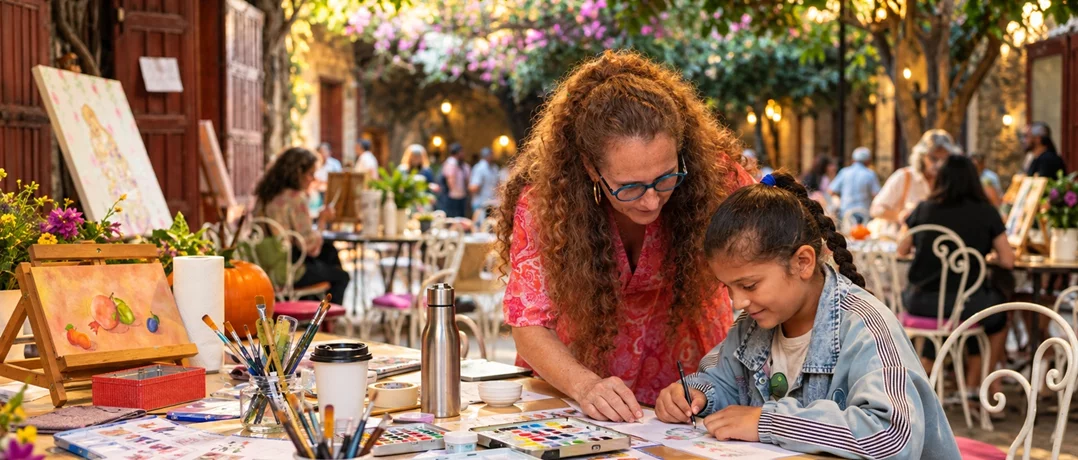
On the weekend of International Artist Day, the lanes of Byblos’ old souk became an open-air gallery. Calligraphers, jewelers, musicians, illustrators and even pumpkin carvers set up among the ordinary shops, and visitors wandered from one to the next, discovering artists as they went. Behind it all is Alice Edde, who organized the second edition of the Byblos Art Walk.
The concept began on a gift-shopping trip. Edde was visiting family in Washington, DC, and a friend took her to a favorite souvenir shop. Instead of trinkets, the owner invited her to look at photographs of horses.
“I said, ‘I’m sorry, I guess I’m in the wrong shop,’” Edde told The Beiruter. The owner explained that the shop belonged to an art walk spanning 15 stores in Georgetown, each hosting a different artist, with visitors strolling from one to the next. “Walking from one shop to the other, now that’s for Byblos. And that’s how I got the idea.”
The first edition took place last June, on Fête de la Musique. This year she moved it to October for practical and symbolic reasons. “The weather is better and cooler, and there’s a better clientele,” she explained.
Choosing the artists
Edde built the lineup largely through social media. “I follow them on Instagram, and if I like somebody, I’ll contact him or her,” she explained. She then visits their studios or meets them in person to describe the project. The response was generally enthusiastic, “they would reply, ‘Sure, why not? Let’s participate.’” The result was roughly 20 participants and a deliberately wide mix of disciplines, from calligraphy and portraiture to jewelry, music and pumpkin carving. “Something for everybody,” Edde explained.
On which activities resonated most with visitors, Edde hesitated before settling on calligraphy. “It was Arabic, so it was more familiar,” she reasoned. Jewelry followed. “Everybody likes jewelry.”
Music, though, played a different role. “The music was the thing that really got people to relax and talk to each other and to talk to new people,” she observed. “The music is very important.”
Students from the Lebanese American University’s Byblos and Beirut campuses also took part, offering free illustrations. Edde called their involvement lovely, and they are already asking for more. “They want to be more involved next year. That’s always a good sign.”
She sees something particular in young artists. “I think they’re very sensitive, and it’s the beauty that appeals to them,” she reflected. “They want to communicate what they see with others.”
Evenings brought film screenings. The program featured classic French films by Godard, arranged with the help of the Byblos International Film Festival. The garden seats about 50, and around 40 people turned up.
Access to the event was free, with a few exceptions. Pumpkin carving required payment for the pumpkins, and the calligrapher and portrait artists charged their usual workshop fees. “But it wasn’t huge,” she emphasized.
Edde could not offer an exact attendance figure, but she was confident about the scale. “It was in the hundreds,” she estimated. “People would come and then come again, and bring their friends.” The crowd was just as varied. “Young, old, men, women, children. Absolutely everybody,” she recalled. Foreign visitors were part of the mix too: “I heard a lot of foreign languages. Europeans and Americans, British, French.”
Creating happiness
Offering a creative space in a country where such opportunities can feel scarce, Edde framed it as a civic contribution. “If we can do this, I think we’re contributing to society,” she reflected. She described Byblos’ pedestrian old town as “one big open art gallery” and returned to a simple conviction. “We all need beauty. We all need good things to help us get through.”
Her own reward is just as simple. “The fact that people were happy and that I created happiness makes me happy.”
Edde’s larger goal is to widen the way people see her city. “I would like more educated people to discover the hidden treasures of Byblos,” she explained. “There’s more to Byblos than the Castle and the Port. But people don’t know about these hidden gems and are put off by their first impression of ordinary shops in the Old Souk.”
The art walk itself will remain an annual event, but Edde plans to keep the momentum going with smaller gatherings at The Art Corner, her space in the old souk that exhibits paintings and hosts workshops. It suits groups of 10 to 12, and she intends to invite this year’s artists back for single-afternoon activities, especially now that cooler weather has arrived. “In the summertime, people want to go to the beach. They don’t want to stay indoors,” she noted.
As for expanding elsewhere, she ruled it out immediately. “Byblos is in my heart. I put my whole heart and soul into Byblos,” she declared. “I love it too much.”
-
-

-
The Beiruter
-
