



Industrialization once propelled developing economies toward prosperity, but technological change and shifting employment patterns are raising doubts about its ability to deliver the economic opportunities it once promised.
Is the traditional path out of poverty disappearing?
Is the traditional path out of poverty disappearing?
By The Beiruter | October 29, 2026

Reading time: 5 min
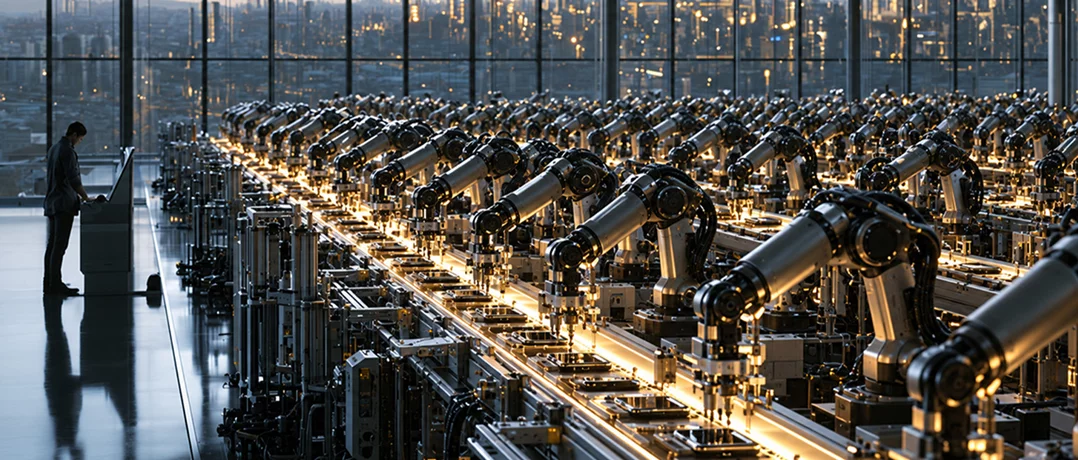
Industrialization once offered developing countries a relatively reliable route from poverty to prosperity. From Britain's 18th-century Industrial Revolution to East Asia's industrial expansion in the late 20th century, manufacturing transformed agricultural economies into centers of industrial production. Factory employment, exports, and productivity gains helped raise incomes and living standards. Yet the path followed by earlier industrializers is becoming more difficult to replicate. Automation is changing the relationship between industrial production and employment, while technological requirements and shifting trade patterns are making competitive manufacturing harder to establish. At the same time, the expansion of services is providing an alternative source of employment, without the productivity gains historically associated with industrial development. In its Industrial Development Report 2026, published in November 2025, the United Nations Industrial Development Organization (UNIDO) estimates that developing countries will need more than 900 million new jobs by 2050 as demographic and technological changes transform labor markets. The prospect of industrial growth without comparable employment gains raises doubts about whether manufacturing can still deliver the widespread prosperity that earlier generations of developing economies achieved. Manufacturing historically offered developing economies an unusual combination of advantages. Unlike many service industries, factories could employ large numbers of relatively low-skilled workers while producing goods for international markets. Export revenues financed investment, technological improvements raised productivity, and industrial employment created opportunities beyond subsistence agriculture. Yet research suggests that countries are reaching the limits of this model earlier in their development. In his 2016 paper Premature Deindustrialization, Harvard economist Dani Rodrik found that countries industrializing after 1990 reached peak manufacturing employment at approximately one-third the income levels of earlier industrializers. His historical comparisons illustrate the disparity. Selected Western European economies reached their manufacturing employment peaks at approximately $14,000 in per capita income, measured in 1990 international dollars. India and several sub-Saharan African economies reached comparable turning points at roughly $700. The experience has not been uniform. Latin American economies experienced particularly pronounced deindustrialization, while Asian manufacturing exporters proved more resilient. UNIDO's 2026 report identifies automation and the digitalization of production among the forces transforming industrial development. Technological improvements can allow factories to produce more with fewer workers, weakening manufacturing's traditional capacity to absorb labor even as production expands. The industrialization ladder
The movement away from agriculture continues across poorer economies, but workers are not necessarily entering manufacturing at the rates associated with earlier industrialization. According to UNCTAD's Least Developed Countries Report 2025, agriculture accounted for 65.1% of employment in the average least developed country in 1991, falling to 48.6% by 2023. Over the same period, manufacturing's employment share rose only modestly, from 5.6% to 7.4%, while services expanded from 25.8% to 38.4%. Rather than experiencing an outright contraction in manufacturing employment, many of the poorest economies have maintained relatively small industrial workforces, while services absorb more workers leaving agriculture. In 2023, services accounted for an average 48.9% of GDP in least developed countries, compared with 10.9% for manufacturing. UNIDO's 2026 assessment similarly identifies substantial industrial development gaps in manufacturing productivity, technology and industrial output across poorer regions. Expanding industrial production alone will not guarantee prosperity if manufacturing cannot generate enough productive employment to support rising incomes. As manufacturing absorbs a relatively small share of workers in poorer economies, services have emerged as a possible alternative route toward development. Yet the economic opportunities offered by services vary considerably. Financial services, information technology and professional activities can generate substantial productivity gains, while informal retail and personal services often offer lower earnings and fewer opportunities for advancement. UNCTAD found that 62.1% of service workers in the average least developed country were employed in less knowledge-intensive activities in 2023, compared with 33% in developed economies. Knowledge-intensive services accounted for just 18% of service employment in the poorest economies, against 31.6% in developed countries. These differences complicate the assumption that expanding services can reproduce manufacturing's historical contribution to economic development. Moreover, technological change is adding pressure to already demanding employment requirements. UNIDO estimates that automation-related displacement could require developing economies to create an additional 160 million jobs by 2050 under a “medium-automation” scenario, beyond employment needs arising from demographic change. Under a higher-automation scenario, the additional requirement could exceed 300 million. Despite these challenges, evidence does not suggest that manufacturing has ceased to offer opportunities for developing economies. Bangladesh and Cambodia demonstrate the continuing importance of labor-intensive production. Manufacturing accounted for 23.1% of Bangladesh's GDP and 27.7% of Cambodia's in 2023, according to UNCTAD. Their industrial development, however, also reveals the limitations of narrow specialization. Textiles and clothing represented 92.8% of Bangladesh's manufactured-goods exports and 52.1% of Cambodia's, leaving both economies exposed to changes in demand, trade policy and production costs. UNIDO nevertheless argues that industrialization remains essential to reducing poverty. Its 2026 report projects that coordinated industrial development, clean energy investment and social inclusion policies could lift 525 million people above the $8.30-per-day poverty line by 2050, compared with a baseline scenario. Such projections depend on substantial policy changes. Although the traditional industrialization model is harder to reproduce, manufacturing remains essential to generating productive employment and sustained income growth, even as technology reduces labor requirements. For economies still seeking the prosperity achieved by earlier industrializers, the ladder remains standing. Its steps, however, are becoming considerably harder to climb.Where the workers are going
Can services replace factories?
A different industrial future
-
-

-
The Beiruter
-
