



Russia’s Africa summit showcased big ambitions, but military influence cannot guarantee economic deals. Can Moscow deliver on its promises?
Russia’s African ambitions

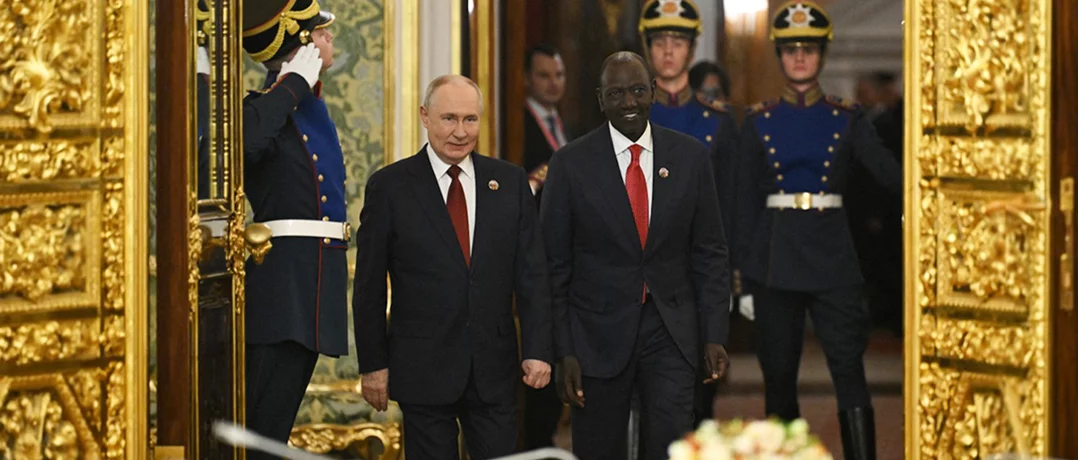
“Contrary to what malevolent forces might think, Africa has not come to ask for help. Africa has come to strengthen its partnership with its friend, the Russian Federation.”
With these words, Burundi’s President Évariste Ndayishimiye, speaking as chairperson of the African Union, set the tone for the third Russia–Africa Summit in Moscow. The gathering brought together delegations from 48 African countries, including 22 represented by heads of state. For Moscow, the goal is to turn its growing influence across the continent into lasting economic and strategic partnerships.
Security as an entry point
Security cooperation has been central to Moscow’s expansion across Africa. At the summit, Ethiopian Prime Minister Abiy Ahmed announced that his country had received 12 Russian Su-35 fighter jets and would acquire four S-400 batteries, thanking President Vladimir Putin for delivering the aircraft a year early.
However, Russian arms exporter Rosoboronexport confirmed the delivery of only the first two aircraft, while the S-400 systems have yet to arrive. The purchases bolster Ethiopia’s military amid renewed fighting in Tigray and tensions with Eritrea.
Ethiopia illustrates Russia's role as an arms supplier. In the Sahel, Moscow has established a more direct military presence. After military coups and ruptured security ties with France, Mali, Burkina Faso and Niger sought Russian weapons, training and operational support, risking new dependencies on an external power. In Mali, Wagner personnel arrived in 2021 to fight alongside government forces. Russia’s state-controlled Africa Corps replaced them in 2025, while Russian contingents also deployed to Burkina Faso and Niger.
In the Central African Republic, around 1,500 Russian personnel in early 2026 trained government troops, fought rebels and protected President Faustin-Archange Touadéra. For Bangui, that assistance strengthens the government’s hold on power, while Moscow gains access to political leaders and commercial opportunities, including mining.
In Libya, Russia has secured access to military infrastructure controlled by Khalifa Haftar’s forces. Satellite imagery shows upgrades at six air bases, while Russian military flights use Libya as a supply corridor for Sahel deployments. These ties expand Moscow’s military reach, but its economic ambitions also depend on partnerships beyond the countries hosting Russian forces.
The economic proposition
Energy offers one of Moscow’s clearest avenues for moving beyond military cooperation. At the summit, state nuclear company Rosatom said it was in advanced talks with Egypt, Togo, Namibia and Tanzania to supply floating nuclear power plants. The proposed 100-megawatt vessels would be serviced and refueled by Russia, providing new generating capacity without conventional nuclear plants but potentially tying customers to Russian technical support for decades.
On October 28, Togo signed a memorandum with Rosatom to study nuclear projects and train specialists, although no construction contract was agreed. Russia already has a much larger undertaking in Egypt, where Rosatom is building the four-reactor El Dabaa nuclear station, with a planned capacity of 4,800 megawatts.
Beyond electricity, Moscow is building on its established role as a supplier of grain and fertilizers. President Putin said Russia serves more than 40 African countries, while agricultural exports to the continent climbed 35% to $2.9 billion in the first half of 2026. Its proposals for machinery and food processing aim to extend that trade into local production.
That emphasis on domestic production also shaped a more concrete agreement with Ghana. On October 29, Russian aluminum producer Rusal and Ghana’s GIADEC agreed to develop a bauxite mine with planned annual output of five million tonnes and an alumina refinery capable of producing 1.2 million tonnes.
The diplomatic bargain
For Moscow, closer ties with African governments offer a wider network of diplomatic relationships amid Western pressure over the war in Ukraine. Russia supports African Union demands for at least two permanent Security Council seats. President Putin also called for reforms to the IMF and World Bank.
However, closer cooperation with Moscow does not necessarily translate into diplomatic alignment. When the UN General Assembly voted to condemn Russia's invasion of Ukraine in March 2022, 28 African countries supported the resolution, 17 abstained, eight did not vote, and only one voted against it. African governments continue to cultivate relationships with China, Europe and the United States, preserving diplomatic choices rather than committing exclusively to any single power.
For governments able to draw on competing offers, that diversification creates leverage to negotiate financing, technology transfer and local jobs. The advantage is uneven: states heavily reliant on Russian security support may have less freedom to switch partners than those seeking investment in energy or industry.
Moscow is nevertheless seeking to institutionalize these relationships. On October 28, Russia and the African Union Commission signed a cooperation plan for 2027–2029, including provisions for political dialogue and coordination at the United Nations. Summit leaders adopted a separate action plan and final declaration the next day, formalizing continued diplomatic dialogue without obliging African governments to align with Moscow.
The limits of expansion
The breadth of this diplomatic agenda contrasts with Russia’s limited economic footprint across Africa. Trade with the continent reached approximately $27 billion in 2025, still below the $40 billion target Putin announced in 2019. By comparison, China’s trade with Africa reached $348 billion, while the European Union’s stood at roughly $395 billion. Egypt alone accounted for nearly 39% of Russia’s African trade, underscoring how concentrated its commercial relationships remain. Its closest security ties in Mali and the Central African Republic do not guarantee commercial access in larger markets where suppliers compete on financing and delivery.
That disparity is compounded by a persistent gap between agreements and delivery. Russian officials reported more than 60 agreements at the summit and forum, but the nuclear sector shows why signatures are an incomplete measure of progress. Despite cooperation agreements with at least 15 African countries, Russia has not completed a nuclear power station on the continent. El Dabaa remains under construction, while Ethiopia’s proposed project is preliminary. In June, Russia’s Foreign Ministry acknowledged that previous summits had generated more declarations than deals.
The war in Ukraine, Western sanctions and pressure on industrial capacity complicate Moscow’s long-term commitments. According to the Stockholm International Peace Research Institute, Russian exports of major arms fell 64% between 2016 - 2020 and 2021 - 2025. The decline began before the full-scale invasion, although wartime production priorities and sanctions have compounded the pressure on exports.
Security partnerships present another test. In Mali, Africa Corps has helped protect supply convoys and support government operations, yet jihadist offensives continue to threaten transport routes and state control. Similar pressures persist in Burkina Faso and Niger.
The Moscow summit illustrates the uneven foundations of Russia’s African partnerships. Security cooperation has given Moscow close access to some governments, but ambitious energy and industrial projects require financing, technical capacity and terms attractive to African counterparts. With other partners available to many of those governments, the next phase will be shaped by negotiations and implementation in individual countries rather than by declarations made in Moscow.
-
-

-
Nami El KhazenJournalistFocusing on geopolitics and international affairs.
-
