



As fuel costs rise, Lebanon’s electric vehicle market is growing, but charging access, maintenance, resale values and electricity reliability continue to shape how much drivers can save.
Lebanon's electric car rush: Are drivers really saving money?
Lebanon's electric car rush: Are drivers really saving money?
By Jessica Habchy | November 01, 2026

Reading time: 7 min
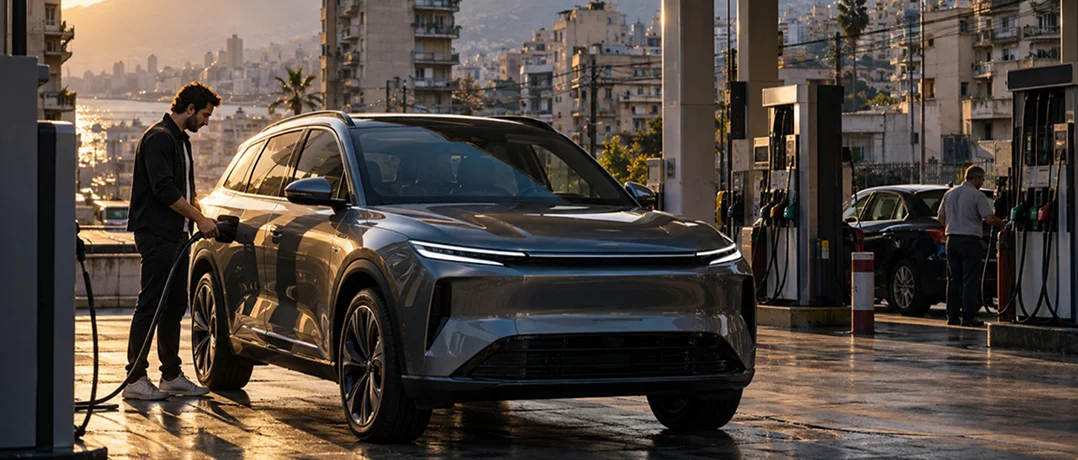
While the world buzzes about Tesla's latest flying car innovation, electric cars are becoming increasingly visible on Lebanon's streets even as drivers struggle to afford gasoline.
With gasoline prices draining household budgets, more Lebanese drivers are looking beyond traditional engines in search of cheaper alternatives. Wars and escalating tensions across the region have pushed fuel prices higher, adding further pressure on Lebanese households. And in a country where electricity shortages have pushed thousands of households to install solar panels, charging a car at home is becoming an increasingly attractive option.
What was once considered a luxury or an environmental choice is gradually turning into an economic calculation. But how big is Lebanon's electric vehicle market today? Is demand really accelerating? And how much can Lebanese drivers save by giving up gasoline in a country that still struggles to provide electricity?
Electric car demand is accelerating
In an exclusive interview with The Beiruter, Elie Azzi, President of the Used Car Importers Syndicate, reveals that the share of electric vehicles in the used car imports covered by his sector has climbed from approximately 5 7% to between 25% and 30%.
Three in ten used car shoppers now ask for an electric vehicle.
Azzi credits rising gasoline prices and cheaper home charging through solar panels.
China has emerged as a major source of these imports, offering increasingly competitive prices. Buyers with greater purchasing power, meanwhile, tend to favor established international automotive brands.
Yet electric vehicles have not completely overtaken conventional alternatives. According to Azzi, hybrid cars, which combine gasoline engines with electric motors, remain more popular among Lebanese consumers.
From a luxury to a growing market
Economist Professor Jassem Ajaka tells The Beiruter that Lebanon's electric vehicle market has evolved from an almost nonexistent niche before the 2019 economic collapse into an expanding segment of the automotive industry.
He estimates that Lebanon currently has between 12,000 and 16,000 fully electric vehicles, compared with an estimated total passenger vehicle fleet of 1.8 million to 2 million.
Based on these estimates, battery electric vehicles account for approximately 0.6% to 0.9% of the country's passenger car fleet.
Although still a small proportion, Ajaka considers the market's expansion significant, particularly given Lebanon's economic difficulties.
The transformation is also changing the profile of electric car buyers.
While electric vehicles were initially associated with luxury models and higher income consumers, increasingly affordable imports, particularly from China, are making electric mobility accessible to a broader segment of the Lebanese market.
Some electric models are now offered at prices close to those of entry level gasoline powered vehicles, making operating costs an increasingly important factor in purchasing decisions.
Gasoline vs. electricity: How much can drivers save?
According to calculations provided by Ajaka, a Lebanese driver covering approximately 1,200 kilometers per month in a gasoline powered sedan consuming 10 liters per 100 kilometers would need around 120 liters of gasoline monthly.
Using an illustrative gasoline price of $18.50 per 20 liter tank, the monthly fuel bill would reach approximately $111, or $1,332 annually.
The gasoline price is illustrative, not current; higher pump prices could mean greater savings.
An electric vehicle consuming 15 kilowatt hours per 100 kilometers would require approximately 180 kilowatt hours of electricity per month.
For the same monthly distance, charging an electric vehicle costs approximately $54 using a combination of the public electricity grid and private generators, or just $5.40 using private solar power. These estimates use electricity costs of $0.30 and $0.03 per kilowatt hour, respectively.
When annual maintenance expenses are included, Ajaka estimates the total operating cost of a gasoline powered car at approximately $1,632, compared with $698 for an electric vehicle charged through the grid and generators, and just $115 when charged using solar power.
That translates into potential annual savings of approximately $934 to $1,517 under his original assumptions.
However, these calculations exclude the purchase price, insurance, battery replacement risks, depreciation, and the initial investment in solar panels.
The financial advantage therefore varies depending on the vehicle, its usage, and the household's electricity supply.
Tax exemptions: A boost for electric cars
Under Article 53 of the 2026 Budget Law, qualifying newly imported fully electric vehicles benefit from a 100% exemption from customs duties and internal consumption taxes, along with a 70% reduction in first registration and circulation fees.
New hybrid vehicles benefit from an 80% exemption from customs duties and internal consumption taxes, as well as a 70% reduction in first registration and circulation fees.
These incentives apply under the conditions and time limits specified in the legislation and do not necessarily extend equally to used electric vehicles.
The hidden costs behind the savings
Azzi identifies the shortage of specialized repair garages and spare parts as a major obstacle.
According to Azzi, vehicles from established international brands can lose approximately 20% of their value after leaving the showroom and around half their value after several years.
For some Chinese vehicles, he estimates that depreciation can reach approximately 75% over time.
These figures are market observations rather than standardized depreciation rates, and actual resale values depend on the model, age, condition, and battery health.
The financial implications can be substantial: a driver who saves hundreds of dollars annually on gasoline could lose a significant amount when reselling the vehicle.
The absence of an extensive charging network adds another challenge, particularly for drivers without private parking or home charging.
Why rental companies are staying away
Mohammad Dakdouk, President of the Syndicate of Tourist Car Rental Companies, tells The Beiruter that rental operators have not yet incorporated electric vehicles into their fleets.
Electric and hybrid vehicles remain relatively expensive for rental companies to purchase, while insufficient charging stations, limited spare parts, and repair difficulties increase ownership risks.
Customers, meanwhile, are mainly looking for affordable vehicles with low daily rental rates.
Investing in more expensive electric models would likely force companies to charge higher rental prices, potentially weakening demand.
According to Dakdouk, Lebanon's rental fleet has declined from approximately 20,000 vehicles in 2019 to just 9,000 today, representing a 55% contraction.
He says growth in the sector is currently at zero, while successive economic crises and wars have caused significant losses to rental businesses, particularly in southern Lebanon and the city of Tyre.
For an industry already struggling to survive, investing in unfamiliar and relatively costly technology remains a considerable risk.
Could electric cars save Lebanon millions?
Lebanon depends heavily on imported petroleum products, making transportation costs vulnerable to international oil price fluctuations. Regional wars have further exposed this vulnerability, as geopolitical tensions and disruptions to energy supplies can quickly translate into higher gasoline prices.
According to Ajaka, the country's annual petroleum import bill generally ranges between $3.5 billion and $4.5 billion, with an estimated $1.5 billion to $2 billion associated with transportation.
Ajaka estimates that a 10% reduction in transportation fuel consumption could generate annual import savings of approximately $150 million to $200 million.
A 25% reduction could theoretically increase those savings to between $375 million and $500 million.
These are illustrative scenarios, not forecasts. Actual savings would depend on the number of gasoline vehicles replaced, driving patterns, electricity generation sources, and international energy prices.
Moreover, replacing gasoline with electricity does not automatically eliminate imported fuel consumption if charging relies on diesel generators or fuel powered electricity production.
Nevertheless, lower petroleum imports could reduce foreign currency outflows, while cheaper transportation could ease operating costs for households and businesses.
Achieving those gains would require reliable electricity, charging infrastructure, specialized maintenance services, and greater consumer confidence.
The road ahead: A promising but uncertain future
Lebanon's electric vehicle market is expanding, but its development is being driven largely by individual economic decisions rather than a comprehensive national transportation strategy.
Consumers are seeking relief from gasoline expenses. Importers are responding with more affordable models. Tax incentives are helping reduce certain purchase costs.
Yet charging infrastructure remains insufficient, specialized maintenance is limited, resale values are uncertain, and businesses are reluctant to commit substantial capital.
The contrast is difficult to ignore Lebanon is witnessing growing interest in electric cars while continuing to struggle with the electricity needed to power them.
And while the world is already witnessing cars designed to take flight, Lebanon is still struggling to secure enough electricity for those firmly on the ground.
For Lebanese drivers, however, the electric transition may ultimately be decided by a much simpler calculation: how much longer can they afford to fill their tanks?
-
-

-
Jessica HabchyJournalist
Focusing on economy and social affairs.
-
