



Lebanese sculptor Nayla Romanos Iliya brings Dante’s Divine Comedy to life through a monumental public installation in Beirut, exploring faith, redemption, identity and hope through steel, concrete and light.
A sculpture of faith and redemption in the heart of Beirut
A sculpture of faith and redemption in the heart of Beirut
By The Beiruter | November 04, 2026

Reading time: 5 min
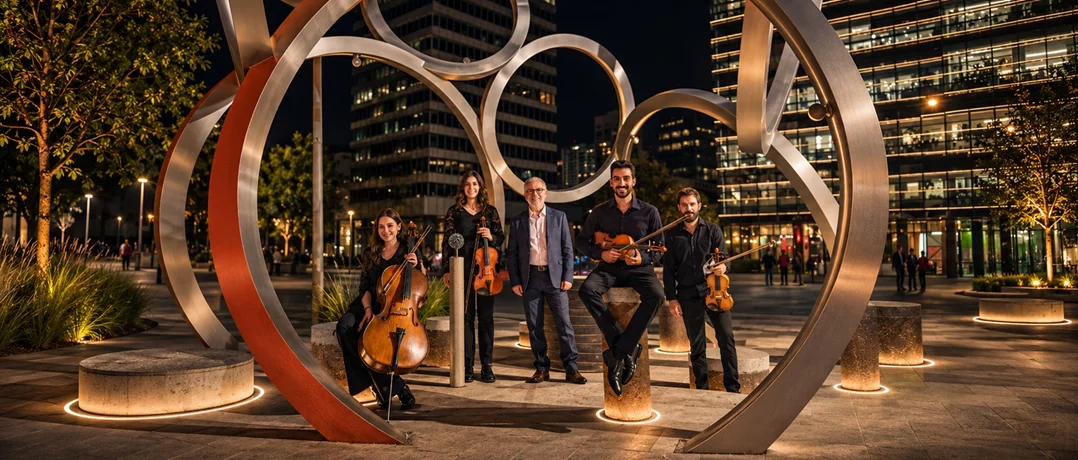
“On the Other Side of Time,” by Lebanese architect and artist Nayla Romanos Iliya, has been unveiled in the square beside Saint Elias Church in Minet El Hosn-Kantari. Drawing on Dante’s Divine Comedy, the site-specific installation translates a medieval vision of sin, redemption and ascent into steel, concrete and light. It offers an open, inclusive space where visitors are invited to pause, look and reflect, and to believe that a ray of hope still exists.
The Lebanese architect turned full-time sculptor’s artistic journey took her from Lebanon to Paris, London, Hong Kong and Dubai. Inspired by Phoenician heritage and its alphabet, she explores identity, belonging, sustainability and the memory of Lebanon’s civil war. Today, she lives and works in Beirut, with sculptures featured in public and private collections in Lebanon and abroad, including the Institut du Monde Arabe in Paris the British Museum in London.
Nayla told The Beiruter that the installation was originally scheduled to be unveiled in 2019, but the October uprising forced a postponement, followed by another delay due to the COVID-19 lockdown in March 2020. “This installation has witnessed very turbulent and challenging times in Lebanon. It is still standing. It survived the Beirut blast, and it remains an inclusive space.”
The project began with instinct. On her first visit, Nayla sensed the site’s promise immediately. “The space talked to me right away,” she recalled. Parks, gardens and squares are scarce in Beirut, and she wanted the work to bring life to the place and welcome everyone. Above all, she hoped it would be “a gift to Beirut and its people.”
With no government funding for public art, the project relied on an unusual alliance of three protagonists. The artist contributed the concept and its realization. A generous, anonymous patron covered every production cost. The Parish of Saint Elias initiated the undertaking and backed it steadfastly from start to finish. Each had a personal tie to the ground. The artist attended school a few steps from the square before the civil war, the benefactor was a parishioner who once lived in the neighborhood, and the church found in the plaza a natural extension for its community events.
The launch included a performance featuring two dancers, who created a spatial choreography set to a symphony inspired by Dante’s Divine Comedy. “It was a tribute to the 700th anniversary of his death,” Nayla told The Beiruter.
The location also carries symbolic significance. It sits at a crossroads, easily reached from both “East” and “West” Beirut, labels born of the civil war that some still consider relevant. It is also a rarity, an outdoor refuge in a district of mostly office buildings, where employees and passers-by can rest. Nayla envisioned a work that would enrich the urban landscape, lend the city meaning and stir awareness at a time when challenges of every kind beset the country.
Three realms in steel and concrete
Why Dante? For Romanos Iliya, the choice was almost inevitable. The poem follows its narrator through Hell, Purgatory and Paradise, an allegory of the soul’s journey toward salvation, haunted by the consequences of sin and brightened by the glories of Heaven. Its tension between the worldly and the spiritual echoes across the globe, but it lands hardest at home. “In Lebanon today, this is critical,” she explained, pointing to long years of corruption and a worsening economic crisis “testing both individual and social consciousness to its limits.”
The timing sharpened her resolve. “It felt really important to do this at a time when challenges of all kinds are running rife in our country,” she noted.
Site and theme proved to be uncanny companions. The poem unites philosophy and theology, and the square abuts a church whose lateral façade forms the work’s backdrop. That façade is plain apart from rows of round windows, and the circle dominates Dante’s picture of all three realms. The square itself rises in four platforms from street level to the church entrance, echoing the sense of ascent at the poem’s core.
Spread across three of those platforms and covering 50 square meters, the installation climbs to about nine meters at its highest point. Each part answers one volume of the poem.
“Inferno” takes the form of a weathering steel cylinder, recalling Dante’s funnel-shaped abyss of nine narrowing circles. A mirror lines its base, and a circular glass pane at the top lets viewers look inside. Carved around the window is the grim warning “Lasciate ogne speranza, voi ch’entrate” (Abandon all hope, ye who enter), the inscription that greeted sinners at the gate of Hell.
“Purgatorio” is conceived as Hell’s inverse. In Dante’s cosmology, Lucifer’s fall hollowed out the abyss and displaced earth on the opposite side of the world, raising Mount Purgatory. Romanos Iliya renders the mountain as ten concrete cylinders of varying dimensions, arranged around the steel structure. Nested together, their combined volume fills the Corten void exactly. “Their different sizes and varying finish, the symbolic tree standing on the tallest of them, are all intriguing features that encourage people to get closer and explore them, and reflect,” she observed.
“Paradiso” is defined by upward motion. Nine brushed stainless steel rings of differing diameters rise from the ground, interlocking and supporting one another as they envelop the structures below. A large mirrored halo crowns the summit, dissolving into its surroundings and curling toward the sky.
Numbers run through the whole composition, mirroring the poem’s own architecture. She traced the pattern through each realm: “Hell is composed of nine circles, with Satan at its bottom, while Mount Purgatory is made up of nine terraces and the Earthly Paradise on top. There are also nine celestial spheres, crowned with the Empyrean in Paradise.”
-
-

-
The Beiruter
-
