



Laetitia Saade has built her place in Lebanon's male-dominated heavy machinery industry through hard work, determination and passion.
Laetitia Saade's rise in Lebanon's male-dominated machinery industry
Laetitia Saade's rise in Lebanon's male-dominated machinery industry
By The Beiruter | November 07, 2026

Reading time: 4 min
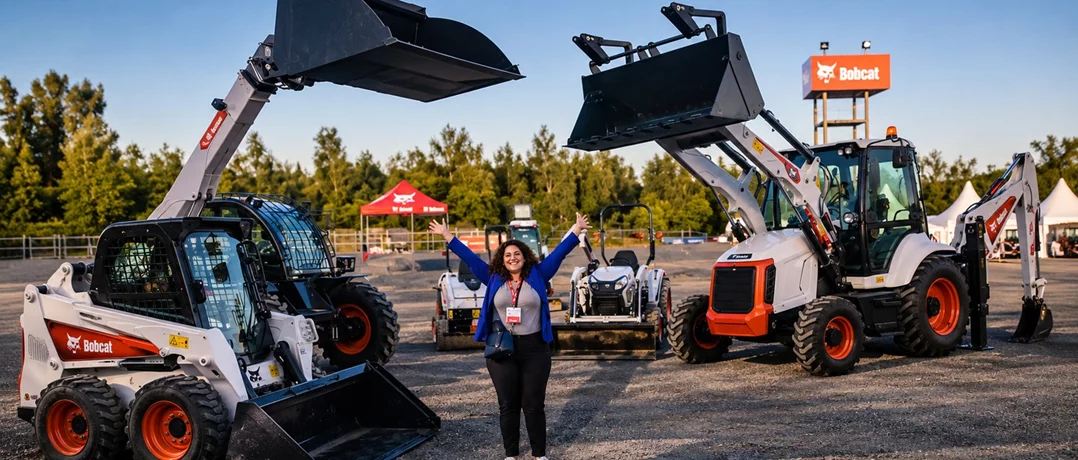
At five years old, Laetitia Saade's job at her father's company was to carry water and serve coffee to customers. Sometimes they let her climb into an excavator or a bulldozer for a few minutes, just to amuse her. Thirteen years into her full-time career, she is Managing Director of Jihad Saadeh Company, the Lebanese machinery business her father founded in 1986.
The road between those two points ran through every department of the firm, and it began on weekends and school holidays.
Laeticia grew up with five siblings, but her vacations belonged to the company. "I always felt an adrenaline rush whenever I watched people unloading and loading machinery and operating different equipment," she told The Beiruter. "I was fascinated by how everything worked, and I felt that this was where I belonged."
The household mindset made her ambition feel more real. She could operate something bigger than a car and she could be strong and capable in the field. "I never felt that I had to limit myself or settle for something smaller simply because society expected me to," she explained.
Mistakes came with the territory. She dropped buckets too hard, mishandled controls and turned right when she should have turned left. Nobody shouted. Her father made certain of it, instructing the longtime employees, "whatever Laetitia needs, help her. Whatever she needs to learn, teach her."
Her journey of hard work
After studying Mechanical Engineering at LUJ and graduating with honors in four years, Laeticia moved through the business, discovering each department. Sales came first, then spare parts, which captured her completely. Today she is, in her own words, "a walking parts catalogue." She can name a component from any bulldozer or excavator, place it and identify the machines it fits.
After-sales service followed naturally. Knowing where each part belonged taught her to trace a defect to its source. Logistics came next, shipping, bookings and customs clearance. By the time she stepped into the top job, she understood the operation from the purchase of a single bolt to delivery of the finished machine.
Outsiders have remarked that she reached the top quickly, in about ten years. She disagreed with this. "Ten years is what you get when someone works eight hours a day, five days a week," she answered. "But when someone works 21 hours a day, seven days a week, it amounts to much more than ten years."
The industry did not always welcome her. Customers sometimes walked in, assumed she was the secretary and insisted on speaking to one of the men. She would politely ask how she could help. They would decline.
"The funny thing is that those same men would eventually come back to me for the final answer," she noted.
Online, the hostility is louder. After the company posted an Instagram reel of an excavator being delivered to the Lebanese Army, commenters told her to go back to the kitchen. Once, such remarks might have stung. Now they draw a laugh. "The people who make these comments have never worked alongside me," she pointed out. "They simply do not know."
Her explanation for the negativity is blunt. "A person who is strong and confident in themselves does not need to make negative comments about others."
The larger obstacle is Lebanon itself. The private sector is strained, public institutions and NGOs lack funding, and individual initiatives no longer have the resources they once did. Meanwhile, employees and their families depend on the company.
Laeticia refuses to solve the problem by cutting corners in either direction. "I cannot compromise on the quality of our spare parts, our after-sales service or the machinery and products we offer simply to maintain our employees' standard of living," she explained. "At the same time, I cannot compromise on our employees' standards simply to generate more revenue."
A company established since 1986 carries a reputation she is determined to protect through the years of crisis. Her family's name is attached to every machine and every invoice, and that responsibility is her main motivation.
In an industry where equipment is heavy and margins are thin, she treats errors as unacceptable. "One mistake can cost a life or thousands of dollars," she observed, which is why she invests heavily in training the right people for the right tasks.
The pressure suits her. She has never liked routine, and she has not lived through two identical days in 13 years.
Laeticia is raising a daughter, and she is applying the same philosophy she received. "I never tell her that she cannot do something because she is a girl, or that she has to do something because she is a girl."
For women considering the field, her advice is to never give up, and never let anyone define what you can or cannot do. She extends an open offer, too. "I am ready, anytime and anywhere, to explain, guide, provide training and teach women how to operate machinery."
Her appeal to parents is equally simple. When a child shows a real passion, nurture it. "Children absorb everything their parents give them," she explained.
If anyone doubts the results, they can ask the customers who once looked past the woman at the front desk, then returned to her for the final word.
-
-

-
The Beiruter
-
