



The 2026 Democracy Perception Index paints an unsettling picture of political discontent, with national pessimism widespread and confidence in international powers shifting.
The world still wants democracy. But does it trust it?
The world still wants democracy. But does it trust it?
By The Beiruter | November 07, 2026

Reading time: 6 min

Public dissatisfaction with the government is hardly new. But according to new data, the gap between people's support for democracy and their confidence in the institutions meant to uphold it is becoming harder to reconcile. For anyone concerned with the future of democratic governance, the figures are sobering. More than two-thirds of people worldwide consider democracy very important, according to the 2026 Democracy Perception Index, published in May by Nira Data in collaboration with the Alliance of Democracies Foundation. Yet the survey, based on interviews with 94,146 respondents across 98 countries between March 19 and April 21, reveals widespread dissatisfaction with political institutions, with more people believing their country is moving in the wrong direction than the right one. In Lebanon, the divide between democratic expectations and public confidence is particularly pronounced. Its net optimism score of −51 places it among the five most pessimistic countries surveyed, while its assessment of judicial fairness is tied for the lowest worldwide. Yet Lebanese respondents also rank among the strongest supporters of international law, despite recording the world's largest annual increase in concern about foreign attack. Democracy's appeal remains intact. Its ability to satisfy the people who believe in it is another matter. What do people actually expect democracy to deliver? For a growing number, the answer is a better life. In 59 of 98 countries, respondents prioritized better living standards, up from 50 in 2025. Promoting a fair and peaceful society came first in 18 countries, freely choosing a government in 10, and protecting individual rights and freedoms in nine. But expectations are only half the picture. The index also assesses eight dimensions of democratic governance, including elections, free speech, judicial fairness and transparency. The strongest overall assessments came from Northern Europe, with Sweden at +29, Norway +23, Denmark +21, Finland +20 and Switzerland +19. Scores represent average net positive responses across eight dimensions. Notably, public satisfaction does not always correspond to conventional classifications of democracy. China received a score of +14, alongside positive assessments in Oman and Vietnam, despite restrictions on political competition and independent media. Lebanon's overall democracy perception score stood at −21, placing it in the survey's most negative category alongside countries including Palestine, Venezuela, and Ukraine. Its judicial fairness score was −36, tied with Romania for the lowest among the 98 countries surveyed. Venezuela followed at −32. The dissatisfaction was not uniform across every measure.Lebanese respondents gave freedom of speech a net score of −32 and civic education −30, compared with −3 for the perceived impact of elections. Optimism about the future is in short supply, even in some of the world's wealthiest democracies. France recorded the lowest net optimism score at −65, followed by Puerto Rico at −61, Lebanon and Germany at −51, and Nigeria at −50. Scores represent the difference between right-direction and wrong-direction responses. Europe emerged as the most pessimistic region, a notable finding amid continued economic uncertainty and political fragmentation across several of its largest democracies. In France and Germany, disputes over public spending and economic performance have contributed to an atmosphere of political uncertainty. The picture has also changed dramatically in just one year. South Korea registered the largest improvement in net optimism, gaining 52 percentage points between 2025 and 2026. Bolivia followed with a 51-point increase, while Venezuela gained 46 points. Among the countries experiencing the greatest shifts in public sentiment, Lebanon stood out. Its net optimism declined by 35 percentage points, tying Bangladesh for the largest deterioration among surveyed countries. Its score of −51 placed it alongside Germany, ahead of only France and Puerto Rico. The survey coincided with renewed fighting between Israel and Hezbollah, adding displacement and insecurity to Lebanon's prolonged economic crisis. As international tensions intensify, public opinion reveals a strong preference for cooperation, even among populations facing immediate military threats. Across 98 countries, 50% supported respecting international law even when it constrained governments, and strengthening alliances was the leading defense priority in 80 countries, compared with military investment in 18. Attitudes toward personal military involvement varied considerably. Among respondents aged 18 to 55, an average of 62% in the Middle East and North Africa said they would fight to defend their country if attacked, compared with 37% in Europe. The corresponding figures were 50% in authoritarian countries and 41% in democracies. Lebanon stood out on two measures. It recorded the third-highest level of concern about foreign attack, behind Ukraine and Georgia, while the share of respondents who were very or extremely concerned rose by 15 percentage points from 2025, the largest increase among all surveyed countries. Despite these concerns, Lebanon was also among the five countries expressing the strongest net support for compliance with international law, alongside Sweden, Kuwait, Ukraine and Syria. The regional divide was also evident in attitudes toward ongoing conflicts. In the war between Russia and Ukraine, respondents in 55 countries agreed more with Ukraine, compared with 30 favoring Russia. In the conflict between Israel and Palestine, 51 countries leaned toward Palestine and 17 toward Israel, with the remaining 30 approximately evenly divided. Washington's international reputation has undergone one of the most pronounced changes captured by the survey, at a time when American foreign policy has become a source of growing disagreement among allies and adversaries alike. The United States' average global net perception score fell from −5 in 2025 to −16 in 2026, an 11-point decline in a single year and nearly 40 points below its 2024 level. The deterioration was particularly pronounced in Europe. The United States also ranked among the five most negatively perceived countries worldwide, alongside Israel, North Korea, Afghanistan and Iran. Switzerland, Canada, Japan, Sweden and Italy occupied the five most positive positions. The changing balance of international opinion is particularly apparent in comparisons between Washington and Beijing. Respondents in 63 of 83 surveyed countries viewed China more favorably than the United States, including 20 of 23 European countries. In Europe, China's net perception score stood at −14, compared with −35 for the United States and −47 for Russia. The United States also faced unfavorable public comparisons in several geopolitical disputes. In the confrontation between Washington and Tehran, respondents in 41 countries expressed greater agreement with Iran, compared with 28 favoring the United States. From Lebanon's deep institutional distrust to growing pessimism in established European democracies, the survey exposes a persistent gap between what citizens expect from political institutions and what they believe those institutions deliver. Democracy continues to command widespread support. The governments operating in its name face a far more skeptical public.Democracy's institutional credibility problem
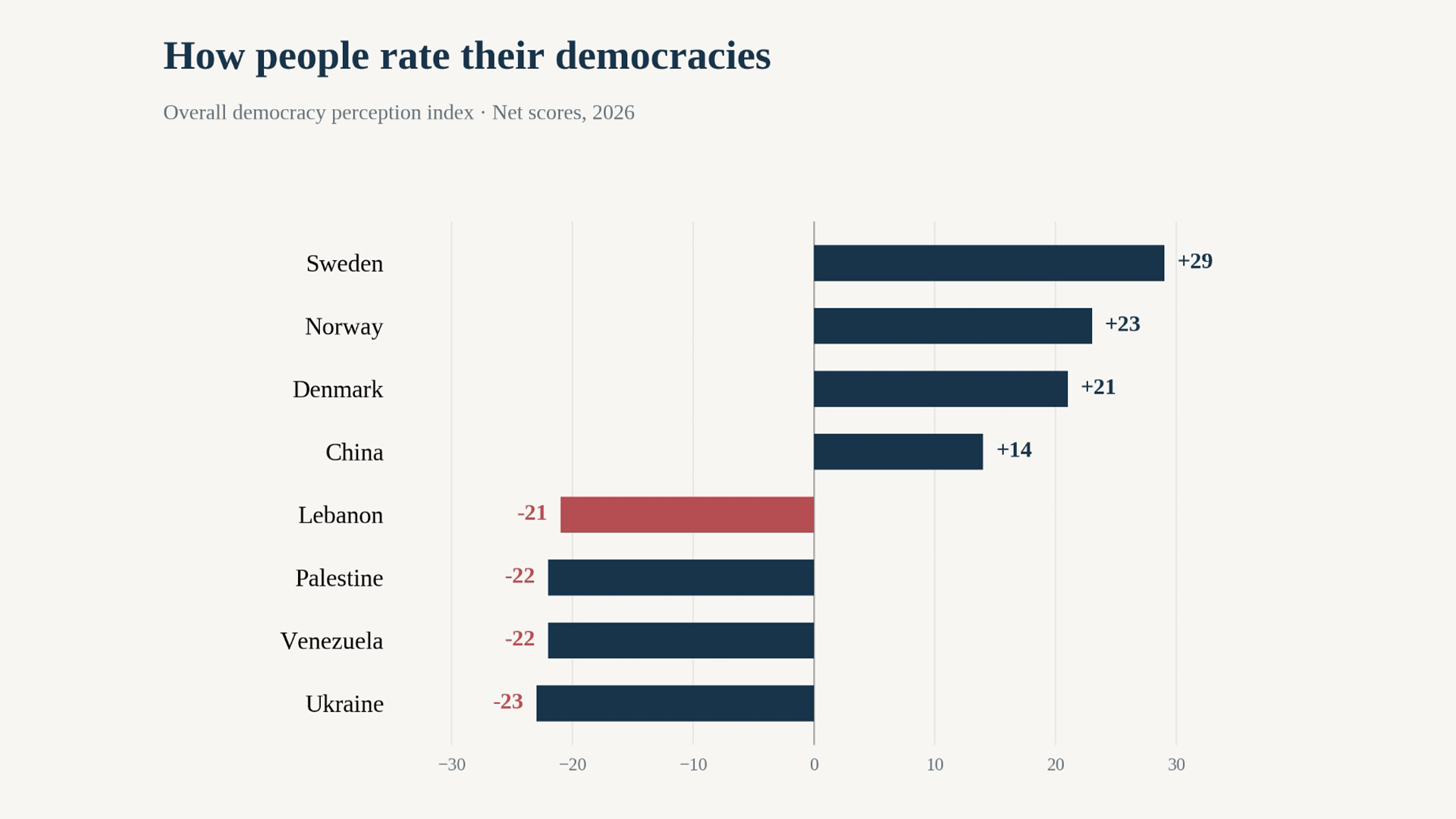 Public assessments of democratic governance vary sharply across countries. Source: Democracy Perception Index 2026, Nira Data and Alliance of Democracies Foundation.
A world divided between optimism and discontent
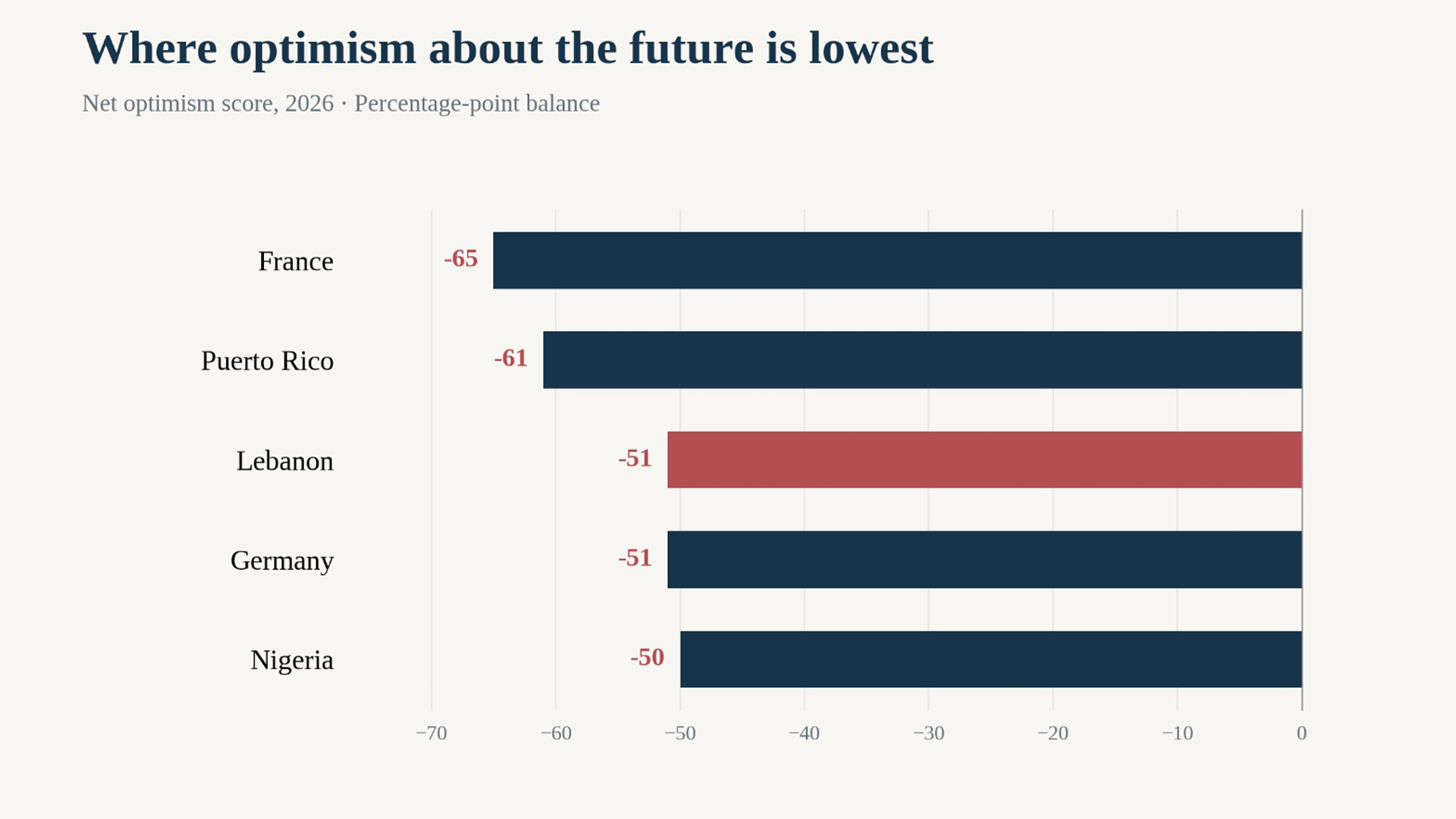 France and Puerto Rico recorded the lowest levels of national optimism in 2026, followed by Lebanon and Germany. Source: Democracy Perception Index 2026, Nira Data and Alliance of Democracies Foundation
Security fears and the limits of international cooperation
America's deteriorating international standing
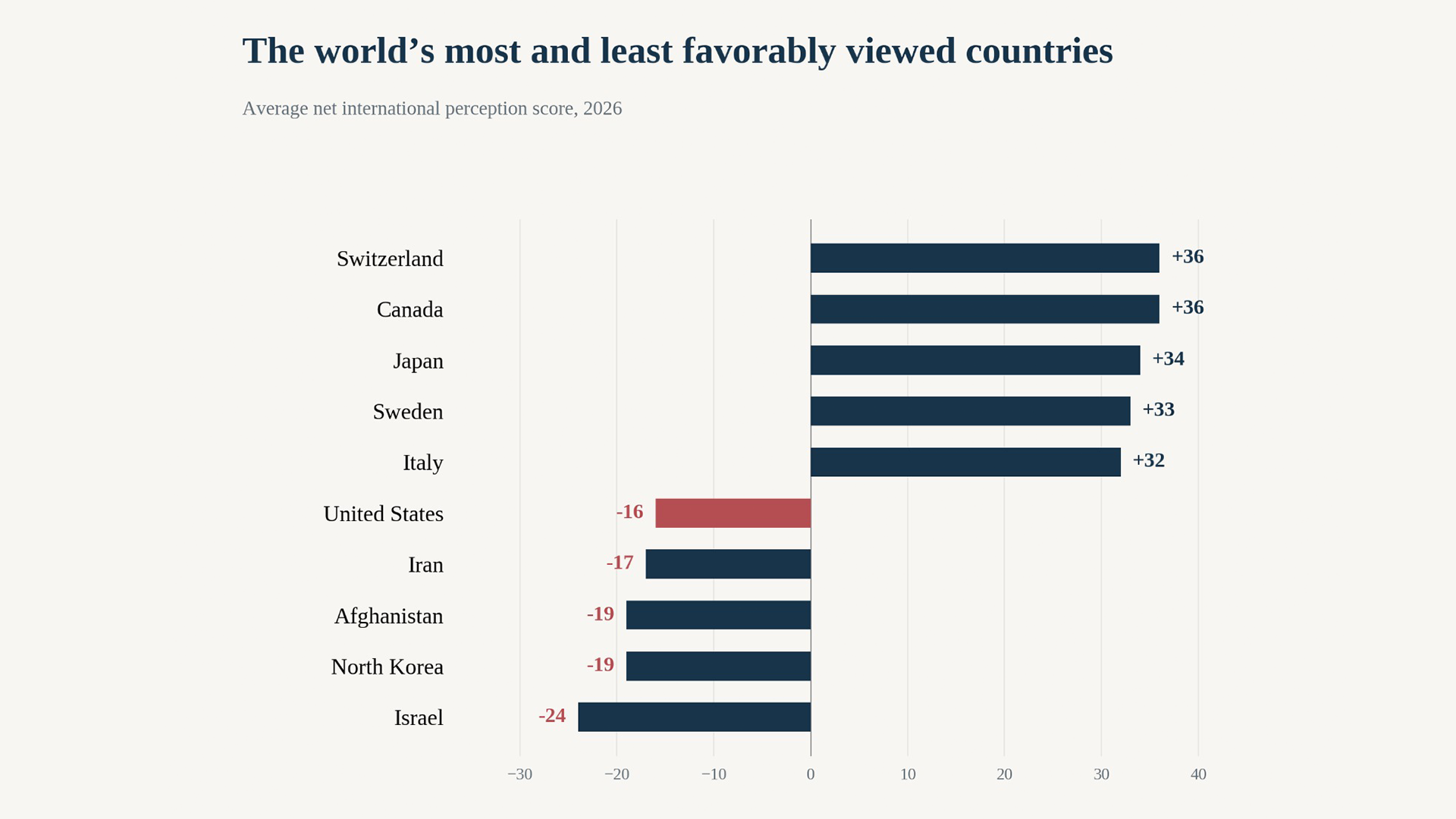 The United States ranked among the world's five most negatively perceived countries in 2026. Democracy Perception Index 2026, Nira Data and Alliance of Democracies Foundation
-
-
-
The Beiruter
-
