



In "Inside of Outside," Lebanese artist Sara Chaar translates Beirut's crumbling infrastructure.
In dialogue with Beirut’s weathered surfaces
In dialogue with Beirut’s weathered surfaces
By Tracy Aboudiwan | November 08, 2026

Reading time: 5 min
Before Beirut was a city she knew, it was a collection of stories – fragments of a life her parents remembered. When Sara Chaar finally experienced the city for herself, she found inspiration in its deteriorating buildings and dilapidated facades.
Beirut is a city of contradictions, where Belle Époque wrought-iron balconies are obscured by tangled electrical wires, bougainvillea spills romantically over bullet-scarred walls and large green garbage bins block sidewalks, their contents overflowing.
On my way to the opening of the "Inside of Outside" exhibition at Art on 56th Gallery, I sidestep one such bin, its stench amplified in the muggy air. I walk past a wellness café and into an enclosed courtyard with a theatrical semicircular veranda. A young, bohemian crowd leans against the iron balustrade, smoking and discussing the art in Arabic-inflected French.
Stepping into the exhibition feels like wandering into a landscape after a cataclysmic event. The artist stands in relaxed contrapposto in the center of the room, her short nails painted black, her waist-length hair almost Pre-Raphaelite. Inspired by Beirut's weathered surfaces, Chaar creates raw, energetic compositions suggestive of broken branches, cracked earth and peeling paint. "Beirut's walls, worn by decades, are like archives; each crack and peeling layer forms a strat[um], like a page from a specific point in time. Each layer within [these] strata tells a different story," she explains.
What those stories might be, Chaar leaves to the viewer. "My intention isn't for the viewer to recognize the original concrete surfaces of the walls, but for the painting to become something beyond its point of departure. I want to create an image that invites viewers to … develop their own associations."
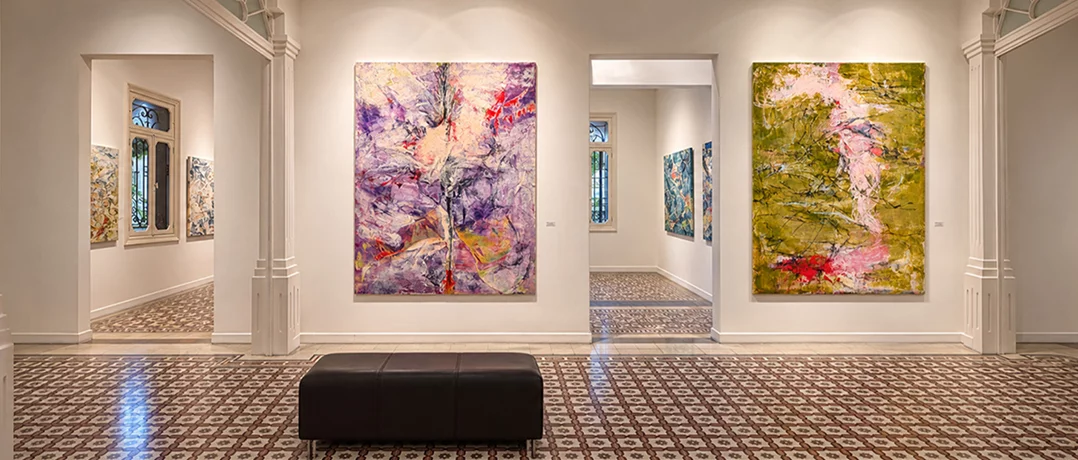
Dominanting the room is "The Soil Held Its Scars," a lush green painting with a streak of pink that appears to float above the composition. The painting is pure seduction of color. Its powdery pink and botanical green could have been inspired by the water lilies in Giverny rather than the grimy streets of Beirut.
Hanging beside it, "The Cold Opening," rendered in harmonizing shades of iris, Tyrian purple and amethyst, calls to mind a bruised flower petal. Applied in successive layers, the paint seems to fold upon itself like wet fabric, its surface interrupted by scratches. The composition is broken by a fissure that runs down the center of the painting, at once disrupting and enhancing it. "In this painting, there was a moment when I carved a line down the middle, almost like opening a wound, and over that, I placed a delicate white veil, like a bandage, gently protecting it," Chaar explains. "I aim to portray the tension between destruction and renewal, so that the viewer can connect to both rupture and rebirth in the same moment."
The gallery stands a short distance from Beirut's port, where the 2020 explosion devastated entire neighborhoods and left an indelible mark on the city's collective memory. In Beirut, where architectural decay is not merely an aesthetic subject but an everyday reality, renewal is a powerful message.
I walk into an adjacent room lined with traditional Levantine star-mandala tiles. While the previous paintings seduce with color, "Our Voices Became Fire" electrifies. Rendered in a muted ochre disrupted by vigorous black strokes, the composition seems to tremble. Up close, the painting reveals the scars etched onto its surface through the artist's painstaking process.
Chaar paints in oils mixed with wax, building textured layers that she then scrapes away to achieve her desired effect. "I choose to work with oils because they give me more time to manipulate each layer. I combine them with cold wax, which has a unique quality. Like a candle, it allows me to scratch through the surface and reveal the layers beneath. This lets me echo how the walls naturally age and erode. Each step and scrape becomes a direct part of the process."
Elsewhere, the exhibition is considerably more serene. In "The Surface Gave Way," translucent white folds of paint sit atop teal, sage and taupe, like seafoam on a windy sea. There is movement here, but it is not frenzied or unsettled. This painting decorates the room without disturbing it, offering a reprieve from the exhibition's recurring imagery of decay.
It would not be fair to expect every work of art inspired by Beirut to be politically charged, or to claim that destruction cannot be rendered in an appealing way. "I see beauty in decay because it reveals the passage of time, the hidden stories beneath the surface," she explains.
I carry her words with me as I step outside, carefully crossing the uneven pavement. A traditional, red-roofed Lebanese villa sits in a clearing, partially obscured by an outcropping of drab concrete buildings. I stop at the wellness café, where the barista hand-whisks my matcha with a bamboo chasen. At the wine bar around the corner, couples lean into each other over candlelight while car horns drown out the soft piano music.
I cross the street to admire the chain purses hanging in the window of French luxury brand Zadig & Voltaire. Should I also admire the cigarette butts and empty water bottles that litter the sidewalk beneath my feet?
That is the infuriating duality of Beirut: seduction and repulsion are inextricably intertwined. The city is at once cultivated and boorish, extravagant and impoverished, intellectual and heedless. If the artist's goal was to capture the tragic beauty of its ruin, she has succeeded.
Chaar has held exhibitions in the United Kingdom, Denmark, Germany, the United States and Canada. "For this exhibition," she says, "[Beirut] became the anchor because I wanted to address the city that shaped part of my identity."
The exhibition features 18 paintings and six works on paper, completed over 18 months. The exhibition runs through October 2026 at Art on 56th Gallery in Gemmayzeh, Beirut.
