



Lebanese farmers are turning edible snail farming into an emerging source of skincare ingredients, tapping into the global demand for snail mucin.
From farm to face, Lebanon’s snail farming industry
From farm to face, Lebanon’s snail farming industry
By The Beiruter | November 06, 2026

Reading time: 4 min
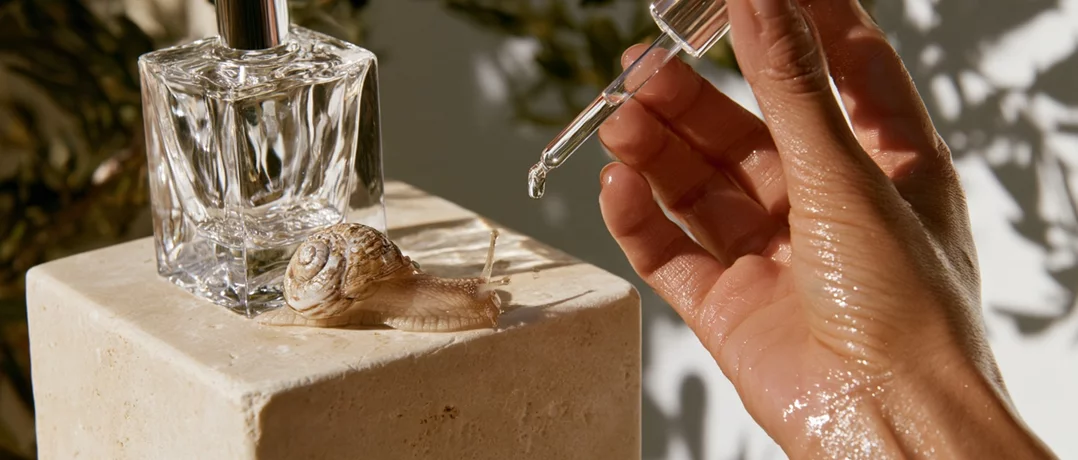
The slime of a garden snail has become a leading beauty product. The ingredient became a staple of Korean skincare, and it is now a bestseller in pharmacies and online stores. The mucus is rich in glycoproteins, hyaluronic acid, and allantoin, and brands praise it for hydration and a smoother-feeling complexion.
Farming of the edible garden snail, Cornu aspersum, began to spread in Lebanon about ten years ago. Recently, a few farmers began to ask the question, what if the snail is worth more alive than on a plate?
Habib Ibrahim, Zahle: “Every snail works for a short shift”
Habib Ibrahim’s farm in Zahle is a short walk from his family’s vineyard. He runs it with his wife and one part-time worker, overseeing each stage of the process, from breeding and feeding to collecting and filtering the snails’ secretion.
“Everything starts with breeding stock,” he told The Beiruter, describing how adult snails are kept in wooden-framed pens lined with fine netting. Their soil is mixed with crushed limestone to provide the calcium needed for healthy shells. Each adult lays around 80 pearl-white eggs in a small hole in the ground. Three to four weeks later, the hatchlings emerge, barely the size of a lentil and almost transparent.
Their diet consists of Swiss chard, cabbage, lettuce leaves and carrots, with no pesticides involved. Ibrahim was particularly careful about what enters the pens, knowing that snails absorb whatever remains on the leaves. “Whatever is on the leaf ends up in the slime, and so on your face,” he noted. “Maintaining humidity is equally important. I water the pens twice daily, keeping the air damp without allowing the soil to become soaked.” As temperatures dropped in November, the snails sealed their shells and entered dormancy, bringing the collection season to a halt.
When it comes to extraction, He avoids shaking, spraying or using salt, instead moving snails of around six months into a dark, quiet room. Placed on stainless-steel mesh above a collection tray, they are left for approximately 30 minutes to crawl and release their secretion. He then rinses them with clean water and returns them to their pens, allowing each at least three weeks of rest before another collection.
“A tired snail makes poor slime,” he remarked, explaining the importance of giving the animals sufficient time to recover.
The raw secretion, thick and stringy, first passes through a coarse cloth before undergoing progressively finer filtration. A final laboratory-grade filter removes bacteria, producing a clear, pale liquid. “This filtrate is supplied to a laboratory in Beirut, while a portion is freeze-dried into powder for own line, a process intended to preserve its proteins.”
His serum contains more than 90 per cent filtrate, alongside a light preservative system to maintain its shelf life. Before reaching customers in 2025, the products underwent patch testing on volunteers. Ibrahim remained conscious that snail secretion could trigger allergic reactions in some people and refused to overlook that possibility. “I would rather lose a sale than hurt someone’s skin,” he concluded.
Ramzi Haddad, Beqaa: “We copy the snail’s own pace”
Ramzi Haddad runs a small setup, with rows of long, low greenhouses equipped with drip irrigation. Inside, a laminated chart tracks each batch of snails by age.
“We keep around 20,000 snails across two greenhouses. It took us two years to reach this size, and it nearly broke us. Early on, I imagined the slime part would be the easy part, because the snails make it for free. It was the hardest part,” he recalled.
The farm operated through a carefully divided system, with separate greenhouses for each stage of the snails’ development. “We separate by age. Egg beds are in one house, juveniles in another, and breeders and producers in the rest. Feed is chard, cabbage and ground grain, with powdered limestone for the shell. We cover every pen with netting, because snails are escape artists.”
Summer brought its own challenges, particularly the need to maintain consistent humidity. “The heat is the enemy, so we run fine misting at dawn and dusk to hold humidity near 80 per cent,” he told The Beiruter.
Finding a suitable extraction method proved more difficult. Haddad had considered several alternatives, including salt water and specialized machines used abroad, before settling on a system he could build and maintain himself.
“I looked at every method. Salt water gets you a lot of slime and hurts the animal, and you end up with salty slime you have to clean again. There are also machines abroad that use ozone, but they cost tens of thousands of dollars, and I did not have it. So, we built a slow, simple system.”
His method involves placing trays of mesh in a dim, cool room, where approximately 200 snails are left for 30 to 40 minutes. “We collect the slime with a soft scraper from the tray below. The snails go back to their houses and rest for a month. We never collect from the same animal twice in one season’s busiest weeks,” he detailed.
The processing continues immediately after collection, as freshness is essential to preserving the secretion. “Everything is done the same day, because fresh slime spoils. First, we filter out the grit. Then we spin it in a centrifuge to separate heavier particles. After that it passes through micro-filters, several times, until the liquid is clear.”
Once filtered, the liquid is kept cold and transferred into sealed containers with a mild preservative to prevent bacterial growth.
Haddad does not manufacture the finished cosmetics himself. Instead, he supplies the filtrate to a cosmetics laboratory, where different formulations are developed for various brands. “Some brands use ninety-plus per cent filtrate for a light, slightly tacky essence. Others use 60 per cent and add plant extracts.”
This practice remains relatively specialized, but its development reflects a growing interest in locally produced cosmetic ingredients and the possibilities of turning an unconventional farming activity into a new beauty industry.
-
-

-
The Beiruter
-
