



In this article, Aya Saati, second-place winner of The Beiruter × 42 Beirut Tech Writing Training Program & Competition, explores how AI-generated voices and deepfakes are undermining trust, spreading misinformation and challenging our ability to distinguish what is real from what is fabricated.
When AI blurs the line between reality and deception
When AI blurs the line between reality and deception
By Aya Saati | November 15, 2026

Reading time: 6 min
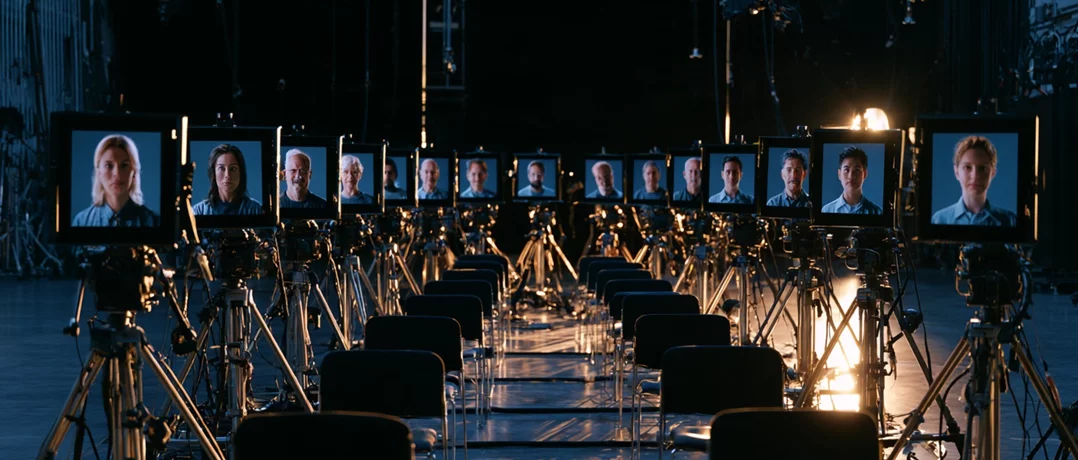
It’s Tuesday 12:00pm and your phone rings. It’s an unknown number. You answer, and it’s your brother’s voice. “Hey, I lost my phone, I’m calling you from my friend’s phone. My stuff got stolen. Can you transfer me some money?”. You’re annoyed, but you don’t hesitate, you send some. Then you try calling him back to scold him for being careless. No one answers. You wait, angry, for him to get home. Except your brother never called you. That wasn’t your brother at all. It was only his voice.
It’s mot science fiction anymore
But how? That sounded exactly like his voice. AI now can do things we once thought were impossible. AI tools can clone a voice or a face using just a few seconds of audio from a voice note, an Instagram story, or a video call. McAfee, a cybersecurity company based in San Jose California, found that one in four adults have already faced some kind of AI voice scam, and of those one in ten were personally targeted. Out of everyone who fell for it, 77% lost money because of it. What used to take real skill and expensive software can now be done by anyone for free and in minutes.
This isn’t a ‘Someday’ problem
People tend to think deepfakes are a future problem, something they’ll have to deal with later. But numbers say otherwise. DeepStrike, a cybersecurity firm based in San Francisco California, estimates that the number of deepfakes increased from around 500,000 in 2023 to about 8 million in 2025. That’s not a small jump, that’s roughly sixteen times more in just two years. It shows how fast this technology is becoming normal.
The World Economic Forum’s Global Risks Report 2026 ranked misinformation and disinformation as the second biggest global risk over the next two years, right behind economic tension between countries. Not cyberattacks. Not even an alarming problem like pollution or hunger. Fake information. Moreover, Europol’s Innovation Lab was already warning about this in 2022, saying deepfakes were becoming increasingly difficult to detect and were creating new challenges for law enforcement. Why? Because the tools used to catch fake data can’t keep up with the tools used to create them.
It’s not just the technology
The AI is not alone to blame. Part of the problem lies in human biology. We naturally learn to recognize and trust the voices of people we know. Real voices have small imperfections, tiny shifts in pitch, and some pauses that AI is learning to fake. That’s exactly the weakness this technology is learning to exploit. A UC Berkeley study in Nature Scientific Reports, found that people matched AI-generated voices to the real person’s identity about 80% of the time and correctly identified a voice as AI-generated only about 60% of the time.
Lebanon gives us a real example of this danger even without AI. A Harvard Kennedy School study examined misleading WhatsApp voice notes from Lebanon 2019—2020 crisis. The messages often sounded trustworthy because the speakers presented themselves as eyewitnesses or insiders. Some warned: "I'm warning you, don't trust anyone." Others said: "everyone who's saying otherwise is wrong and an idiot”. People believed them anyway, not because of what was said, but because of how it sounded. Now imagine what AI can do with the same trick copying pitch, tone, and rhythm so well that the voices don’t just sound confident. It sounds exactly like a real human being, exactly like someone you know. Would you ever question that if you already recognize his voice?
The deeper danger
Scams are the obvious danger, the one everyone already understands. We worry about our elders and kids falling for something like this, a thief, a stranger pretending to be someone they trust. But there’s a quieter danger underneath it, one nobody really thinks about until it’s already happened.
The damage from fake content isn’t just about the one lie itself. It’s the accumulation, lie after lie, that slowly damages trust between people, society, and the sources people rely on. Psychologist Lisa Fazio who studies misinformation at Vanderbilt University, has raised a related concern: “As a society we don't want to be in the position where people distrust actual news footage because they can claim that it's “just AI.”” People start losing track of what’s true and what isn’t, even when they’ve seen it with their own eyes. That’s a slower kind of damage, but it might end up being the bigger one.
It’s AI... is it?
There’s even a name for this problem, the “liar’s dividend”. Once people know fakes that look very convincing exist, real media starts losing its power. Imagine scrolling through Instagram and seeing a Reel of a famous politician saying something shocking. The video looks real, his facial expressions look very natural, and his voice sounds the same. You open the comments and see people arguing: “It’s AI.” “No it’s real, look at his mouth” “It’s clearly AI look at his fingers”. Suddenly you don’t know what you are watching anymore.
And that’s the turning point and the deeper danger. If people start doubting every video, every voice note, every forwarded message, the problem stops being about people believing fake things. It becomes about people no longer believing real things too. A real emergency call from an unknown number might be ignored because it feels suspicious.
It may sound like a strange kind of damage. Nobody really reports “I stopped trusting things” as an incident. Nobody wants to admit that their own eyes and ears were fooled by something that felt completely real. But the more fake content that’s convincing we encounter, the harder it becomes to know what we can trust. The danger is no longer just believing something false. It’s beginning to doubt what is true.
Is there an actual solution?
There’s no perfect solution here to stop AI scams, but we can change the way we react to them. Before believing, sharing, or reacting to something we should pause and think. Where did this come from? Is there another reliable source? Moreover, families can agree on a secret word only they would know. On a bigger scale, we need better AI-detection tools and media literacy so that people learn to question what they see without assuming everything is fake.
Back to where the question was really raised
Now imagine that same call again. Your phone rings, an unknown number, your brother’s voice, asking for money, urgent and upset. But this time, you pause for five seconds, wondering if it’s real. You then hang up and call him back on his real number. He picks up confused, having no idea what you’re talking about. That five second pause is the whole point. It gives you a moment to question what feels real before you act on it. So, can we still trust what we see and hear? We can, but we can’t assume something is true just because it looks or sounds real. Seeing was never the same as believing. We just forgot the difference and now AI is forcing us to remember.
