



The familiar circus tent is back in Beirut. With Fusion, Cirque du Liban returns after years of challenges, bringing international performers to the Lebanese stage and reconnecting with audiences who grew up watching its shows.
Cirque du Liban is back on the Lebanese stage
Cirque du Liban is back on the Lebanese stage
By Yara Saliba | November 13, 2026

Reading time: 5 min
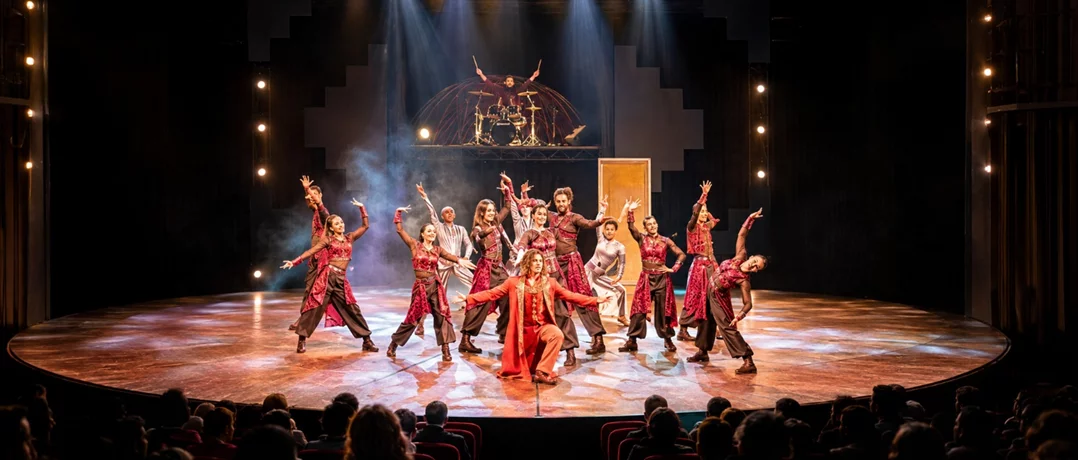
As you pass by Forum de Beyrouth, it is hard to miss the enormous tent standing to its left. Yes, it is Cirque du Liban. For many Lebanese who grew up attending its performances, seeing the tent return brings back memories of a form of entertainment that had been absent from the country's scene for a long time.
As Lebanon has experienced years of uncertainty, marked by economic crises, wars, political tensions and instability, businesses have shut down, cultural activities have been put on hold, and several entertainment projects were forced to take a step back. Cirque du Liban was one of them.
Established in 2005, the Lebanese company became a familiar name in the country's entertainment scene, bringing circus performances to audiences of all ages. But in 2019, the company was forced to suspend its activities due to the crises and challenges the country was facing. Now, after years away, Cirque du Liban has returned with a new production, Fusion, bringing together artists of more than 15 nationalities in a show that marks a new chapter for the company and Lebanon.
The road back to Beirut
The road back to Beirut was not an easy one. Before leaving the Lebanese scene, Cirque du Liban's last production was Fontana, which opened in late 2019. It was the Middle East's first travelling water circus and brought together a cast of more than 80 people. But the show had to stop shortly after opening. "We reopened for a few days, but then we had to close again. We couldn't continue," recalled Izak Abou Sari, one of Cirque du Liban's founding members, during an interview with The Beiruter.
The Beirut port explosion on August 4, 2020, was another major blow to the company. At the time, Cirque du Liban was dealing with the transportation of its production equipment when the explosion took place and all of its equipment was destroyed. "To be honest, after the explosion we couldn't return to the country and recover from what happened," Abou Sari shared. The impact of the disaster, with the country's continuing instability, kept the company from bringing its productions back to Beirut for years.
The challenges were not only financial but also logistical. Bringing the company's large-scale productions back to Lebanon meant transporting an enormous amount of equipment across borders. Abou Sari mentioned that the process involved more than 45 high-cube, 40-foot shipping containers. "We did not have the means or the available routes to transport all this equipment between countries," he added.
Instead, the company continued its work abroad, presenting productions in countries such as Saudi Arabia and the UAE. The return became more realistic only after a land route connecting Saudi Arabia to Lebanon through Jordan and Syria became accessible again. This eventually led the company to return to Beirut with a new production, marking the beginning of a new chapter.
Fusion: A new beginning for Cirque du Liban
Fusion brings together artists from more than 15 nationalities, including Lebanese, Brazilian, Russian, Ukrainian, Belgian, Belarusian and Latvian performers. The production is entirely Lebanese, with a Lebanese team behind the show. "It is a multinational group of artists, from Lebanon to the world and from the world to Lebanon. We bring them all together in one show in Beirut," Abou Sari explained.
Despite the international cast, the Lebanese identity of the company remains at the heart of the production. Abou Sari shared that Cirque du Liban is built around teamwork, with everyone involved contributing to its productions. "Everyone who becomes part of Cirque du Liban becomes a member of the company and has a hand in its productions," he said.
This collaborative approach was also reflected in the making of Fusion. According to Abou Sari, preparing the show took approximately three months, covering everything from casting and selecting the artists to developing the music and handling the logistical arrangements. The music was composed specifically for the production, and different team members contributed to the costume design and choreography.
Reconnecting with the Lebanese audience
The audience's reaction was another surprise for the company. Abou Sari pointed out that many people who had grown up attending Cirque du Liban were excited to see it return, with some of the company's current hospitality staff and ushers remembering their first visits when they were just four or five years old. "They were even more excited than we were," he recalled. What made the response even more surprising was that the company had spent less than 20 days marketing Fusion before its launch, and yet the first two weeks of performances sold out.
The reopening of Cirque du Liban is not meant to be a one-time return. The company hopes to continue developing its productions and bringing more of its international shows to Lebanese audiences. Despite the situation in the country, Abou Sari said the team has decided to keep moving forward. "We have made the decision to move forward, whatever the situation in Lebanon may be."
Cirque du Liban's return is also a reminder of the talent Lebanon has to offer, both regionally and internationally. At a time when so much of the country's cultural and entertainment scene has been put on hold, seeing a Lebanese production attract audiences again is a welcome change.
-
-
-
Yara SalibaJunior Writer/Translator
-
