



Lebanon’s olive heritage brings communities together, celebrates agricultural traditions and highlights the importance of supporting local farmers and preserving the country’s olive production.
Celebrating Lebanon’s olive heritage through festivals
Celebrating Lebanon’s olive heritage through festivals
By The Beiruter | November 13, 2026

Reading time: 4 min
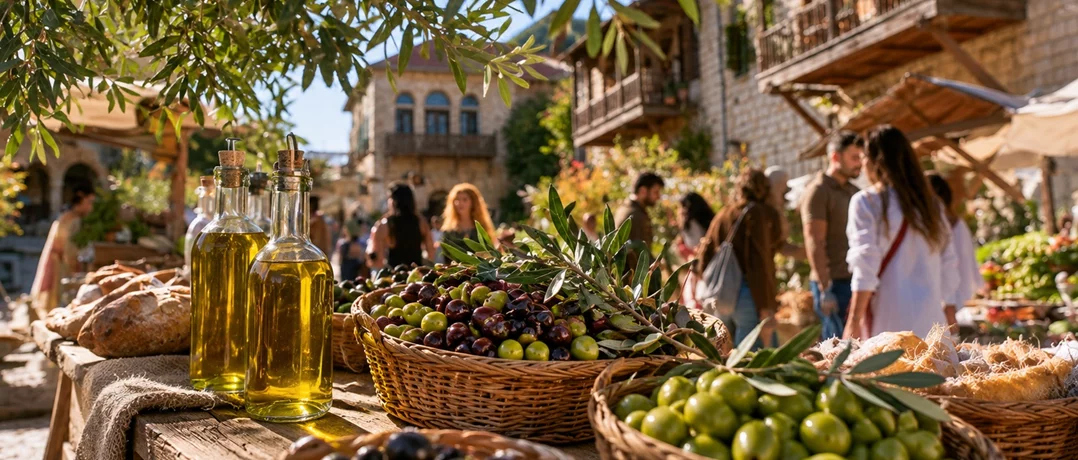
Lebanon’s first olive festivals of their kind turned a fragile harvest into a statement about roots, quality and identity. As farmers face mounting challenges and local production seeks greater recognition, preserving this heritage has become increasingly important. Communities on opposite sides of Lebanon’s mountains staged inaugural festivals dedicated to the fruit.
A village builds a festival from scratch
The first Mazraat el Chouf Olive Festival opened to the sound of church bells outside the Saint George Church. For Carole Bou Chakra, the municipality’s deputy mayor, the setting was deliberate. “The village has both communities, and they insisted that the launch be from in front of the church,” she told The Beiruter. “It is for the sake of shared living.”
Bou Chakra, the only woman among the fifteen members of the municipal council, said the idea began as a springtime event before evolving into something more rooted in the land. “We found the team format didn’t quite suit us, so we asked why not create a concept for the village itself,” she recalled. The organizers settled on an olive festival and had less than twenty days to deliver it.
They were nervous. Those fears eased when Agriculture Minister Nizar Hani, who sponsored the opening, told them it was among the best festivals he had visited. Attendance, by her estimate, reached around 3,000 people, and everything was free.
The program was built around movement through the olive groves. Hikers and cyclists followed trails that wound down toward Marj Bisri and back, with each stop run by local chalet owners offering coffee and ka’ak. Dabke troupes and artistic tableaux greeted walkers along the route, many of them prepared by student performers from the village’s public school under the direction of Majdi Dbayyeh, a key member of the organizing committee. At one point, in the rain, participants linked arms to form what Bou Chakra described as the longest dabke line the village had attempted.
Lunch was an homage to the harvest, roasted potatoes and onions, hot thin bread dipped in ba’iyyeh, the fresh green first-pressed oil, plus manakish, kishk and za’atar. The most talked-about item, though, was a first of its kind. A celebrated local ice-cream maker produced an olive-flavored gelato. “Nobody had ever made it before,” Bou Chakra said, laughing that it “brought peace to the sweet tooth.” Two young women also exhibited olive-shaped ceramics.
Crucially, Bou Chakra stressed, it was not funded by the municipality. “We found ourselves on our own, from one another,” she explained. Villagers contributed the money, built the set and staffed every station. “We didn’t bring in a single person from outside.”
She hopes the festival becomes annual and sees its meaning as larger than a day out. “It is a message of love and strength, we cannot do without our roots,” she noted. “However long we are away, in the end we come back to earth and soil.”
Hasbaya: A festival and a promise
In Hasbaya, the first Olive Festival and Exhibition opened under the patronage of Agriculture Minister Nizar Hani. The event was organized with the Marathon Hermon association, whose president called it a first step toward making the gathering an annual platform for farmers to show and market their produce.
Organized by the Marathon Hermon association, the event brought growers, producers and buyers into one space. Visitors could browse the varieties of olives and olive oil on display, along with products derived from them, a showcase of what Hasbaya and the neighboring Arqoub district have long been known for. Farmers there have endured damage to their land and restricted access to their groves, and the exhibition gave them a place to present the fruit of a harvest that was never guaranteed.
The program mixed ceremony with practical help. Mayors, village heads and agricultural officials joined the unions of municipalities of the Hasbani and Arqoub districts, whose leaders spoke in support of the sector. Hani described the South as “a fundamental pillar on the map of Lebanese olives” and noted that tests on oil from presses in the Nabatieh governorate had come back in line with national standards.
Agricultural expert Fouad Wensa led a seminar on picking and post-harvest handling, covering how decisions made in the grove and at the press shape the quality of the oil. Farmers on the national registry also received battery-powered shears and saws donated by SEAL, tools that make the labor-intensive harvest somewhat lighter.
A local harvest or festival can become an opportunity for community building and economic support. Hence, they bring attention to the challenges facing Lebanese farmers and the need to protect the quality, identity and market value of their produce. Preserving Lebanon’s olive heritage requires investing in the people and land that sustain it.
-
-

-
The Beiruter
-
