



Lebanon’s National Strategy for the Rights and Inclusion of Persons with Disabilities marks an important step towards a more inclusive society. But how far have people with Down syndrome come in accessing employment opportunities?
The journey towards inclusion for Lebanese people with Down syndrome
The journey towards inclusion for Lebanese people with Down syndrome
By Yara Saliba | November 14, 2026

Reading time: 6 min
On November 3, 2026, Lebanon officially launched its National Strategy for
the Rights and Inclusion of Persons with Disabilities (2026–2030), an
initiative led by the Ministry of Social Affairs in partnership with UNFPA and
ESCWA. The five-year strategy aims to shift the country's approach to
disability from one centered on welfare and assistance towards a rights-based
model built on equality, independence and participation.
Built around ten pillars, the strategy addresses areas including education,
healthcare, accessibility, social protection and economic empowerment. Its
employment pillar seeks to improve access to professional opportunities for
people with disabilities, while its broader objectives call for greater
inclusion across Lebanese society.
The new National Strategy also focuses on people with intellectual disabilities, including those with Down syndrome. Being born with Down syndrome can bring challenges for individuals and their families, particularly when it comes to social acceptance and inclusion, including finding a job and becoming part of the workforce. Access to employment remains a major barrier. In Lebanon, several associations are working to create more opportunities for people with Down syndrome.
LDSA: Advocating for equal opportunities at work
Founded in 1998, the Lebanese Down Syndrome Association (LDSA) is one of the
first associations in Lebanon dedicated to people with Down syndrome. After
several years of inactivity, the association was reactivated in 2023, when a
new board was elected, with Chantal Khoury becoming its president. Since then,
the association has focused on two main objectives: raising awareness about
Down syndrome and advocating for the rights of people with the condition. Its
work targets families, schools, universities, businesses and the wider
community.
For Chantal Khoury, the launch of Lebanon's National Strategy was an
important milestone, as it makes disability inclusion the responsibility of all
ministries, instead of leaving it solely to the Ministry of Social Affairs. She
also recalled that, during the launch at the Grand Serail, some ministers
admitted they had previously been unaware of the challenges faced by people with
disabilities. “They told us that they had been blind to these issues before,
and that they had only now realized how much this community needs support,” she
said to The Beiruter.
When it comes to employment, Khoury pointed to the misconceptions
surrounding people with Down syndrome, particularly the belief that they cannot
perform regular jobs or that hiring them is an act of charity. "We do not
want companies to hire our children out of pity. We want them to recognize
their talents and understand the value they can bring to the workplace,"
she noted.
Article 74 of Lebanon's Law 220/2000 requires private companies with 30 to
60 employees to hire at least one person with a disability, while companies
with more than 60 employees must allocate at least 3% of their workforce to
employees with disabilities. Employers who fail to meet these requirements are
subject to an annual financial penalty. “Unfortunately, many companies prefer
to pay the penalty instead of employing people with disabilities,” she stated.
Rayan Saab, an LDSA board member responsible for employment inclusion,
explained that the association works with both job seekers and employers. It
helps people with Down syndrome develop the skills needed to enter the
workforce while training companies to create welcoming workplaces free from
bullying, discrimination and exclusion.
“People with disabilities are not a separate group from society. They are people like everyone else, and they face difficulties just like anyone else,” Saab told The Beiruter. The recruitment process also presents a major obstacle, as job applications can be complicated and inaccessible to people with intellectual disabilities. Still, LDSA has helped members of its community find employment. Khoury mentioned individuals working at Ginger & Co, the Radisson Hotel, Silhouette and Al Forno.
Acsauvel: Building independence from an early age
Founded in 1979, Acsauvel is a non-profit association supporting children
and adults with intellectual disabilities, including people with Down syndrome.
It focuses on developing each child's abilities and independence from an early
age.
In her interview with The Beiruter, Dana Saadeh, president of Acsauvel,
said: “Every child has their own program according to their potential and
abilities.” The association teaches everyday skills, such as washing and
dressing independently, while encouraging children to explore activities like
reading, writing and drawing.
But what happens when they turn 18?
They can continue at Acsauvel's protected workshops, where they learn
routines, take on responsibilities, manage their time and handle money. The
association also gives them opportunities to put their skills into practice
through its shop. They create mosaic mirrors, pottery, coasters, decorative
pieces and Christmas ornaments, which are sold in the shop and displayed at
exhibitions. “When people visit our exhibitions, see the products they have
made and show interest in their work, it strengthens their self-confidence. It
makes them feel respected and valued,” Saadeh added.
Acsauvel also seeks opportunities for young adults with Down syndrome to gain work experience and participate in society beyond the association. Saadeh mentioned initiatives with Alpha and Agonista Coffee, as well as training opportunities in hair salons. However, finding employers willing to hire them remains the major problem while helping people in the association.
Agonista: The challenges of running an inclusive business
For Dr. Wassim El Hage, founder of Agonista Coffee, the idea of creating an
inclusive workplace came from his experience as a physiotherapist. After
working for several years with people with intellectual and physical
disabilities. “I discovered how much potential they have, both mentally and
physically, and how much they need to work, be employed and become independent,
just like their siblings, relatives and friends,” El Hage admitted during an
interview with The Beiruter.
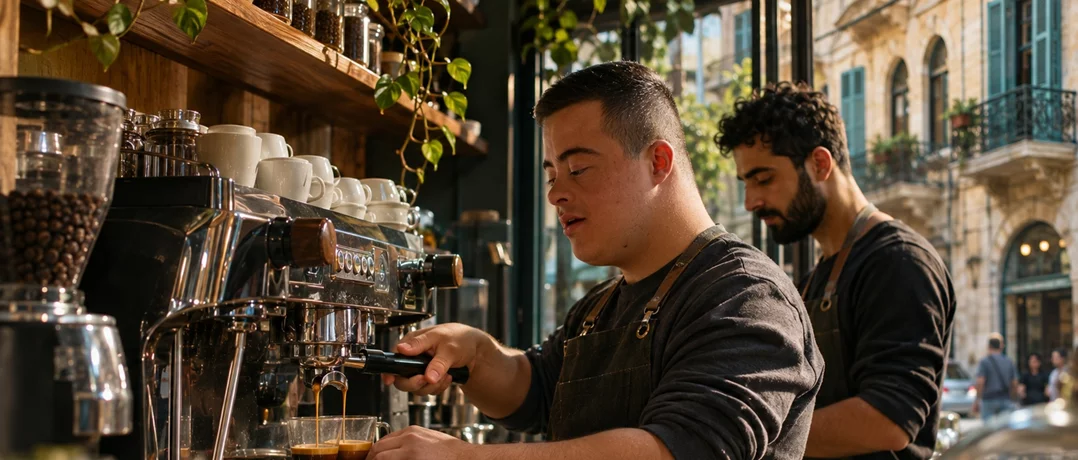
This experience inspired him to establish Agonista in 2018. The coffee shop
began with six young men and women, mainly people with Down syndrome, who
received training in life skills, communication and practical tasks needed to
work in a coffee shop. Each participant was given the opportunity to try
different positions so the team could identify the responsibilities that best
matched their abilities.
“Around 80% of our employees were people with special needs,” he noted.
According to El Hage, having a workplace where employees share similar
experiences can make it easier for people with intellectual disabilities to
adapt, learn their responsibilities and feel included.
Agonista expanded into catering and coffee truck services, but the economic
crisis forced several branches to close. It now operates at City Mall in Dora.
El Hage shared that running an inclusive business comes with higher costs and
little state support. “The costs of running a social enterprise are higher than
those of an ordinary business,” explaining that a task normally handled by one
employee may require three employees with disabilities.
He also believes that society needs to move away from assumptions about what
people with Down syndrome can and cannot do. “We need to give them
opportunities, help them and make sure they are included everywhere. They can
work, be productive and contribute to society just like anyone else,” he said.
While they may need more time, training and certain accommodations, he stressed
that they can become very good at tasks they enjoy.
People with Down syndrome have the same basic needs and aspirations as
everyone else, including the opportunity to work, earn a living and feel
comfortable in their workplace with the right support and an inclusive
environment.
The launch of Lebanon’s National Strategy marks an important step towards
greater recognition of the rights and needs of people with disabilities. For
years, these issues received limited attention. Moving forward, creating more
inclusive workplaces will require employers to reconsider their recruitment
practices, provide appropriate support and offer people with Down syndrome
equal opportunities to join the workforce and the Lebanese society.
-
-
-
Yara SalibaJunior Writer/Translator
-
