



In the medieval Islamic world, science and faith were not opposing pursuits but often complementary ways of understanding creation, inspiring advances in astronomy, medicine and mathematics that would influence intellectual traditions for centuries.
When the study of science was an act of faith
When the study of science was an act of faith
By The Beiruter | November 23, 2026

Reading time: 5 min
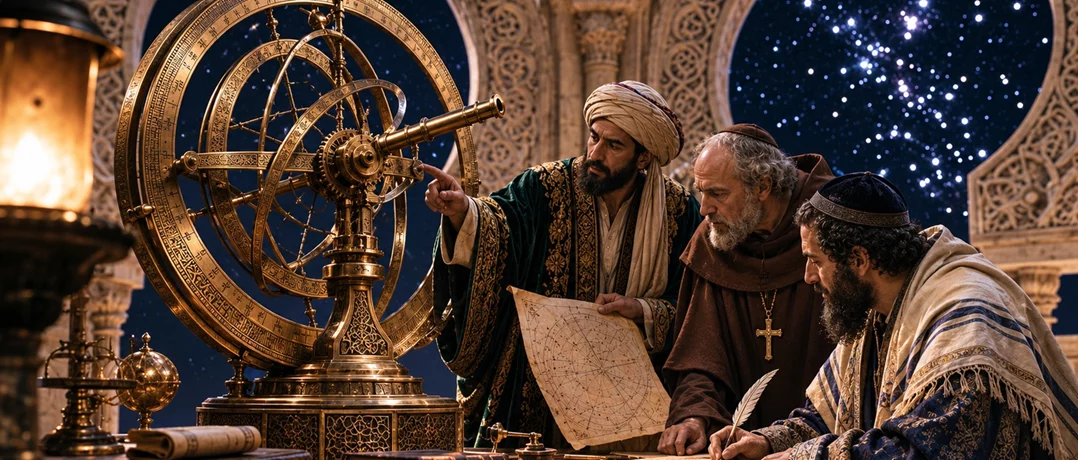
In 1291, a prince in Yemen produced an intricate brass astrolabe capable of calculating celestial positions, determining time, and identifying the direction of Mecca. The instrument, now held by the Metropolitan Museum of Art, united astronomical precision and religious devotion, allowing its user to study the heavens while fulfilling earthly obligations. While science and religion are often treated today as competing approaches to understanding the natural world, in premodern Islamic societies, pursuits now classified under these categories frequently belonged to the same intellectual tradition. “The modern binary between ‘science’ and ‘religion’ is something we should be cautious about imposing upon the premodern past,” Fyza Jazra, a historian of science at Stanford University, told The Beiruter. Between the eighth and tenth centuries, Abbasid intellectuals drew upon Greek, Persian and Indian knowledge to advance astronomy, medicine and mathematics. Understanding the natural world, for many scholars, was itself a way of understanding God. In medieval Islamic societies, the study of the natural world often carried religious significance, with astronomy, mathematics and medicine offering ways to understand the order of creation. Islamic intellectual traditions encouraged the contemplation of natural phenomena, including the movements of celestial bodies and the cycles of day and night, “The Qurʾan and other Islamic religious traditions provided an important intellectual framework within which Muslim scholars thought about nature,” Jazra said. Religious practice also presented problems that demanded mathematical precision. Muslims needed to determine the direction of Mecca, calculate prayer times according to the sun's position and establish the lunar calendar, giving astronomy and mathematics practical applications in everyday life. Yet religious belief did not preclude scientific criticism. Scholars distinguished among disciplines, recognizing that mathematics, theology and philosophy employed different methods of establishing truth. The 13th-century Persian astronomer Nasir al-Din al-Tusi, for example, challenged inconsistencies in Ptolemy's Earth-centered model of the cosmos, developing a mathematical mechanism known as the Tusi couple to explain planetary motion more consistently. The scientific achievements of the Abbasid period depended on more than the intellectual contributions of individual scholars. They required sustained financial patronage, institutions dedicated to learning and a political elite willing to invest in the acquisition of foreign knowledge. Following the establishment of Abbasid rule in 750, Baghdad developed into a major center of translation and scholarship. Greek medical treatises, Indian mathematical knowledge and Persian intellectual traditions circulated among scholars working in Arabic and Syriac. “We must also recognize the significant contributions of non-Muslim scholars to the intellectual and scientific life of the Islamic empires during this period,” Jazra said. Among the most influential was Hunayn ibn Ishaq, a ninth-century Christian scholar whose translations made Greek medical knowledge accessible to Arabic-speaking physicians. The participation of Christians and Jews complicates the familiar description of this period as an exclusively Muslim intellectual achievement. Long before the emergence of modern European science in the 16th and 17th centuries, European physicians were studying medical treatises written in Persia, while mathematicians relied on methods developed in the medieval Islamic world. “One important aspect of this legacy is the transmission of scientific knowledge into Latin Europe,” Jazra said. Beginning in the 12th century, translation centers in Toledo, Sicily and Italy brought Arabic scientific and philosophical works into Latin, introducing Europeans to centuries of accumulated knowledge, Jazra explained. Consider Ibn Sina, the Persian physician and philosopher whose Canon of Medicine was translated into Latin in the 12th century and became a cornerstone of European medical education. Its influence endured for centuries, with more than 35 editions published during the 15th and 16th centuries alone, according to a 2013 historical review in the medical journal Heart Views, available through the U.S. National Library of Medicine. The influence of Arabic scholarship is also embedded in the language of modern mathematics. The word algorithm derives from the Latinized name of al-Khwarizmi, whose writings helped introduce Hindu-Arabic numerals into Latin Europe, while algebra comes from al-jabr, a term in the title of his mathematical treatise. The familiar account of an Islamic golden age followed by Europe's Scientific Revolution obscures a crucial fact: scientific inquiry in the Islamic world did not end when European scholarship began to flourish. Astronomical and medical scholarship continued within Ottoman, Safavid and Mughal societies long after the medieval Abbasid period. In 1654 or 1655, for example, Muhammad Zaman al-Munajjim al-Asturlabi produced an elaborate astrolabe in Mashhad, Iran, whose rotating face incorporated the Arabic invocation opening most chapters of the Quran, according to the Metropolitan Museum of Art's Art of the Islamic World educational collection. Nor were intellectual exchanges limited to a single direction. Greek, Persian and Indian knowledge entered Arabic scholarship, underwent substantial revision and subsequently circulated through European institutions, where scholars developed their own contributions. “It is important to resist presenting this history merely as a precursor to European modernity,” Jazra said. To understand the significance of these scientific traditions is therefore to abandon the notion that scientific progress belongs to one civilization at a time. The history of knowledge is far less orderly, and considerably more interconnected, than the conventional story of successive golden ages suggests.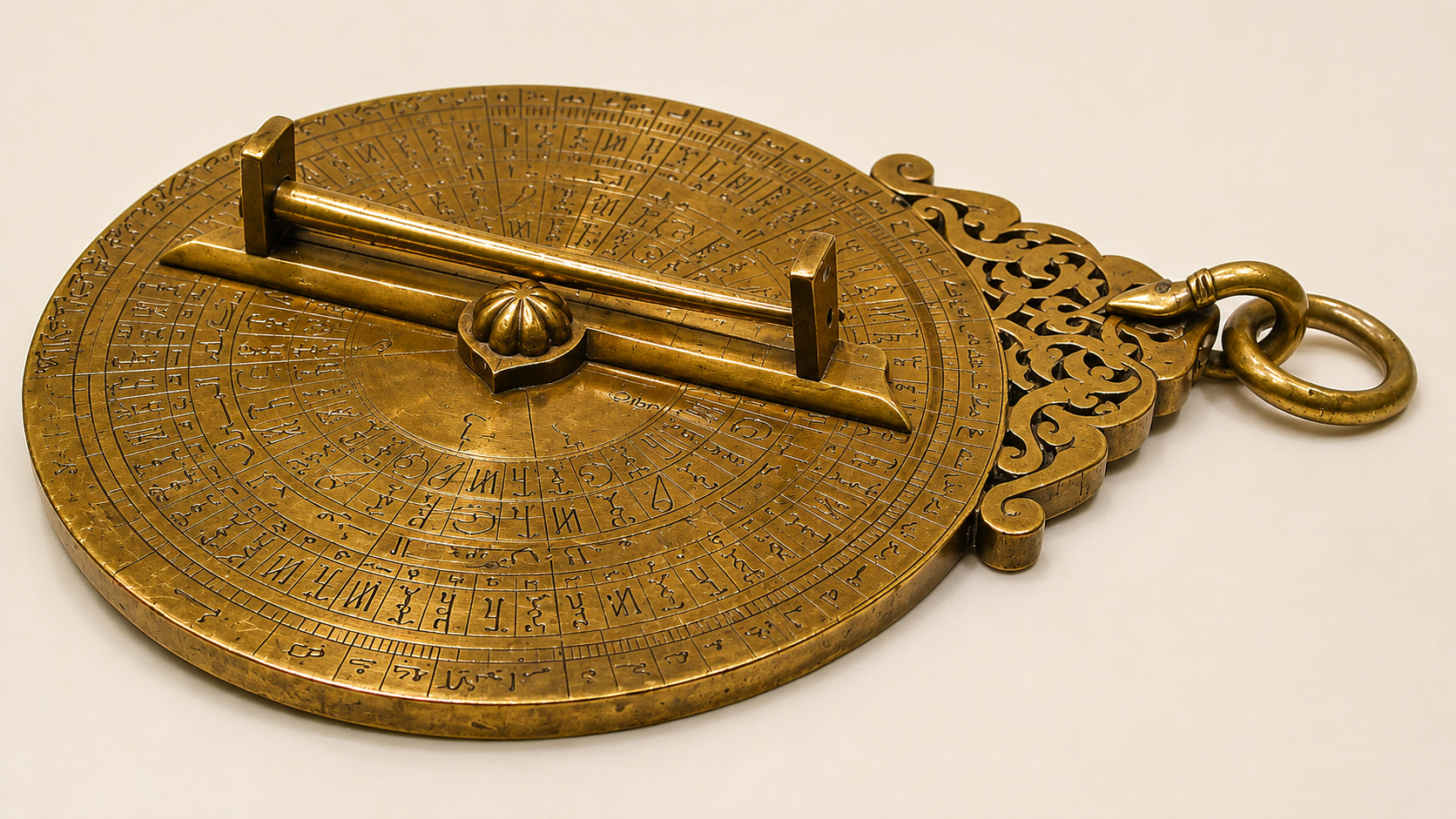 Astrolabe by ‘Umar ibn Yusuf ibn ‘Umar ibn ‘Ali ibn Rasul al-Muzaffari, 1291. (Courtesy of The Metropolitan Museum of Art, Edward C. Moore Collection, Bequest of Edward C. Moore, 1891)
Religious commitment and the investigation of nature were not inherently opposed.
Science in the service of faith
For many scholars operating in the Islamic world, studying nature could have religious significance: knowledge of the created world could contribute to knowledge of its Creator.
Baghdad's intellectual experiment
Numerous examples attest to the participation of Christian, particularly East Syriac, and Jewish scholars who worked under the patronage of Muslim caliphs and other members of the ruling elite.
From Arabic to Latin
Their works became integral to the intellectual life of medieval European universities and continued to influence European scholarship well into the early modern period.
Beyond the golden age
The most significant legacy of these traditions lies in the recognition that scientific knowledge has always emerged through cross-cultural encounters, intellectual exchange, and sustained scholarly collaboration.
-
-

-
The Beiruter
-
