



Three leaders. Three nuclear powers. One historic summit. Trump, Xi and Putin met in Shenzhen, but the world's biggest disputes remain unresolved.
The Promise and Limits of the Shenzhen Summit
The Promise and Limits of the Shenzhen Summit
By Nami El Khazen | November 22, 2026

Reading time: 6 min
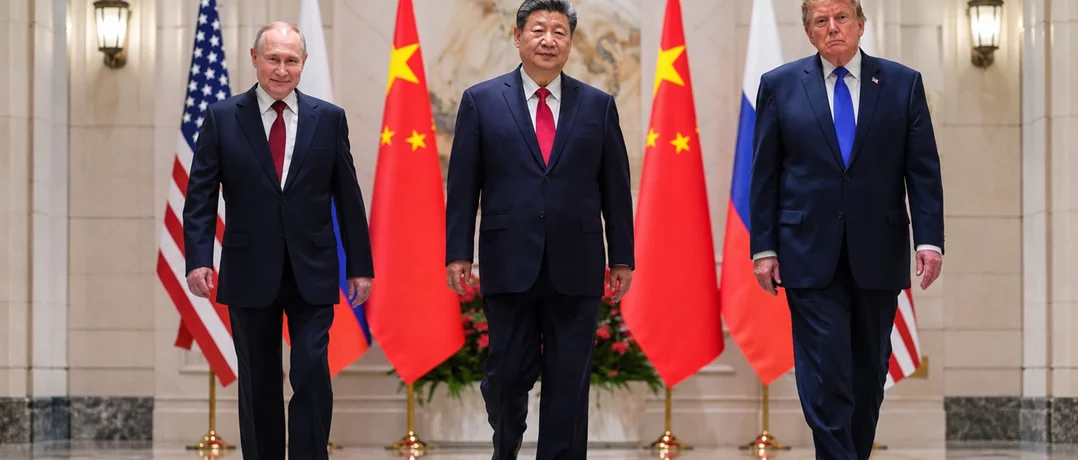
In the wooded hills above Shenzhen, Chinese President Xi Jinping welcomed American President Donald Trump and Russian President Vladimir Putin to Kylin Villa. On November 19, the leaders of China, the United States and Russia gathered for the first trilateral summit in their countries' history.
The three powers had once fought on the same side during the Second World War, helping shape the international order that emerged from it. Today, they occupy three permanent seats on the United Nations Security Council and command the world's three largest nuclear arsenals.
Yet eight decades of shifting alliances, ideological divisions and strategic rivalries have transformed their relationships. Against this backdrop, the three presidents came together for a diplomatic encounter without precedent.
Inside the Shenzhen summit
Before the trilateral session, Trump held separate meetings with Putin and Xi, lasting approximately 40 minutes and an hour respectively. The three presidents then gathered for roughly 90 minutes of talks, including discussions behind closed doors.
Their opening remarks revealed a shared emphasis on dialogue and international stability, although each leader approached these objectives from a different perspective. Xi called for peaceful coexistence among major powers, an appeal Putin extended to cooperation on economic relations, energy and food security. The Russian president also referred to Ukraine, which he had discussed separately with both counterparts.
Trump similarly emphasized the importance of maintaining communication between rival governments, arguing that refusing dialogue could not resolve international disputes. But his attention turned particularly to the nuclear threat, calling for reductions in global arsenals and measures to prevent their use, alongside concerns about Iran and Ukraine.
The discussions culminated in a four-point joint document titled the Declaration toward Peace.
The Four-Point Declaration
The common ground reached in Shenzhen extended across several areas of international cooperation, beginning with the United Nations, where all three countries hold permanent seats on the Security Council. The leaders pledged to make the organization more effective in responding to global challenges, although they outlined no specific changes to its membership, veto powers or decision-making procedures.
The agreement also extended to energy security, with Washington, Moscow and Beijing committing to increase the production and supply of refined petroleum products while maintaining stable energy flows, an issue made particularly pressing by the conflict involving Iran and disruptions to shipping through the Strait of Hormuz. No specific production targets were announced.
The most pointed language addressed international justice. The leaders emphasized state consent and the immunities of state officials, warning that the International Criminal Court and similar bodies must not abuse their jurisdiction. This provision was notable given the ICC's arrest warrant against Putin, issued in March 2023 over the alleged unlawful deportation of Ukrainian children, and Washington's opposition to the court's proceedings against Israeli officials. None of the three countries is party to the Rome Statute, though the declaration does not affect the court's existing warrants or legal powers.
The declaration also addressed nuclear security, affirming that nuclear war cannot be won and must never be fought. The three governments committed to dialogue on reducing nuclear risks and preventing proliferation.
The Nuclear Question
That pledge came nine months after the expiration of New START, the last treaty limiting American and Russian strategic nuclear forces. Signed in 2010 by Barack Obama and Dmitry Medvedev, it capped each side at 1,550 accountable deployed strategic warheads and provided for inspections and data exchanges. Russia had suspended participation in 2023, and Putin subsequently proposed observing the treaty's central limits for another year after its expiration, without securing a new binding agreement.
Trump, meanwhile, had long sought to bring China into nuclear arms-control negotiations. His first administration unsuccessfully pursued trilateral talks, an objective he revived as Beijing expanded its arsenal. China has resisted joining comparable reductions, arguing that its nuclear forces remain substantially smaller than those of Washington and Moscow.
The Shenzhen meeting did not establish such negotiations. The leaders announced no numerical reduction targets, verification arrangements or timetable, and the declaration did not specify whether future nuclear discussions would take place among all three governments.
The Conflicts Left Unresolved
Beyond nuclear arms control, the leaders also considered wars that remained outside their written commitments. Ukraine had featured in Trump's separate conversation with Putin, who described its resolution as a shared interest. The Kremlin later said the war was not the principal subject of the trilateral talks. Speaking afterward, Putin ruled out a moratorium on strikes against Black Sea shipping and energy infrastructure following Ukrainian attacks on the Kerch Bridge.
Washington also sought common ground over Iran. Trump said he and Xi agreed on the importance of maintaining energy flows through the Strait of Hormuz and preventing Tehran from acquiring nuclear weapons. Neither Iran nor Ukraine was mentioned in the final declaration.
Taiwan also featured in Xi's separate meeting with Trump. According to China's state-run Xinhua news agency, Xi warned Washington against setbacks in bilateral relations over Taiwan, while Trump reportedly stated that the United States does not support Taiwanese independence. The White House did not independently confirm the remark, and Taiwan's government disputed the Chinese account. The Korean Peninsula was also discussed during the trilateral meeting, without producing a specific commitment.
The Diplomatic Stakes of Shenzhen
While the three presidents met in Shenzhen, Ukraine's European allies gathered in Berlin for a summit of the Coalition of the Willing. German Chancellor Friedrich Merz rejected comparisons with the 1945 Yalta Conference, where Allied leaders negotiated Europe's postwar settlement, warning that such a format could not bring peace to Ukraine.
Behind that historical reference lay a broader European concern: that Washington, Moscow and Beijing might begin dividing the world into spheres of influence, with European governments excluded from decisions affecting their own security and political future. The prospect of major powers negotiating arrangements over the heads of smaller countries carried particular resonance in a continent still shaped by the consequences of Yalta.
Washington sought to address those concerns. Trump joined the Berlin discussions by telephone from Air Force One, while his envoys, Steve Witkoff and Jared Kushner, attended in person. Kushner assured European leaders that Washington intended to involve them in negotiations with Moscow and discussed possible security guarantees for Ukraine. Zelensky emphasized the need for credible guarantees and European participation.
Moscow, meanwhile, had its own reasons for supporting the trilateral format. According to The Wall Street Journal, Putin had proposed the meeting during an October 9 telephone conversation with Trump, initially seeking discussions concerning Ukraine. Yet the encounter also offered a diplomatic gain independent of those negotiations. An assessment published by the Council on Foreign Relations argued that Putin's appearance alongside Trump and Xi reinforced Russia's standing as a major power despite Western efforts to isolate it.
For Beijing, however, the calculations were different. China had reportedly hesitated over a gathering that could overshadow APEC and draw it into sensitive negotiations concerning Ukraine. Hosting it nevertheless placed Xi at the center of an unprecedented diplomatic event, reinforcing China's international visibility. Trump, by contrast, could engage both strategic rivals directly and revive his push for trilateral nuclear arms control.
The summit ultimately evolved beyond the Ukraine-centered discussions reportedly envisioned by Moscow, producing a declaration addressing broader international concerns. Beijing has called for continued working-level contacts, and the December 14–15 G20 summit in Miami could offer another opportunity for high-level exchanges. Trump and Xi are expected to meet again, although Putin's attendance remains uncertain. While Shenzhen established what the three powers could agree to in writing, the harder questions, from nuclear arms control to Ukraine and Iran, remain on the table.
-
-

-
Nami El KhazenJournalistFocusing on geopolitics and international affairs.
-
