



Can Azerbaijan manage an alliance with Turkey and a partnership with Israel as the two grow more hostile to each other?
Azerbaijan between Israel and Turkey

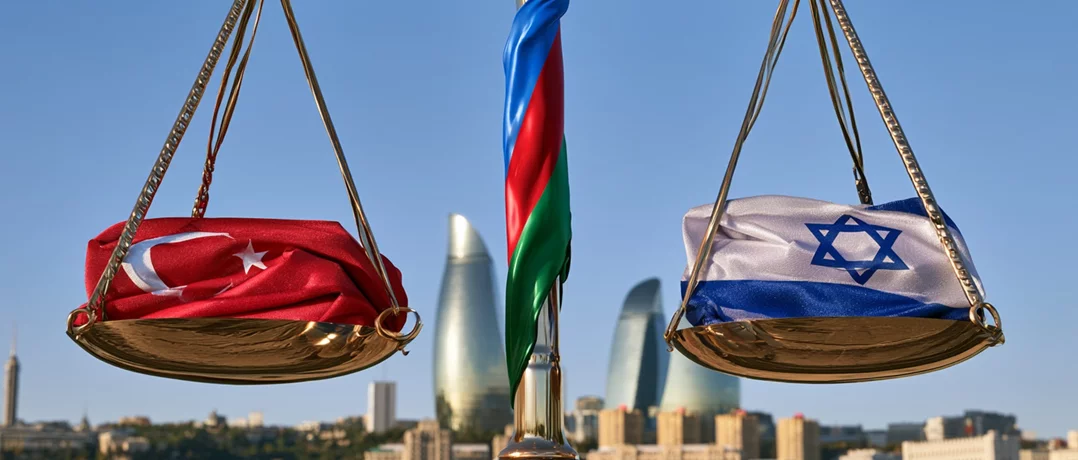
Azerbaijan and Israel have deepened their long-standing partnership over the past years through energy exports, arms deals and new agreements on artificial intelligence. Azerbaijan has supplied between 40 and 60 percent of Israel’s oil in recent years, and its oil exports to Israel rose by about 55 percent between 2023 and mid-2024. Azerbaijan, for its part, has greatly benefited from military cooperation with Israel. From 2016 to 2020, Israel supplied 69 percent of Azerbaijan’s major weapons imports, and in 2025, according to UN Comtrade, Israeli exports of arms, ammunition, accessories and parts to Azerbaijan reached $418 million. Baku also opened a trade office in Israel in 2021 and an embassy in 2023.
Azerbaijan’s partnership with Israel reflects a pragmatic convergence of interests in energy, security and technology, and, alongside its ties with Washington, may even position Baku within efforts to expand the Abraham Accords. How, then, does Baku’s closeness to Israel affect its relationship with Turkey, its most important ally, at a time of growing Turkish–Israeli rivalry in the region?
“One nation, two states” under strain
Turkey and Azerbaijan have long described themselves as “one nation, two states.” Turkey was the first country to recognize Azerbaijan’s independence in 1991, and ties deepened as it backed Baku in the conflict over Nagorno-Karabakh. Defense cooperation was matched by energy integration, built around major pipelines linking the Caspian to Turkey and beyond
The Baku–Tbilisi–Ceyhan (BTC) oil pipeline and the South Caucasus Pipeline (Baku–Tbilisi–Erzurum) carry Caspian oil and gas through Georgia to Turkey, while the roughly 1,800-km Trans-Anatolian Natural Gas Pipeline (TANAP), 58 percent owned by Azerbaijan, 30 percent by Turkey's state pipeline company BOTAŞ, carries Azerbaijani gas across Turkey to supply the Turkish market and onward to Europe. Turkey offered Azerbaijan support against Armenia and a counterweight to larger neighbors; for Ankara, Azerbaijan provided energy, regional influence and a bridge to the wider region.
Two issues are now testing this partnership with the first being identity. In September, Azerbaijan introduced school dress rules that led to pupils and teachers in headscarves being excluded from classes, drawing criticism from Turkish President Recep Tayyip Erdoğan’s Justice and Development Party (AKP), for which lifting Turkey’s own headscarf bans was a signature achievement. Baku’s ruling New Azerbaijan Party responded by insisting that brotherly ties do not entitle outsiders to impose ideological views.
Baku's defense of secularism is closely tied to how it views national security, and that view is shaped largely by Iran. Azerbaijani officials have long been wary of Iranian religious and political influence, particularly through Shia networks and clerics loyal to Tehran. Iran in turn, worries that Azerbaijan could stir nationalism among the millions of ethnic Azerbaijanis living in its northwest. This is why Baku reacts sharply even when criticism comes from a close ally like Turkey.
The second, and more strategic, issue is Israel. For Baku, the relationship serves core national interests, providing a valuable security partner alongside Turkey and a hedge against Iran. That choice has carried risks since the U.S.–Israeli war against Iran began in February. Tehran has repeatedly accused Baku of letting the United States and Israel use its territory for intelligence and military operations against Iran. Baku, however, has firmly denied breaching its neutrality in the U.S.–Israeli war against Iran. Even so, when a drone struck Azerbaijan’s Nakhchivan exclave on March 5, President Ilham Aliyev called it “a terrorist act” committed by Iran against Azerbaijan, though tensions later eased.
Ankara sees the relationship very differently. Erdoğan has become one of the fiercest critics of Israel's conduct in Gaza and has placed support for the Palestinians at the center of his regional rhetoric. Turkey and Israel are also increasingly hostile rivals in Syria. In August, Ankara went further, signing the Mecca Joint Defense Agreement with Saudi Arabia and Pakistan. Erdoğan has said the pact's vision is not limited to three countries and has not ruled out a similar arrangement with South Caucasus states. Some commentators in Baku have even described Azerbaijan as one of the strongest candidates for membership, though others doubt the pact is mature enough for expansion. Although Ankara insists the pact targets no one, analysts see it as running counter to Israel's interests, leaving Baku in a delicate position. Its closest ally is building a security bloc seen as a counterweight to Israel, even as Azerbaijan deepens its military ties with the Israelis. For some Turkish critics, Azerbaijan's continued cooperation with Israel is therefore incompatible with its claims of Muslim solidarity and amounts to a snub to Ankara.
A strong bond remains
Still, there is no sign that the alliance is collapsing. The two presidents have avoided direct public confrontation, and both governments have moved to contain the dispute. On October 15, Turkish Foreign Minister Hakan Fidan met Aliyev in Baku on the sidelines of the 7th Summit of the Conference on Interaction and Confidence Building Measures in Asia (CICA) and urged the two countries to resolve their disagreements through dialogue rather than through propaganda on social media.
Azerbaijan continues to rely on Turkish defense support and export routes, while Turkey depends on Azerbaijani energy and on Baku's position in the Caucasus. With shipping through the Strait of Hormuz still disrupted, Azerbaijani oil and gas reaching markets through Turkey have only become more valuable. That gives both Ankara and Israel reason to court Baku more actively. Turkey relies on Azerbaijani gas through TANAP and on its role as a transit hub, while Israel draws a large share of its oil from Azerbaijan, much of it shipped from Turkey's Ceyhan port via the BTC pipeline. As each competes for influence in the region, both may try to draw Azerbaijan further to their side. Paradoxically, the very ties with Israel that irritate Ankara may also make Baku more useful to it. As Turkish–Israeli tensions escalate, Azerbaijan is one of the few actors with close relations to both. One such initiative came in April 2025, when Baku hosted Turkish–Israeli talks aimed at preventing military clashes in Syria.
The friction looks more like a dispute over the terms of a close partnership than the start of its breakdown. The real warning signs would be changes to defense cooperation, energy arrangements or diplomatic coordination, and so far, there have been none. For Azerbaijan, its ties with Israel expand its options, but managing them without alienating Turkey will remain one of the central tests of its foreign policy.
-
-

-
Peter ChouayfatiPolitical Analyst and Researcher
-
