



Lebanese swimming champion Laetitia Hamdoun reflects on the pressure of carrying a legacy and finding strength in the sport that became both her challenge and her refuge.
Laetitia Hamdoun and the discipline of a champion
Laetitia Hamdoun and the discipline of a champion
By The Beiruter | November 26, 2026

Reading time: 4 min
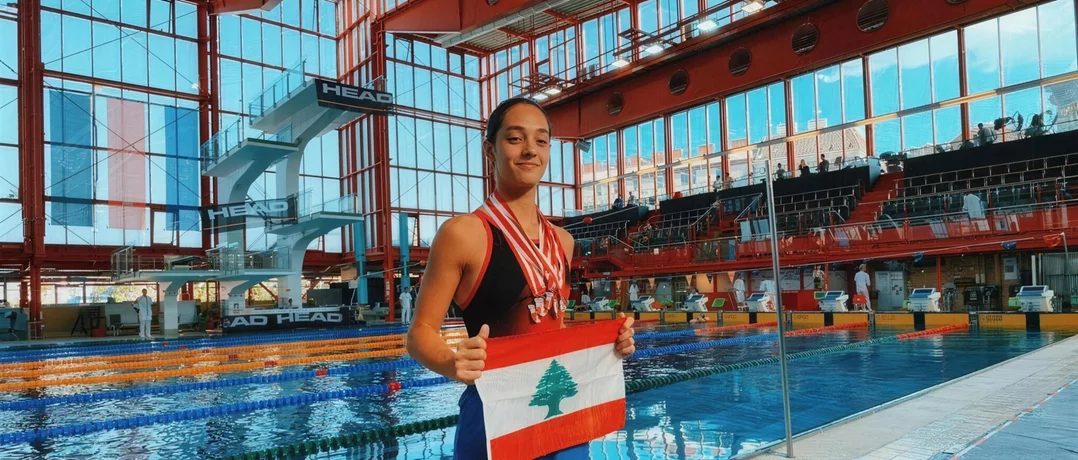
At 22 years old, Laetitia Hamdoun has spent much of her life in the water. Thirteen years of competitive swimming have given her a trove of Arab and Lebanese records and a place among the region’s fastest swimmers. Along the way, she has gained a profound understanding of what it costs to carry a legacy on one’s shoulders.
Her path to the sport began with her mother’s instinct. “My mother used to put us in a lot of sports. I did gymnastics, karate, dance, all of that,” Hamdoun told The Beiruter. Swimming arrived by way of necessity. “My sister had scoliosis, so she put us in swimming, and that’s basically how I started.”
She began training in 2011, and destiny intervened two years later. The head coach of the team she trained with happened to visit the pool, watched her, and invited her to trial with the senior group. Her progress was swift. “I started improving quickly and was able to keep up with the older swimmers,” she explained, “so he began focusing on me more until I eventually entered my first competition.”
She made her debut at the Lebanese Championship in 2013, followed a year later by her first international meet in France.
The success behind the work
2019 defined her rise. “2019 was a great year for me in swimming,” Hamdoun reflected. She set three Arab records, one of which made her “the eighth-fastest Arab” in the 100-meter backstroke. She also claimed fifth place at the Asian Age Group Championships. Lebanese records fell with astonishing regularity, “between 2017 and 2019, I would say I broke more than 50 records.”
Her more recent achievements have made her all the more proud. Only weeks ago, at the World Interuniversity Championship in Slovakia, she stood on the podium after finishing third in the 50-meter backstroke.
Hamdoun has been building a second future away from her swimming career. She graduated in July with an undergraduate degree in occupational therapy and is now pursuing a master’s in sports management. She has to bend her swimming schedule around her studies. She swims “five to six times a week, at least,” with three weekly visits to the gym. Each session, shaped by whatever she is refining, varies between ninety minutes and two hours.
In the lead-up to race day, heavy preparation is required. “I set a goal for myself from the moment I start training. I decide that I want to achieve a certain time in a certain event,” she explained. “That’s basically what motivates me and helps me organize my training sessions.” As competition nears, she meditates and rehearses each length in her mind. “I try to visualize my race more, to imagine how I’m going to swim it.”
When the pandemic arrived in 2020, her connection to the sport began to weaken. “I began skipping swimming a lot,” she admitted. “From that point on, I also started experiencing a lot of difficulties with my mental health, and I was struggling quite a bit.” She drifted in and out of the pool and the gym, never finding consistency until the summer of 2026.
The turmoil stemmed from her personal life rather than from competition. Yet swimming remained a paradox for her. “My struggle with my mental health made me want to quit many times,” she confided. “But at the same time, swimming was a safe space where I could be myself and feel at peace at the same time. So it was a big conflict for me.”
Even now, the moments before a race can be daunting. The 100-meter backstroke, the event that earned her an Arab record and helped her qualify for the Olympics, has become both her pride and her burden. “I feel like I have a legacy to uphold,” she admitted. “There’s a lot of pressure behind it.” Her method is to “just try to breathe and calm myself down, so I can perform as best as I can.”
The person who has sustained her most emotionally is her coach, Mohammad Sakr. “He’s believed in me since I was little. He continued pushing me, even during the times when I stopped, and he always encouraged me to come back.” He shapes each session around her needs and her mood. “Definitely,” she declared, “he’s the biggest support I have right now.”
Her sights are now set on the World University Games, expected in July 2027. “God willing, I’ll qualify,” noting that other competitions remain unscheduled.
Hamdoun thought of what she would tell her younger self if she had the chance. “I would tell her to enjoy it. Even when you are achieving the times you want, still enjoy it, give yourself credit, and recognize that you’re working hard to achieve those goals.”
It is a profound expression for the athlete who has lived both the thrill of each record and the heavy weight of doubt. She will continue to swim, towards her goals and towards a deeper peace with the journey to come.
-
-

-
The Beiruter
-
