



Sydney eye surgeon Domit Azar restores sight in rural Cambodia and brings his children along to learn the value of service.
A family mission to restore sight in Cambodia
A family mission to restore sight in Cambodia
By Adella Beaini | November 29, 2026

Reading time: 5 min
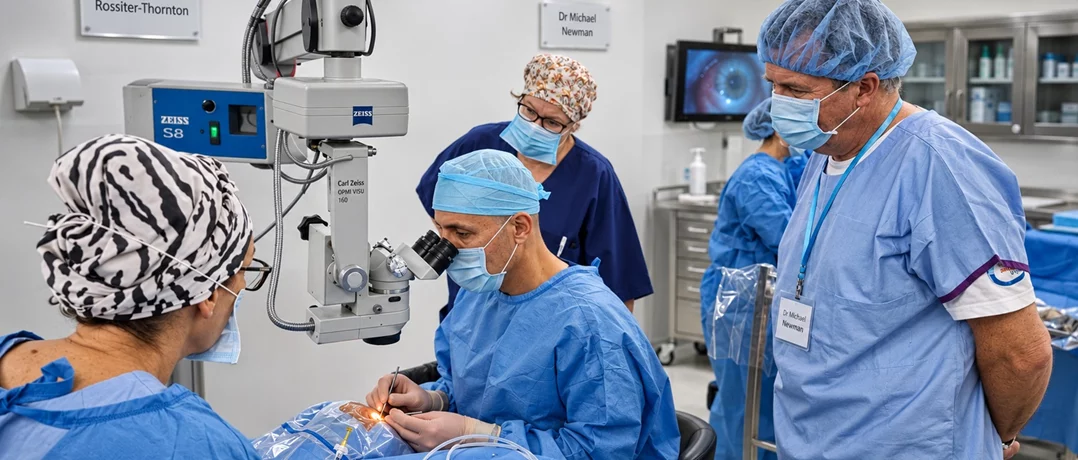
For Sydney eye surgeon Domit Azar, restoring someone's eyesight is about more than helping them see again. It can give them back their independence, dignity and ability to care for their families.
But for the father of six, his humanitarian work in rural Cambodia has also become an opportunity to teach his own children some of life's biggest lessons.
Dr Azar recently returned from his latest volunteer mission with Cambodia Vision, where he joined eight other Australian eye surgeons to provide free operations to people with little or no access to specialist medical care.
This time, he brought his 11-year-old daughter along, following a trip with his eldest son, then 12, the previous year.
It is a decision he hopes will leave a lasting impression on all six of his children.
A calling from childhood
Growing up in Sydney's western suburbs in a close-knit Lebanese Christian family, medicine was always the goal.
“I cannot remember a time in my life when I did not want to be a doctor,” Dr Azar said.
His father was a trained tailor who worked as a bus driver, while his mother was a housewife.
He entered medical school at just 17, became a doctor at 23 and eventually specialized in ophthalmology after witnessing eye surgery during his first year working as a doctor.
Now, after more than 20 years as a specialist eye surgeon, he says he still loves the work.
But alongside his regular career, he has found another purpose in using his skills to help people who cannot afford or access the treatment they need.
“My humanitarian work in Cambodia allows me to use the skills I have been fortunate enough to acquire for the benefit of some of the most disadvantaged people in the world,” he said.
“It has become the most satisfying work I do in my professional life.”
Giving people their sight back
Dr Azar has volunteered with Cambodia Vision for several years, travelling to rural communities where access to specialist healthcare can be virtually non-existent.
On his most recent trip, the team assessed approximately 4,000 patients, with 640 requiring eye surgery.
The nine surgeons operated on all 640 patients in little more than five days, with Dr Azar personally performing 97 operations.
Most of the patients had significant visual impairment or blindness caused by cataracts.
The conditions were challenging, with limited equipment and technically demanding procedures, but the need was too great to wait.
“Of course, I would love to have better equipment and greater financial resources… and I could have decided that the conditions were not good enough. I could have waited until better equipment became available,” he said.
“But the people who were blind could not wait. So we went, and we operated.”
For patients living in remote communities, the consequences of blindness can extend well beyond their eyesight.
Without the support systems available in Australia, losing their vision can mean losing the ability to work, earn an income, care for their children or move around independently.
“Restoring their eyesight does not merely allow them to see again. It restores their independence, their dignity and their ability to contribute to their families and communities,” Dr Azar said.
Bringing his children into the operating theatre
For Dr Azar, the trips have also become a way to spend valuable one-on-one time with his children while exposing them to a world very different from their own.
Last year, he took his eldest son to Cambodia. This year, it was his daughter's turn, with plans to take her twin brother next year.
The children are not simply travelling as observers. Under supervision, they help patients on and off operating beds, assist with eye drops and work alongside the medical teams.
“I don't take my children to Cambodia simply to show them how fortunate they are. I take them because I want them to understand what they can do with that good fortune,” he said.
“As a father, it is tremendously satisfying to see your child doing something for somebody else without expecting anything in return.”
He hopes the experience will teach them lessons that cannot be learnt in a classroom.
The meaning of success
Dr Azar's commitment to humanitarian work is closely tied to the values instilled in him by his Lebanese parents.
His father arrived in Australia from Ardeh in northern Lebanon in 1966, aged 20, while his mother, from Hardine, arrived with her family two years earlier.
They worked hard to create opportunities for their children, raising their family with an emphasis on compassion, humility, generosity, faith and hard work.
He believes those values continue to shape his work today.
“I want my children to be ambitious. I want them to work hard, pursue excellence and become successful in whatever fields they choose,” he said.
“But I also want them to understand the distinction between success and significance.”
“Success is largely about what happens to you. Significance is about what happens to others because of you.”
While he hopes to continue returning to Cambodia and eventually take all six of his children, he is also keen to expand the work through better equipment and greater financial support.
He is quick to acknowledge that the trips are only possible because of the support of his wife, Lia, a radiologist, who takes on the responsibility of caring for their family while he is away.
For Dr Azar, the ultimate measure of a life well lived is not professional recognition or personal achievement.
“There will come a time when our degrees are framed, our promotions have been achieved, and our accolades have gathered dust.”
“And perhaps then the most important question will not be, ‘What did I achieve?’”
“It will be, ‘Who was better off because I was here?’”
