



At Fizz in Mar Mikhael, poet Serge Nasr and musician Serge Volant brought ‘Flexible Ending Arrangements’ and ‘Everyday Is All There Is’ into the same room, turning an hour of spoken word, ambient music and field recordings into something intimate and unexpectedly immersive.
A conversation between words and sound

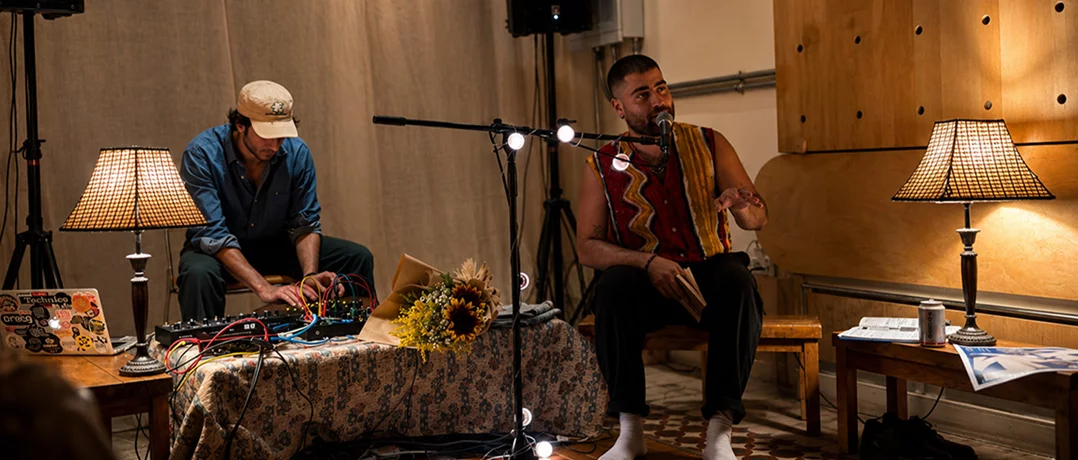
On Aug. 2, Fizz in Mar Mikhael became the setting for a small experiment in sound and poetry. As a compact DJ setup sat to one side, Serge Volant worked through his sounds while Serge Nasr sat beside him with a microphone, surrounded by small light bulbs that gave the room a warm, almost domestic feel.
Nasr took his shoes off. A small gesture that made the performance feel more personal.
He began reciting from “Flexible Ending Arrangements,” exactly one year after the release of his debut collection of poetry and visual stories. Written from his experiences as a queer man in Lebanon, the book moves through desire, intimacy, grief, relationships and memory, documenting a personal life that is rarely given this kind of space in Lebanese literature.
A year later, the poems were no longer sitting between the pages of a book. They were moving through a room, carried by Nasr’s voice and Serge Volant’s electronic sounds.
For that hour, the outside world seemed to fall away. The music had enough space to breathe.
Giving the poems another life
The first part of the performance drew from Nasr’s book, where the poems already have their own rhythm. For a collection so closely tied to memory and personal experience, hearing the poems spoken aloud gave them another kind of presence. Listening to them over Volant’s ambient sound revealed another side to the writing.
Nasr says he discovered that many of his poems had more room to change than he had previously thought. Volant’s music, especially in the first part of the selection, carried what Nasr described as a hopeful tone, changing the way he approached the poems as he recited them.
“I kind of recited; I changed the way I'm reciting the piece, which gave it a whole new meaning, which I personally loved,” Nasr says.
That openness is important to Nasr’s approach to his own writing. He does not see a poem as something permanently fixed once it has been written. “I love to experiment with different things,” he says, explaining that he wants his work to “take different forms, different shapes, to have its own life.”
For Nasr, the poems have always been closely tied to lived experience. His writing does not treat queerness as a separate subject from love, heartbreak or memory; these are the experiences through which he understands his life.
That made the anniversary reading significant beyond the return to a debut book. It was a queer Lebanese writer bringing intimate experiences that have often remained private into a shared public space, then allowing those same words to change through sound.
When sound changes the words
Volant’s role was equally responsive. His debut album, “Everyday Is All There Is,” draws from personal memories, travel, Beirut, field recordings and everyday moments. For the performance, he reinterpreted pieces from the album and adjusted their arrangements around each poem.
“Ambient music has a lot of openness in it,” Volant says. “It does not always demand the listener’s full attention in the same way as a very structured song, so it leaves room for a voice and for language.”
That was perhaps what made the pairing work so naturally. A field recording could establish a place, while the modular synthesizer could bring in uncertainty or movement. Volant explains that these sounds created “a space between something real and something imagined,” which felt fitting for poetry and memory.
From the audience, the result felt almost cinematic. There was no rush to get from one poem to the next. The sound created a setting around Nasr’s voice, allowing certain words and pauses to stay in the air.
Then came the poems after the book
The second half moved beyond “Flexible Ending Arrangements” with four pieces Nasr wrote after the book was published. They were denser, less rhythmic and harder to approach musically, so Nasr became more involved in describing the feeling he wanted.
“I was telling him the vibe that I want to have, something a bit more grunge,” Nasr says, describing the process of shaping the pieces together.
One poem in particular, “Bent Backs and Scraped Knees,” changed dramatically in the process. Nasr had originally written it with an accusatory quality. With Volant’s music underneath it, he heard something else.
“It became more as a plea, like I'm pleading for help kind of thing,” he says. “It's a plea, see me, hear me, I'm talking to you, why aren't you listening?”
That shift was one of the clearest examples of what the collaboration could do. The poem remained the same piece of writing, though its emotional temperature changed once another medium entered the room.
A conversation inside the music
Volant says the biggest challenge came when Nasr’s poems entered songs that already contained lyrics. Rather than separating the two, they searched for spaces where the voices could coexist.
“There was a risk that the two voices could compete with each other,” Volant says. “But once we found the right spaces between the verses, it became one of the most interesting parts of the performance.”
Nasr felt something similar from the other side of the microphone. For him, the music did more than accompany the poems. “With the music, everything felt more complete,” he says, adding that he felt he was “responding to the exact scene in which the conditions of the poem were created in the first place.”
That idea came through during the performance. Nasr’s delivery was deliberate, with pauses, repetition and changes in intensity shaping how each piece landed. He explains that these choices are a major part of his performance practice, from where he stops to what he repeats and how he uses eye contact and his body.
Somewhere between the page and the stage
There was something reassuringly informal about the evening. The setup was small. Nasr was sitting in socks. Volant was surrounded by cables, equipment and small lights. Nothing tried to turn the room into a grand concert hall.
That intimacy suited the music. Volant says the album itself is personal, which is why introducing it in a small, familiar space felt right to him. “I did not want the first public experience of the music to feel distant or overly formal,” he says.
For Nasr, this performance also seemed to mark another step in how he wants to work with his writing. He is already interested in bringing poetry into dance, music and theatre, with the hope of eventually creating sequences of performance that tell a story. “I feel like this is the next stage of my career,” he says.
-
-
-
Rayanne TawilCultural writer
-
