



Pope and Archbishop of Canterbury meet at Vatican, signaling renewed dialogue, historic divisions, and cautious hope for Christian unity and cooperation.
A historic and symbolic meeting between two churches
A historic and symbolic meeting between two churches
By The Beiruter | April 29, 2026

Reading time: 4 min
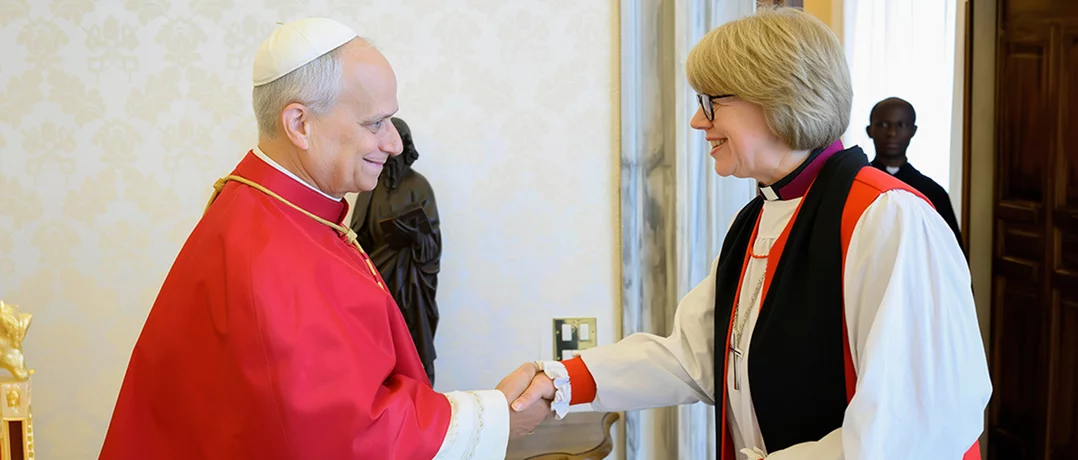
The recent meeting between Pope Leo XIV and Sarah Mullally, the Archbishop of Canterbury, at the Vatican stands as a defining moment in the evolving relationship between the Roman Catholic Church and the Anglican Communion.
Their joint prayer, held within the Apostolic Palace, was more than a ceremonial gesture; it symbolized a renewed commitment to dialogue despite deep-rooted theological and institutional differences. This encounter reflects both the enduring legacy of separation and the persistent hope for reconciliation.
The recent meeting with the pope and its significance
The meeting between Pope Leo XIV and Archbishop Mullally carried immense symbolic weight. After a private discussion, the two leaders prayed together in a rare display of unity between the heads of two historically divided Christian traditions. The Vatican described the moment simply as a “time of prayer,” yet its implications extend far beyond that modest characterization.
Pope Leo XIV acknowledged that relations between the two churches remain strained by both historical disputes and contemporary disagreements. Issues such as the ordination of women, authority within the Church, and broader questions of doctrine continue to separate Catholic and Anglican theology. Nevertheless, the pope reaffirmed his commitment to dialogue, insisting that Christians must continue striving for unity “no matter how intractable” these differences may appear. In doing so, he echoed the ecumenical vision of his predecessor, Pope Francis, who highlighted that division undermines the credibility of the Christian message.
For her part, Mullally framed the meeting within a broader moral context. She highlighted the responsibility of Christian leaders to address global crises, from war and poverty to social fragmentation, by presenting a unified message rooted in human dignity and compassion. Her remarks underscored a shared mission that transcends doctrinal divides, even as those divides remain unresolved.
The meeting also forms part of a wider pattern of symbolic rapprochement. Notably, the 2025 visit of King Charles III to the Vatican, during which he prayed alongside the pope, marked the first such event since the English Reformation in the 16th century (which began with King Henry VIII). Together, these gestures suggest a deliberate effort to cultivate visible unity, even in the absence of full theological agreement.
Equally significant is the timing of Mullally’s visit, which coincides with the 60th anniversary of the first formal ecumenical agreement between Anglicans and Catholics in 1966, whereby the Common Declaration was signed in Rome to advance unity between Anglican and Roman Catholic Churches. That milestone initiated decades of theological dialogue, yet progress has often been uneven. The current moment reflects both the achievements and the limitations of that long process.
The history of the Church of England
Understanding the significance of this encounter requires a return to the origins of the Anglican-Catholic divide.
The Church of England was born out of political necessity as much as theological conviction. In 1534, Henry VIII (known for his many wives) broke with the Roman Catholic Church after failing to secure an annulment of his marriage to his first wife, Catherine of Aragon. This act led to the establishment of a separate ecclesiastical authority under the English crown, formalized through the Act of Succession and Act of Supremacy.
The resulting church retained many elements of Catholic tradition, including episcopal governance and liturgical practices, while incorporating key aspects of Protestant theology. Over time, it developed a distinctive identity that sought to balance continuity and reform. The Book of Common Prayer became central to this identity, providing a unified framework for worship and doctrine.
The centuries that followed were marked by conflict and adaptation. The English Reformation, the English Civil Wars, and subsequent political transformations all shaped the Church of England’s development. By the modern era, it had emerged as both a national institution (closely tied to the British state) and the spiritual center of a global communion of autonomous churches.
Today, the Anglican Communion spans more than 100 million adherents across 165 countries. Unlike the Roman Catholic Church, it lacks a centralized authority; the Archbishop of Canterbury is regarded as “first among equals” rather than a supreme leader. This decentralized structure has allowed for diversity but has also made the communion more vulnerable to internal differences.
The election of the first female archbishop
The appointment of Sarah Mullally as Archbishop of Canterbury on 25 November 2025 marked a historic turning point in the evolution of the Church of England. While the ordination of women began relatively recently, female priests were first ordained in 1994 and female bishops in 2015, her elevation to the highest office represents a decisive break with centuries of exclusively male leadership.
Yet her appointment has also exposed deep fractures within the Anglican Communion. Many churches in Africa and other regions, aligned with conservative theological positions, have rejected the legitimacy of female leadership. Organizations such as Gafcon have warned that her appointment could accelerate a formal split within global Anglicanism. In contrast, supporters in the United Kingdom (UK) and elsewhere have celebrated her as a symbol of progress and inclusivity.
This internal debate mirrors the broader disagreements between Anglicanism and Catholicism. The Roman Catholic Church maintains a firm prohibition on the ordination of women, a position rooted in longstanding doctrinal interpretations. As a result, Mullally’s leadership presents both a challenge and an opportunity for ecumenical dialogue.
Hence, the meeting between Pope Leo XIV and Archbishop Sarah Mullally encapsulates the complexities of modern Christian unity. It is a recognition that, despite centuries of division, dialogue remains both possible and necessary.
Ultimately, the significance of this historic encounter lies not in any immediate resolution of differences, but in the willingness of both leaders to engage with honesty and perseverance. Their shared prayer serves as a reminder that, even in the face of enduring disagreements, the pursuit of unity remains an essential, and ongoing, endeavor.
-
-

-
The Beiruter
-
