A century after the Armenian Genocide, Lebanon stands as both refuge and testament to a people who rebuilt identity, memory, and influence from displacement.




A century after the Armenian Genocide, Lebanon stands as both refuge and testament to a people who rebuilt identity, memory, and influence from displacement.

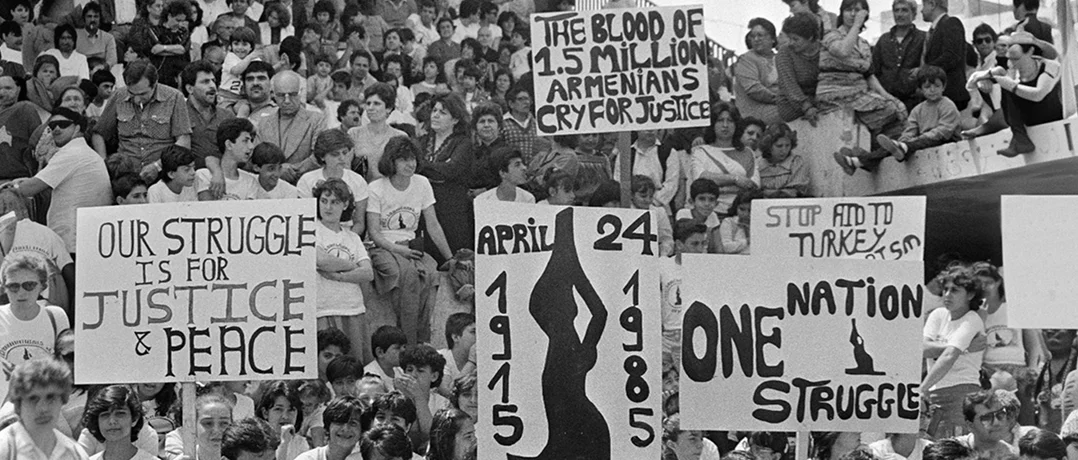
One of the world’s oldest peoples, Armenians built a distinct civilization in the highlands of Anatolia over 3,000 years ago, complete with churches, an early alphabet, and a deep literary tradition. Christian before much of Europe, they endured centuries of upheaval, from Persian and Arab rule to Mongol invasions, surviving with a profound resilience. Then, in the spring of 1915, a premeditated attack was made to exterminate the people of Armenia entirely.
On Armenian Genocide Remembrance Day, we honor the survivors who chose Lebanon, and the Lebanon that chose them back.
What followed was a methodical, state-led campaign of annihilation, carried out by the Ottoman Empire's Young Turk government during World War I, rooted in a vision of a homogeneous Turkish-Muslim state with no place for Armenians.
It began on April 24, 1915, with the arrest of around 250 Armenian intellectuals and leaders in Constantinople, most of whom were killed shortly after, effectively decapitating Armenian society. This was followed by the mass deportation of up to 1.2 million Armenians on death marches into the Syrian desert, where starvation, violence, and exposure were widespread and often deliberate. Women and children were routinely abused, and survival was grim.
By the end of the campaign, around 600,000 to 1.5 million Armenians had died, and over 90% of the Armenian population in eastern Anatolia had been wiped out or displaced. Estimates of the dead range from 600,000 to 1.5 million, and over 90% of the Armenian population in eastern Anatolia had been wiped out or displaced.
Raphael Lemkin, who coined the term “genocide” in 1944 was influenced by the Armenian case, which helped lay the groundwork for the UN Genocide Convention. The Armenians did not only suffer one of history's worst atrocities, they furnished humanity with the legal and moral vocabulary to name it.
Ambassador Henry Morgenthau, U.S. Ambassador to the Ottoman Empire, 1915, said it most eloquently,
I am confident that the whole history of the human race contains no such horrible episode as this.
Survivors of the genocide became stateless and scattered across the world, with many settling in Lebanon, the largest Armenian community in the Arab world. The first arrived in Beirut around 1917 after long journeys from Anatolia. French Mandate authorities initially placed them in quarantine in Karantina before relocating them to marshland east of the city, land few others wanted.
They rebuilt from nothing. By the late 1920s, they had purchased and developed this area into Bourj Hammoud, naming its streets after lost hometowns like New Sis and New Marash. Churches and schools were built first, often side by side, before proper housing, as survival meant preserving faith and education. Oral histories recall collective rebuilding efforts, priests and survivors pooling whatever they had. Some gave money. Some gave jewelry. Those with nothing offered their labor.
There, a street is named after the Arax River, the river that flows through Turkey, Armenia, and Iran, that borders the heartland of ancient Armenian civilization. Most of the people who walk that street today have never seen that river.
Within a generation, Bourj Hamoud had become one of the most densely populated neighborhoods in the Middle East, packed with tailors, jewelers, clockmakers, leather workers, doctors, and engineers. By the eve of Lebanon's civil war in 1975, the Armenian community had grown from a few thousand refugees to over 200,000 people, the largest Christian community in Beirut, holding an estimated 25% of all Lebanese bank deposits. Haigazian University, founded in 1955, was the only Armenian university outside Armenia. Beirut had become the undisputed intellectual and spiritual capital of the global Armenian diaspora.
Turkey still does not formally recognize the genocide. For the Armenian people, this denial is not merely a political irritant, it is a second wound, a century-long insistence that what happened to their grandparents did not happen. Lebanon, to its lasting credit, became in 1997 the first Arab country to officially recognize the genocide, and renewed that recognition in 2000. It is a small gesture against an enormous silence.
The Armenian community holds six parliamentary seats in Lebanon and has long played an outsized political role for its size. This influence is anchored in three main parties: the Dashnak, Ramgavar, and Hunchak, which maintain extensive networks of schools, media, and social institutions, giving the community rare internal cohesion within Lebanon’s sectarian system.
During the civil war, Armenians adopted a policy of “positive neutrality,” avoiding alignment with warring factions while coordinating across party lines to protect their people and institutions. This strategy largely preserved their neighborhoods and unity.
In the post-war period, Armenian political alliances have had measurable impact on national coalitions. Over time, the community has used disciplined voting power to secure representation and institutional guarantees, turning demographic minority status into sustained political leverage shaped by a deep historical awareness of vulnerability.
The Armenians carry their story with them, in a name, in a language, in the particular stubbornness of a people who have been told, more than once, that they no longer exist, and who have answered, every time, by continuing to exist.
No people simply vanish into silence; what is denied lingers, what is buried resurfaces, and what is true finds its way back into view. Justice may be delayed, truth may be contested, but neither is erased. In the end, they prevail. That is what survival looks like. That is what it means to refuse to disappear.