



As BAFF brings cinema beyond Beirut, Joze Piranian’s documentary turns inward, tracing a journey of silence, family and the courage to finally speak.
A return to what was left unsaid

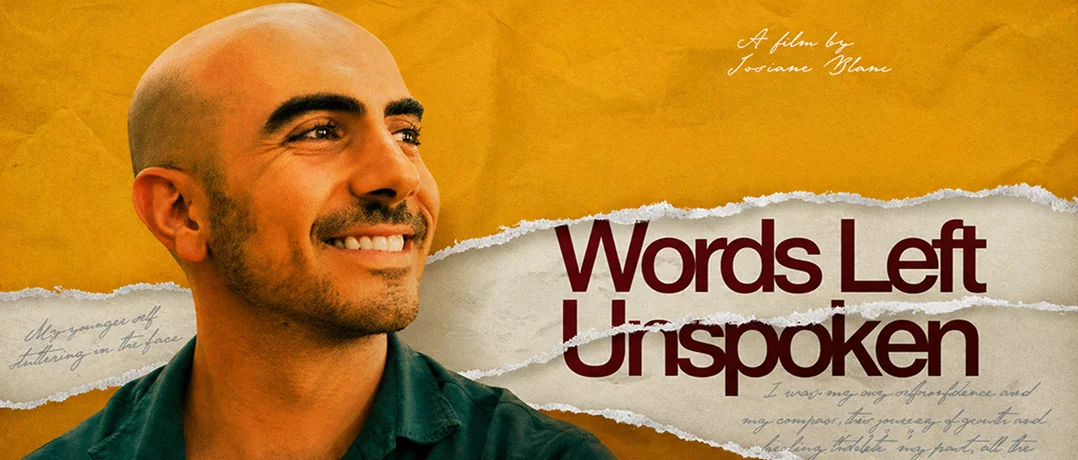
After months where screens went dark during the height of the war and public gatherings grew uncertain, the Beirut Art Film Festival (BAFF) returns, carrying a different weight with less routine programming than a reinstatement of public cultural life.
Across Lebanon, from Byblos to Deir el Qamar, Roumieh to Zahle, a film about silence is finding its way into public spaces. Screened in municipal libraries, cultural centers and small theaters, “Words Left Unspoken” is not settling in one place but moving deliberately, stopping in towns like Jezzine, Mtein, Zgharta and Zouk Mkayel. Part of the BAFF “United in Heritage” program, this nationwide tour transforms the documentary into something shared, showing not on a single screen but across a map of encounters, where each stop invites a different audience into the same intimate reckoning.
The film, directed by Josiane Blanc follows Joze Piranian, a Toronto-based keynote speaker, stand-up comedian and author, traveling back to Lebanon to confront the life he spent in silence because of his severe stutter. The man who spent more than two decades without speaking returns to his family, his memories and the places where his voice first receded.
A film that belongs outside Beirut
For Alice Mogabgab, BAFF’s artistic director, the decision to include “Words Left Unspoken” in the touring program was instinctive. “Because it is about heritage,” she says, before widening the frame. The screenings fall under BAFF’s long-standing effort to move cinema beyond Beirut and into regions with their own cultural rhythms and audiences. “From the beginning, the idea was to go to places that already have cultural life,” she explains. “This is very important for us.”
In this context, heritage expands beyond monuments or landscapes. It becomes something more fragile and interior, carried in relationships, in language, in the silences that shape how people grow and connect. By bringing the film into libraries, municipal halls and cultural spaces, BAFF leans into proximity, into the idea that certain stories resonate more deeply when encountered close to home.
Returning to where it began
For Piranian, returning to Lebanon was not symbolic; it was necessary. “Growth and healing are not the same,” he says.
Growth is implementing a new behavior in a new environment. Healing is implementing a new behavior in the old environment, often where the struggle began.
After years spent building a public voice abroad, his return becomes an attempt at something more difficult than progress: confrontation. Conversations with his family, long avoided, take on a different weight when held face-to-face. “To experience any real sense of closure, which is a process and not a single moment, I felt I had to return to the original scene,” he explains.
The film traces this movement patiently. There is no dramatic rupture, no single turning point. Instead, it is shown through fragments, pauses, hesitations, attempts that slowly accumulate into something softer and more enduring.
The weight of what is unsaid
The hardest conversations, he admits, were with those closest to him. “I had built up a story in my head that they might shut down, interrupt or walk away,” he says. “Instead, they leaned in. They were open. Afterward, we all felt lighter.”
“Words Left Unspoken” lingers in that space where silence is not empty; it is dense with assumptions and fears. For much of his life, silence functioned as protection. “If I avoided speaking, I avoided stuttering. If I avoided stuttering, I avoided people’s reactions,” he says. However, that same silence became limiting, shaping how he moved through the world and how he saw himself.
Today, his understanding has changed. Silence is no longer something to escape entirely; it is something to redefine.
There is a version of it that is intentional and even powerful, but it is no longer rooted in fear.
A beginning disguised as an ending
What gives the film its intensity is not only the act of speaking but where it happens. Performing stand-up in Lebanon, in the same environment where silence first took hold, becomes a form of reversal. “It was the moment where taking action replaced holding back in the very place where that pattern was first formed,” Piranian says.
Fear, the film suggests, does not disappear; it shifts. “My public voice does not mean the fear is gone,” he says. “It means I have learned to act despite it.” The tension remains, but it no longer dictates the outcome.
Piranian describes the documentary as both a closure and a beginning. “Closure is not a finish line,” he says. “It is an ongoing process. But it has to begin somewhere.”
As “Words Left Unspoken” continues its journey across Lebanon, it carries that same proposition. Not resolution, but initiation. Not answers, but the possibility of asking.
And in rooms scattered across the country, in Byblos, in Zahle, in Zgharta, in places where audiences gather for an hour and then return to their lives, the film leaves behind: the sense that what remains unsaid does not disappear, it waits.
-
-
-
Rayanne TawilCultural writer
-
