Ain Ebel, one of southern Lebanon's oldest Christian villages, continues to preserve its history, faith and identity as residents choose to remain on their land despite war, displacement and ongoing security restrictions.




Ain Ebel, one of southern Lebanon's oldest Christian villages, continues to preserve its history, faith and identity as residents choose to remain on their land despite war, displacement and ongoing security restrictions.

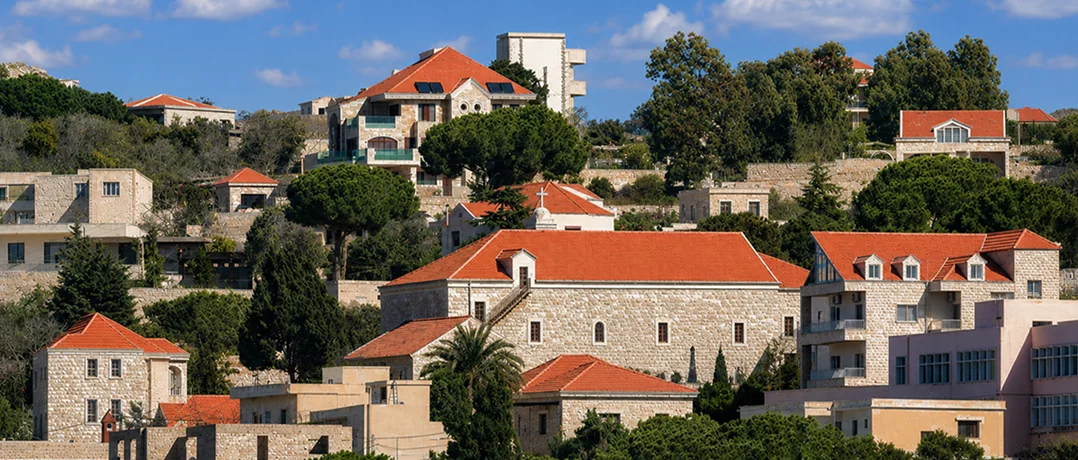
Only a few kilometers from the Israeli border, sits Ain Ebel, one of the oldest continuously inhabited Christian villages in southern Lebanon. Surrounded by olive groves, vineyards, and pine forest, it has weathered empires, wars, and waves of displacement while holding onto a powerfully rooted identity.
The name "Ain Ebel" comes from Semitic roots: Ain means spring, and Ebel (or Ibl) is generally read as "irrigation," giving the village its poetic title, "the spring of irrigation." A rival etymology, favored by historians like Joseph Toufik Khoreich and Taissier Khalaf, traces "Ebel" to an Aramaic word for hermit or monk, "Spring of the Monk", hinting at an early Christian ascetic presence in the wider region of Jabal Amel long before the village took its modern shape.
Archaeological traces around the village, including Neolithic tools found in the nearby Wadi Koura and ancient graves unearthed by 19th-century French scholar Ernest Renan, point to settlement stretching back millennia. But the Ain Ebel known today largely traces its Christian, Maronite character to the 16th and 17th centuries, when families from Mount Lebanon migrated south to farm feudal lands, a movement that intensified under Fakhr al-Din II, the emir credited with uniting much of present-day Lebanon and forging alliances with the Maronite community.
Speaking six months into the renewed war, Mayor Ayoub Khreish described a period that has been, in his words, "difficult, and still difficult." Ain Ebel sits encircled by Bint Jbeil, Yaroun, and Tiri, "all three of these areas were heavily involved in the fighting," he told The Beiruter. From the war's earliest days, the village made a decision, "we didn't want anyone from outside entering the village's land," meaning any armed person, "because we knew that if armed men entered our village and fired from here, they would immediately strike us." Young men began keeping watch at night, and residents tracked unfamiliar cars through the village.
The hardest moment, Khreish said, came when the Lebanese Army withdrew from the area. "That was the worst thing that happened, that we were left without the Lebanese Army and without state protection, if you will. And we were caught between the two sides, between the yellow and the blue." When Israeli forces then ordered the roughly 1,800 residents to evacuate entirely, the village refused. "We told them we weren't going to leave," he said. "Our priest was with me in this; we said we wanted to stay under the protection of the church, and if they wanted to strike us, then let God decide what happens."
The partial compromise that followed, confinement to the village's northern half for roughly two to three months, still came at a cost: "When they saw how determined we were to stay in our village, they told us we could stay in half of the village only."
Even now, Khreish said, restriction defines daily life. "When the war ends, people have many needs. Someone needs to go to the doctor, someone needs to go to Beirut, someone needs work. And we're trapped." Ain Ebel remains inside what residents call the "yellow zone”. "If we want to leave, we need a permit, and if we want to enter, we need a permit. We can't enter without authorization from the UN, or Caritas, or someone."
State reconstruction has bypassed the village entirely, he said. "The state has started, for example, repairing the electricity network and repairing the water network. But in the yellow zone, that's not allowed. The state can't enter here. They haven't really taken care of us at all. We're still buying fuel, we're still operating our own motors, we're still pumping water for people, and we're still collecting the garbage. We're basically doing everything instead of the state." He asked, simply: "How long can we keep going like this?"
Khreish singled out the Church for its support through the crisis: "The church stood by our side.. Without them, we would have been completely helpless."
He hopes the Feast of the Assumption can be marked properly this year, calling it something that "really lifts our spirits," because, as he put it, "people have become exhausted. They need something to lift their spirits again." Much of the community's energy now goes toward its children, "The most important thing we're doing now is organizing activities for the children, because the children have been confined for six months."
Père Hanna Sleiman: "This land is holy”
Père Hanna Sleiman, situated Ain Ebel's endurance within a longer memory. "People came to the village around 1936, approximately," he said, tracing the founding families to the era of Fakhr al-Din, when settlers arrived "mainly from Hadath al-Jebbeh, Hasroun." At the time, he said, "the village was still a very small place, almost like a farm. Then people settled there and stayed, and we're still here today."
He described the village's transformation in a few lines, “A small number of people came, and then people began marrying and having children. And the village became what it is today. It transformed from a small village into the 'Bride of the South.'" That status, he said, owed something to geography, "we're a tourist area, and the village is located on elevated hills". "Before that, the entire Jabal Amel region didn't really have restaurants and cafés. We had restaurants and casinos, and these were among the first in the area." That era ended, he said, "around the time of the Lebanese events that began in 1975," though the village later regained a hotel and now has two tourism complexes.
Its newest landmark, still under construction, is a Marian shrine on the village's highest hill. "Today, the village is building a tower for the Virgin Mary and a shrine to Our Lady of Light on the highest hill in the village. I believe this is the highest Marian shrine in the East," he said. "We're building a tower that is 60 to 70 meters high, with a four-meter statue of the Virgin Mary on top." The statue was built by the village itself, "we had finished the construction, and then the events happened while we were transporting the statue. We had made it ourselves and were preparing to install it." He added, "once things settle down, we'll put it up and complete what we started, God willing."
Asked about the village's refusal to leave through successive wars, Père Sleiman gave two reasons. "First of all, we say that this village is holy land. The feet of Jesus, the Virgin Mary, and the saints have walked upon it." And second, "this land is mixed with the blood of our fathers, grandfathers, and martyrs, who built this village through the sweat of their brows. They built it into a village and gave their blood for it. And we have paid the price for Lebanon since 1920, for the sake of Greater Lebanon. More than a hundred martyrs died for this village and for defending it."
He closed with the village's pattern across each war: "The village was displaced and then returned to. In 2006, we refused to leave. In 2023, we refused to leave. And in 2026, we refused to leave. And for as long as God gives us life, we will not leave this village."
Ain Ebel has survived because its people have always treated staying as more than a choice. Through displacement, war, and uncertainty, the village remains tied to the land, its church, and the generations that built it. Today, despite restrictions and exhaustion, its residents continue to rebuild, care for their children, and look toward a future they still believe belongs here. In Ain Ebel, staying is a way of preserving a history that its people believe must continue.