



Al Qoubaiyat the Christian capital of Akkar

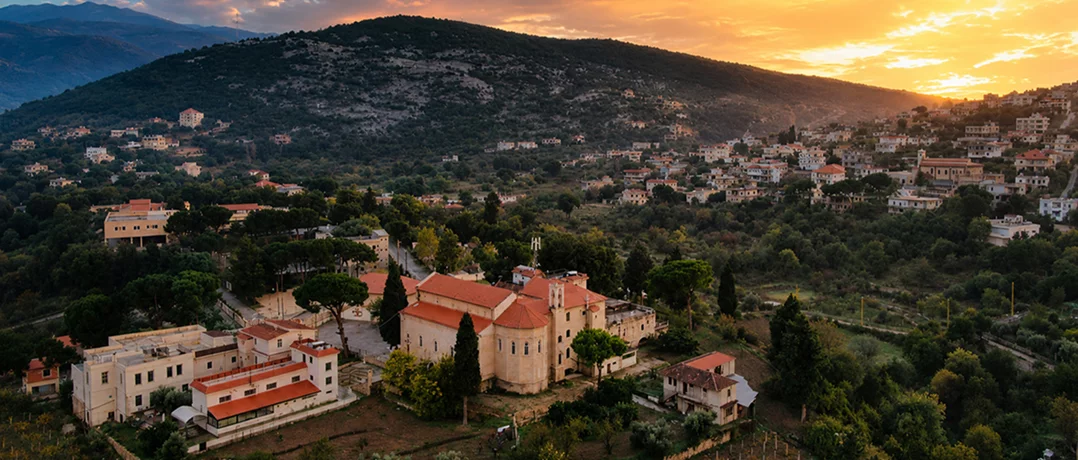
In a fertile mountain valley in northeastern Lebanon, Al Qoubaiyat, also spelled Kobayat, is the largest Christian village in the Akkar Governorate, and one of the most historically layered communities in the country's north. With a civil registry population of roughly 12,000 to 15,000, predominantly Maronite, the village has served as Akkar's Christian anchor since Ottoman times, even as its winter population shrinks to a fraction of that number when residents retreat from the snow.
A name written in water
Al Qoubaiyat's Aramaic name reflects its defining resource. The word "Qbayya" means a large pool of water, and "Qbayyat" its plural, a fitting name for a region historians describe as unusually rich in springs, ponds, and streams. That abundance made the valley a magnet for settlement across millennia, long before the modern village took shape. Archaeological remains scattered through the area, cemeteries and ruins dating to the Bronze and Iron Ages, some 3,000 years old, point to continuous habitation stretching back to Phoenician times. Positioned along ancient trade routes linking the eastern Mediterranean toward Rome, the valley functioned for centuries as a corridor between East and West, a geography that shaped its economy of agriculture, silk, and trade long before it became known primarily as a Christian stronghold.
From Ottoman tax rolls to French Mandate
Al Qoubaiyat's documented history as a defined settlement begins in earnest in the 17th century, when its name started appearing in the legislative court records of Tripoli as the largest village in Akkar subject to Ottoman taxes. By the Ottoman era, it had already become the district's biggest population center, a status that led to the establishment of one of Akkar's first municipalities in 1912. When the French Mandate began a decade later, Al Qoubaiyat was elevated further, becoming the administrative center of its own qaimaqamiya (sub-district). Though Akkar was later reunified under a single administration based elsewhere, Al Qoubaiyat retained its role as a municipal and institutional hub, today hosting a courthouse, civil registry, police station, public clinic, and post office, infrastructure disproportionate to a village its size, a legacy of its historic administrative weight.
A French consul touring Lebanon in 1912 described the valley's fertility as nothing short of astonishing, a remark still echoed by locals who point to the terraced orchards and irrigated fields that define the landscape today.
Faith at the center
Religious life in Al Qoubaiyat runs deep, anchored by institutions like St. Doumit Monastery, a Carmelite monastery built in 1835 on the site of an older church after a land donation by Jabbour Seif Hobeich. Ancient artifacts uncovered during its construction were reportedly sold to help fund the new building, a detail that speaks to how thoroughly layered the village's history is beneath its visible surface. The church seen today dates to 1852 and was remodeled in Neo-Gothic style in 1914; the Carmelite mission that built it went on to found a school that shaped generations of local education. Elsewhere in the village, numerous Maronite churches and shrines dot its several quarters, Al-Qoubaiyat proper, Al-Gharbiyé, and Martmoura among them, reflecting a communal life still centered on parish and feast rather than any single town square.
War and its long shadow
Like much of Christian Lebanon, Al Qoubaiyat was shaped by the civil war that began in 1975. Village sons joined Christian militias, defending northern Christian areas against Syrian and rival factions; some died in the conflict's final years. That period also left a more complicated inheritance, filmmakers and local chroniclers have noted how the war eroded an older memory in the village, one in which Muslim neighbors from surrounding areas had once helped protect Kobayat's monastery, a solidarity that sectarian violence gradually pushed into the background of local memory, even as it isn't entirely forgotten.
A mountain village today
Modern Al Qoubaiyat leans into its geography as much as its history. Spanning some 70 square kilometers and ranging from roughly 550 to 1,900 meters in elevation, it has become a hub for outdoor activities in Akkar, including hiking, camping, mountain biking and off-roading in summer, as well as skiing on its higher peaks in winter. Nearby forests, springs, and valley trails draw both returning villagers and outside visitors, feeding a modest but growing tourism economy that complements the agriculture the valley has supported for millennia.
But it is the older story, of water, trade routes, monasteries, and a community that has anchored Akkar's Christian presence since Ottoman tax rolls first recorded its name, that residents most often point to when asked what makes Al Qoubaiyat different from the villages around it.
-
-

-
Jenna GeageaReporter/Writer
-
