



The long-term effects of alcoholism extend beyond drinking itself, shaping grief, relationships, identity and recovery long after the addiction begins or ends.
Alcoholism, recovery, and what remains

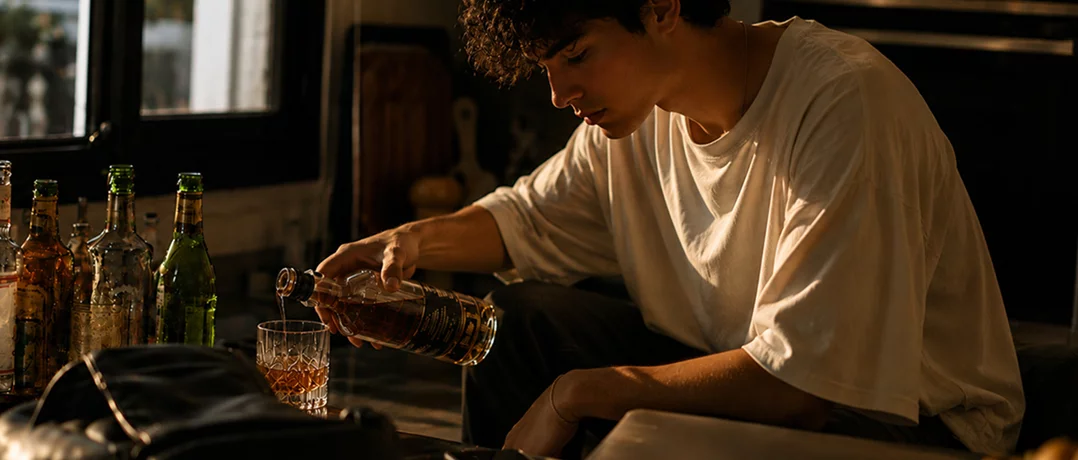
Alcoholism rarely tells a single story. For some, it ends in sobriety hard-won after years of relapse. For others, it never resolves at all, leaving behind an absence with no shape. Three people, at three very different points along that spectrum, describe what addiction actually costs, and what, if anything, can be rebuilt afterward.
Henry, 50: "I was wasting the life he didn't get to have"
For Henry, drinking began the day his twin brother died of a sudden heart attack. "He was the person who had been beside me since before either of us knew what life was," he said. "I drank because I wanted the noise to stop." What started as grief slowly lost its justification. "In the beginning, everyone thinks they're making a choice. I told myself, 'I'm drinking because I'm grieving.' Then eventually I didn't need a reason."
The cost accumulated. "I lost jobs. I lied to people I loved. I missed birthdays. I missed weddings... I became very good at disappearing while technically being there." Multiple attempts at rehab failed before something shifted at 40. "I finally understood that I was running out of time... My brother was gone. I couldn't bring him back. But I was still alive, and I was wasting the life he didn't get to have."
Ten years sober now, Henry resists the idea that recovery erases what came before. "There are relationships I damaged that never came back." What changed isn't the grief itself, but his relationship to it. "Before, I drank to avoid grief. Now I let myself feel it. You can survive a feeling without escaping it." His guiding principle remains modest by design: "I don't tell myself, 'I'm cured.' I tell myself, 'I'm sober today.'"
Miriam, 62: "we lost him while he was still alive"
Miriam's story has no resolution yet. Watching her son's drinking escalate, she described becoming, in her words, "a detective in your own home", reading footsteps, breath, and silence for signs of how bad the night had been. "Our lives started revolving around a person who wasn't really participating in them anymore," she said.
The turning point came gradually, then all at once. "I remember looking at him and realizing I was afraid of my own son. That broke something inside me... This was the little boy who used to sleep with his head on my shoulder." After a final fight, he left with a bag of clothes and never returned. "I don't know where my son sleeps. I don't know if he's alive. And every time my phone rings from an unknown number, my heart stops for a second."
Miriam carries guilt she knows isn't rational, but can't fully release. "They tell me addiction is a disease, that I did everything I could. But mothers don't think like that." What lingers most isn't just grief, but its ambiguity. "When someone dies, there is a funeral. There is a grave... I don't have that." Asked what she'd say if he were listening, her answer was unconditional: "I wouldn't ask him to apologize. I'd just tell him to come home. Even if he isn't sober. Even if he has nothing... I would tell him that his mother is still here."
Sara, 29: "I'm scared of who I'll be when I leave"
Sara's story is still being written from inside its first chapter, as she recently checked herself into rehab. She describes years of renegotiating her own definition of the problem. "I kept moving the line... I was measuring my drinking against the worst possible version of alcoholism just so I could convince myself I wasn't there yet." The moment she recognized she'd lost control was starkly simple, "I don't want another drink. But I also knew I was going to have one. That's when I realized I wasn't making the decision anymore. The alcohol was."
What she was drinking to escape, she says, was mostly herself. "Alcohol gave me a few hours where I didn't have to be anyone. But then the next morning, everything was still there. Except now there was shame on top of it." The losses she grieves most are cumulative, "Time... entire nights I don't remember."
Early in recovery, her fear is the long road afterward. "I'm scared I'll leave here, stay sober for a few months, and then convince myself I'm okay again... Even good days scare me because I used to celebrate with alcohol." She's already revising what recovery even means. "People imagine recovery as getting your old life back. I'm starting to think it's actually about building a different one." Asked what she'd tell herself a year from now, "I'd ask her if she stayed... Today, I stayed. Tomorrow, I'll try to do it again."
Three versions of the same disease
Henry's decade of sobriety, Miriam's unresolved absence, and Sara's fragile first steps describe the same disease from three entirely different vantage points, recovered, waiting, and beginning. None of their stories end neatly. Henry still carries fear alongside sobriety. Miriam carries love with nowhere to send it. Sara carries a single day at a time, refusing to promise more than that. Together, they suggest that alcoholism is a story that people learn, or struggle, to keep living inside of.
-
-

-
Jenna GeageaReporter/Writer
-
