



Lebanese para-athlete Arz Zahreddine has turned cutting-edge prosthetic technology, relentless discipline and self-financed determination into a career among the world’s fastest para-sprinters.
Arz Zahreddine’s pursuit of the extraordinary
Arz Zahreddine’s pursuit of the extraordinary
By Jenna Geagea | September 22, 2026

Reading time 4 min
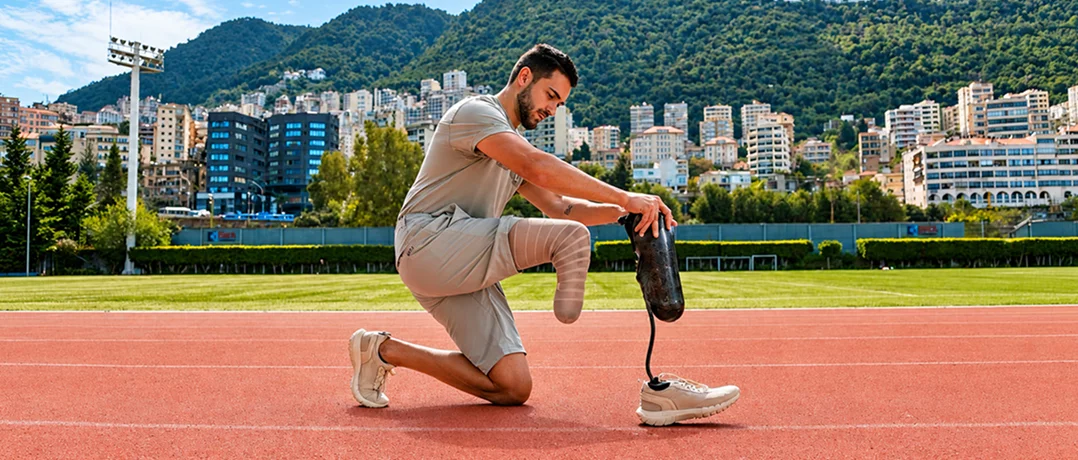
At the age of three, a grave accident cost Arz Zahreddine his right leg. Now approaching 28, he ranks among the eight fastest para-athletes in the world and is the third-fastest in Asia.
“All the big entrepreneurs have something in common that allows them to get ahead of the world,” Zahreddine told The Beiruter, recalling the insight that reshaped his athletic career. “I found that through technology. So I thought, how can I get ahead of my time?”
His answer was a high-end carbon prosthetic leg - technology designed not only to restore mobility, but to help him outrun the clock itself.
A journey from fencing to the track
Before sprinting became his calling, Zahreddine found his way into competitive sport almost by chance. At seven, while doing homework, he turned to his mother with a simple question: what is fencing, and is it available in Lebanon?
That curiosity launched a career in which he became the only Lebanese athlete with an amputation to compete internationally against able-bodied fencers, amassing roughly fourteen medals, gold, silver and bronze, across World and Arab Championships.
Behind those results lay a considerable physical toll, including nineteen surgeries, often prompted by fragments of his prosthesis working loose each time he bent his leg.
By 2018, drawn toward sports management and a growing fascination with technology's competitive edge, he pivoted entirely. Fencing gave way to sprinting. His first race came mid-year in Lebanon, and within months he had qualified directly for the Asian Games in Indonesia.
What distinguishes Zahreddine's rise is his principle. He refused to accept a wildcard invitation to major competitions, the route many national federations use to fill remaining Olympic or Paralympic slots.
"I do not want to put on my CV that I went as a wildcard," he stated plainly. Instead, in 2019, he traveled to Italy, took first and second place in the 100 and 200 meters, and met the qualifying standard outright, earning his place at both the World Championships and the Tokyo Paralympic Games on merit alone.
Today he holds international records across the Arab world, West Asia and the Francophone Games, with his primary specialty resting in the 200 meters. A late addition to the 400 meters at the West Asia Championships, made at his coach's urging, unexpectedly secured him qualification for that distance as well, hence he now prepares to compete in the 100, 200 and 400 meters at the Asian Games within a matter of weeks.
Building a self-financed independent operation
Zahreddine's athletic career resembles a self-financed enterprise. Unaffiliated with any Lebanese club, he assembled his own team consisting of a former Olympic coach, a hypnotherapist, a sports psychologist, a dietician, a physiotherapist, a medical team, and a media and marketing unit. Training regularly takes him abroad, including stints at INSEP in Paris, the world's top-ranked national training center, reserved for athletes among the global top ten.
That professionalism has been forged against considerable adversity. He identified three defining hindrances that impacted his life. Following the Beirut explosion, his coach left the country which disrupted his training continuity.
He then suffered a Grade 2 micro-tear of the Achilles tendon, the product of prior overtraining, which cost him a season and a half. Finally, the most poignant of all is the persistent funding instability tied to Lebanon's broader economic turmoil. By his own account, he remains the most well-funded para-athlete from his country, yet still operates on a fraction of the roughly $300,000 annual budget enjoyed by Asia's top-ranked competitors.
Emotional support, in the conventional sense, holds little appeal for him. "Motivation is a universal scam," he remarked, framing his career as a business with tasks to complete and medals to secure, regardless of how he feels on a given day. His prosthetic technician, Pierre Tannoury, and his coach and mentor, Ahmad Hazer, form the backbone of a support system built on technical precision rather than encouragement.
Looking toward Los Angeles
His ambitions ahead are unambiguous. 2027 the Games in Armenia and the World Championships in Uzbekistan, where he intends to become the first Lebanese athlete to medal at a world event, alongside setting another record at the Francophone Games.
Beyond that lies the 2028 Los Angeles Paralympics, his third Games, where the goal is to qualify and to medal. His outlook for the years beyond is characteristically bold, nothing short of holding every relevant international record in his category. "Remember this," he insisted as the conversation drew to a close.
Zahreddine’s prosthesis may have changed the mechanics of how he runs, but it is his insistence on treating every element of his career as something to be engineered, financed and refined that has carried him through sports and through life.
-
-

-
Jenna GeageaReporter/Writer
-
