



At the Rachid Karami International Fair, thousands gathered for Haru Matsuri. During this two-day anime festival, cosplay, Japanese pop culture and community transformed one of Lebanon’s most iconic spaces into something entirely unexpected.
Attack on Tripoli: Anime fans take over the fairgrounds
Attack on Tripoli: Anime fans take over the fairgrounds
By Rayanne Tawil | May 18, 2026

Reading time: 5 min
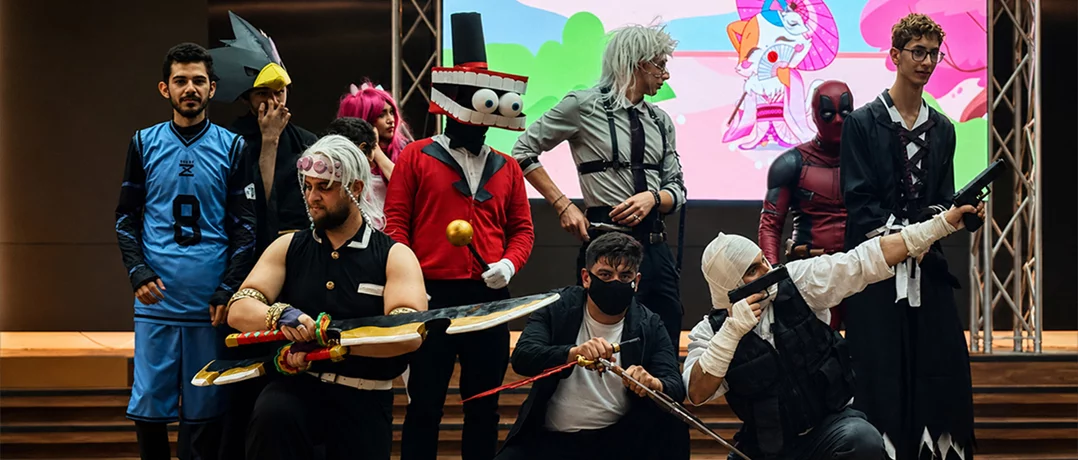
This Saturday, the wide concrete walkways of the Rachid Karami International Fair (RKIF) looked nothing like the Tripoli most people think they know. Teenagers in elaborate wigs posed beside families carrying bubble tea. Someone dressed as Deadpool walked past a child holding a cardboard katana. Anime soundtracks drifted across the fairgrounds while rows of booths sold manga prints, handmade jewelry, Japanese snacks, trading cards and crocheted characters with giant embroidered eyes.
Near the stage, a crowd gathered for the cosplay parade. Some costumes had taken months to prepare. Others were improvised with foam armor, stitched fabrics and carefully painted props. Every few minutes, someone stopped for a photo. Nobody seemed embarrassed by any of it.
For two days, Haru Matsuri, organized by Kaliko.friends, transformed the fair into Lebanon’s largest anime gathering, pulling visitors from Beirut, Saida, Baalbek and beyond.
“We expected around 200 people in the first Tripoli edition,” said co-founder Moustapha Zakkour. “Around 650 showed up.”
Eight years after Kaliko first began organizing anime conventions in Lebanon, the festival has grown from a small community initiative into a sprawling cultural event filled with tournaments, cosplay competitions, karaoke, workshops and Japanese lantern ceremonies. This year’s edition stretched across the open-air grounds of the fair with a scale that even longtime attendees seemed surprised by.
Built by fans, carried by volunteers
Kaliko did not begin as a company with investors or institutional support. Angie Zakkour, co-founder of Kaliko and also known inside the community as Malak, started it eight years ago as a tiny anime-themed store in Beirut.
“When Moustapha and I got married, he convinced me to make events,” she said, laughing while rushing between volunteers and stage organizers. “It was scary because it’s not easy for people to understand the anime community. I was surprised people accepted it in a really nice way.”
Anime has been a part of her life since childhood. “It was a dream since I was a child to work in something related to anime,” she said. “I was watching conventions in America and Saudi Arabia and asking myself: why not Lebanon?”
That question slowly turned into a network. Today, Kaliko runs events year-round, from cinema screenings to community meetups. Haru Matsuri alone relies on more than 100 volunteers.
“Without them, nothing would happen,” Angie said. “It’s not just us anymore. It’s a whole community together.”
Some people help with logistics, photography, crowd management, or even costume competitions. The ages are from teenagers to adults in their thirties and that kind of mix feels natural.
Riham Salem, an artist volunteering at the festival while running her own booth, described the atmosphere as something people genuinely need right now. “People always look for something to change their mood,” she said while fixing wind-blown prints with duct tape. “Lebanese people create happiness out of depression.”
The SpaceToon generation grew up
For many attendees, Haru Matsuri feels less like discovering anime and more like returning to something that never fully left them.
“It started with SpaceToon,” Moustapha said, referring to the Arabic children’s television channel that introduced generations across the Arab world to Japanese animation. “People watched Dragon Ball, Naruto, One Piece, then later searched for more online.”
According to him, anime culture exploded internationally after 2019, when streaming platforms expanded their anime catalogs during the COVID-19 lockdown years. Lebanon followed the same wave.
Inside the festival, that generational nostalgia blended with newer internet fandoms. One booth sold Yu-Gi-Oh cards while another displayed matcha desserts beside handmade anime figurines. Cosplayers moved easily between Japanese anime characters and Western pop culture icons like Rick and Morty or Star Wars villains.
Karim Dagher, attending the Tripoli edition for the first time, wandered between booths carrying newly purchased collectibles. “It’s a gathering of people that love anime and other media,” he said. “It shows this is bigger than people expect.”
Nearby, Marc Dahan stood beside friends comparing trading cards. “Most people here have the same obsessions,” he joked. “So we all recognize each other.”
That sense of recognition seems to be what keeps the festival growing. People arrive from different cities already connected through online fandoms, gaming communities and cosplay groups. Haru Matsuri gives those digital worlds a physical place to exist.
Reviving the fair through pop culture
The setting itself became part of the experience. Designed by Brazilian architect Oscar Niemeyer, the RKIF has long stood as one of Lebanon’s most striking modernist landmarks. Haru Matsuri gave it a completely different rhythm.
“What was remarkable was the diversity of participants,” said Hani Chaarani, director of the fair. “Families, students, artists, cosplayers, young people coming from different regions of Lebanon.”
For Chaarani, the festival reflects a larger effort to reactivate the fair through contemporary cultural events targeting younger audiences. “Heritage cannot survive as a frozen monument,” he said. “It must remain alive and connected to society.”
That connection became visible everywhere across the grounds. Teenagers filmed TikToks beneath Niemeyer’s arches. Families sat eating ramen on the concrete steps. Groups of friends rested in cosplay makeup while waiting for the next competition.
Moustapha believes Tripoli gives the festival something Beirut cannot. “In Beirut, there are always events,” he explained. “In Tripoli, when something like this happens, people get more excited.”
The venue also allows the festival to expand outward rather than inward. Previous editions in Beirut relied heavily on indoor halls. Here, visitors moved freely between open-air food courts, gaming zones and stage performances beneath the evening sky.
As sunset approached on Sunday, the crowd gathered for the lantern ceremony Angie had mentioned all weekend. Pink light spread slowly across the fairgrounds as anime music echoed from the stage behind them, while holding glowing paper lanterns against the darkening Tripoli sky.
-
-

-
Rayanne TawilCultural writer
-
