



In the second installment of a three-part investigation, The Beiruter traces how political mobilization, Hezbollah’s rise, and decades of war transformed Dahiyeh into one of Lebanon’s most politically charged places.
Becoming Dahiyeh: The political symbol

In July 1983, eight years into Lebanon's civil war, As-Safir, one of Lebanon's leading Arabic-language newspapers, devoted an extensive dossier to Beirut's southern suburbs.
Its headline gave Dahiyeh striking national scale: “The Southern Suburb... One Quarter of the Nation.”
The report documented wartime displacement alongside rapid population growth and investment, as schools, hospitals, and public services struggled to keep pace.
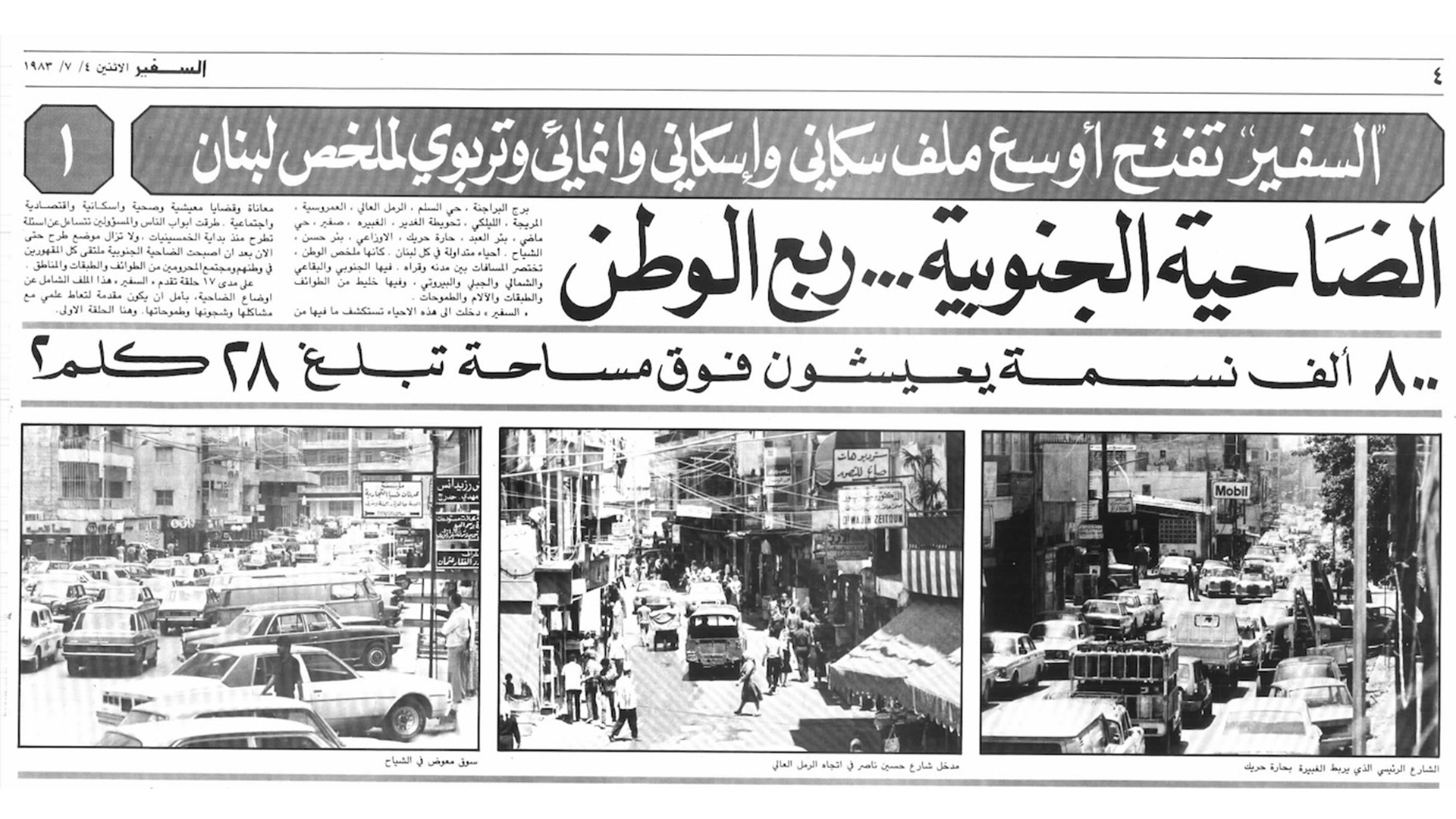
1983 As-Safir special report, "The Southern Suburb... One Quarter of the Nation." Archival material from UMAM Documentation & Research's 2007 exhibition, "Collecting Dahiyeh."
The dossier appeared at a turning point in Lebanon's Shiite politics. Israel had invaded Lebanon the previous year. Imam Musa al-Sadr had disappeared in Libya five years earlier, after founding the political movement that developed into Amal. Within Lebanon's Shiite community, meanwhile, a new organization backed by Iran and committed to its doctrine of velayat-e faqih was beginning to coalesce.
That organization was Hezbollah.
In 1983, however, Amal remained the dominant Shiite political movement, and Hezbollah had yet to acquire the position in Lebanese politics, or in Dahiyeh, that it would hold in the years to come.
Over the next four decades, that balance would change dramatically. Hezbollah would develop a substantial political, institutional and security presence in the southern suburbs, while repeated Israeli military campaigns would make Dahiyeh a recurring battlefield. After the 2006 war, Hezbollah would use its extensive role in compensation and reconstruction to deepen its institutional presence in the southern suburbs, while the destruction of Dahiyeh would lend the area’s name to a concept debated within Israeli military strategy.
Hezbollah’s eventual dominance in Dahiyeh can make that trajectory appear inevitable. It was not.
Dahiyeh’s political history began well before Hezbollah’s creation. Understanding that history helps explain how the area acquired one of Lebanon’s most politically charged place names.
Before Hezbollah, a new Shiite politics
The political mobilization of Lebanon’s Shiite population preceded Hezbollah by decades.
During the 1950s and 1960s, Shiites participated across Lebanon’s existing political currents, including Arab nationalist and leftist movements. By the late 1960s, however, Imam Musa al-Sadr was building a political project centered more explicitly on the position of Lebanon’s Shiite communities.
Al-Sadr arrived in Tyre in 1959 and a decade later became the first head of the Supreme Islamic Shiite Council. Political scientist Samir Nasr identifies 1969 as the beginning of a new phase of Shiite political organization, with mobilization intensifying between 1973 and 1975.
Al-Sadr increasingly directed that political organization toward demands on the Lebanese state. In 1973, the council presented the government with 16 demands and threatened political action if they were not addressed. By 1974, he had established Harakat al-Mahrumin, the Movement of the Deprived, presenting deprivation as a national cause extending beyond the Shiite community.
The movement challenged established Shiite political families, including the Asaad family in the south and the Hamadeh family in the Bekaa, while competing with leftist parties for support. By 1975, Nasr wrote, it had become the Shiite community's most significant mass organization.
Amal developed from that mobilization, establishing a military wing in 1975. After al-Sadr disappeared in Libya in 1978, it developed into a major Shiite militia and political force under Nabih Berri, its leader since 1980 and Lebanon's Parliament speaker since 1992.
The movement acquired particular significance in Beirut’s southern suburbs, where migration from South Lebanon and the Bekaa had created a growing Shiite constituency with enduring ties to those regions.
Writing in 1983, As-Safir recalled the different names that had become associated with the area, including “the suburb of the deprived,” a designation it linked to al-Sadr’s movement. The phrase carried the political language of the Movement of the Deprived into Beirut’s southern outskirts, where many of the inequalities around which al-Sadr had mobilized were especially visible.
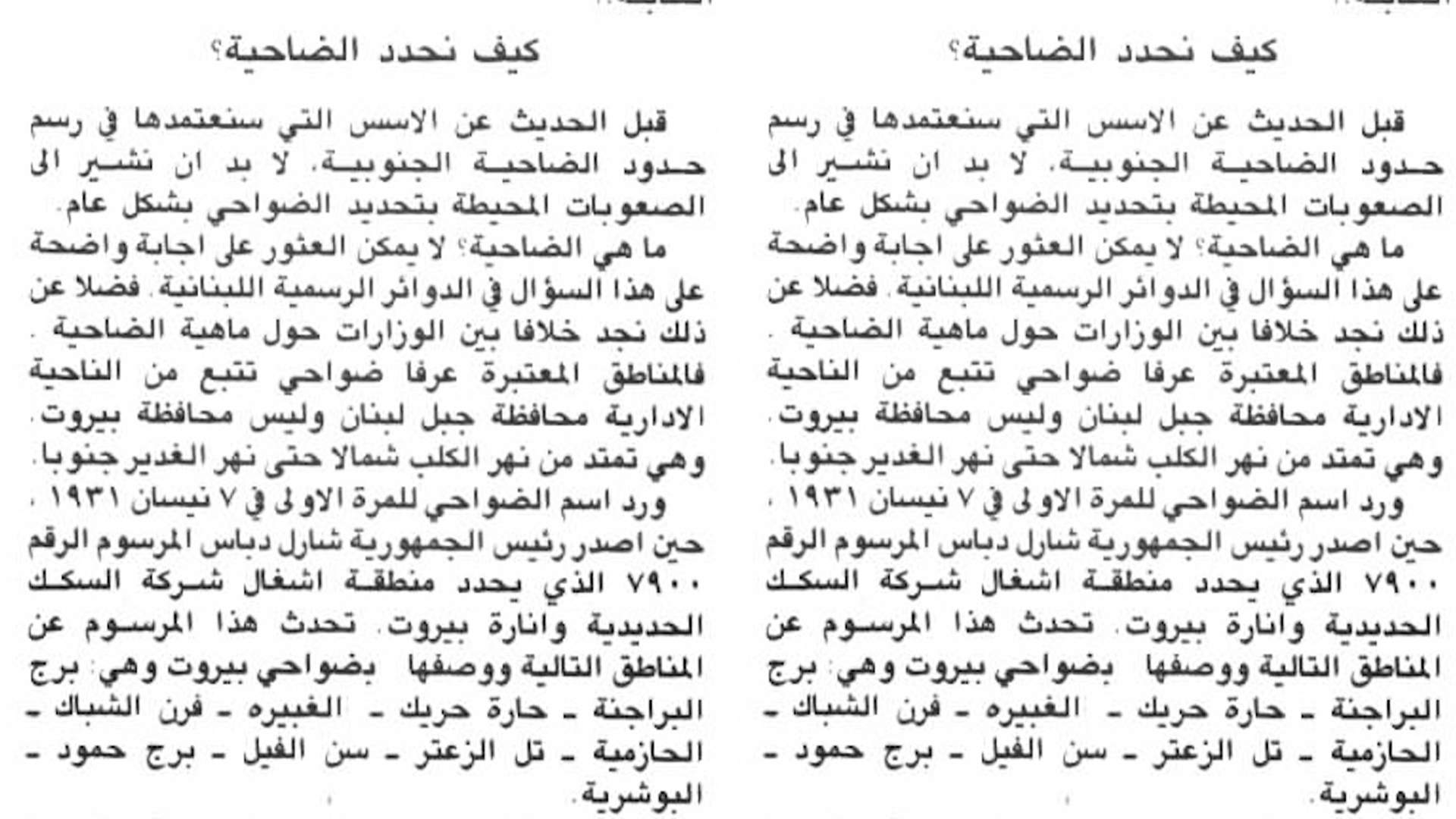
Excerpts from As-Safir’s 1983 dossier on Beirut’s southern suburbs, “Names of the Southern Suburbs” (left) and “How Do We Define the Suburbs?” (right). Archival material from UMAM D&R’s 2007 exhibition, “Collecting Dahiyeh.”
One quarter of the nation
By the time As-Safir published its dossier, nearly eight years of war had changed the constituency al-Sadr had helped mobilize.
Displacement had brought Lebanese families into Haret Hreik, Burj al-Barajneh, Tahwitat al-Ghadir, Bir Hassan and surrounding districts, adding to a population already enlarged by decades of migration. Some settled in buildings abandoned during the fighting, while construction outside formal planning systems extended into areas that had only recently remained open.
The newspaper struggled even to establish how many people were living there.Under “Area and population,” As-Safir put the southern suburbs at 28 square kilometers and cited estimates of 750,000 to 800,000 residents, while warning that the absence of official statistics made such figures uncertain.
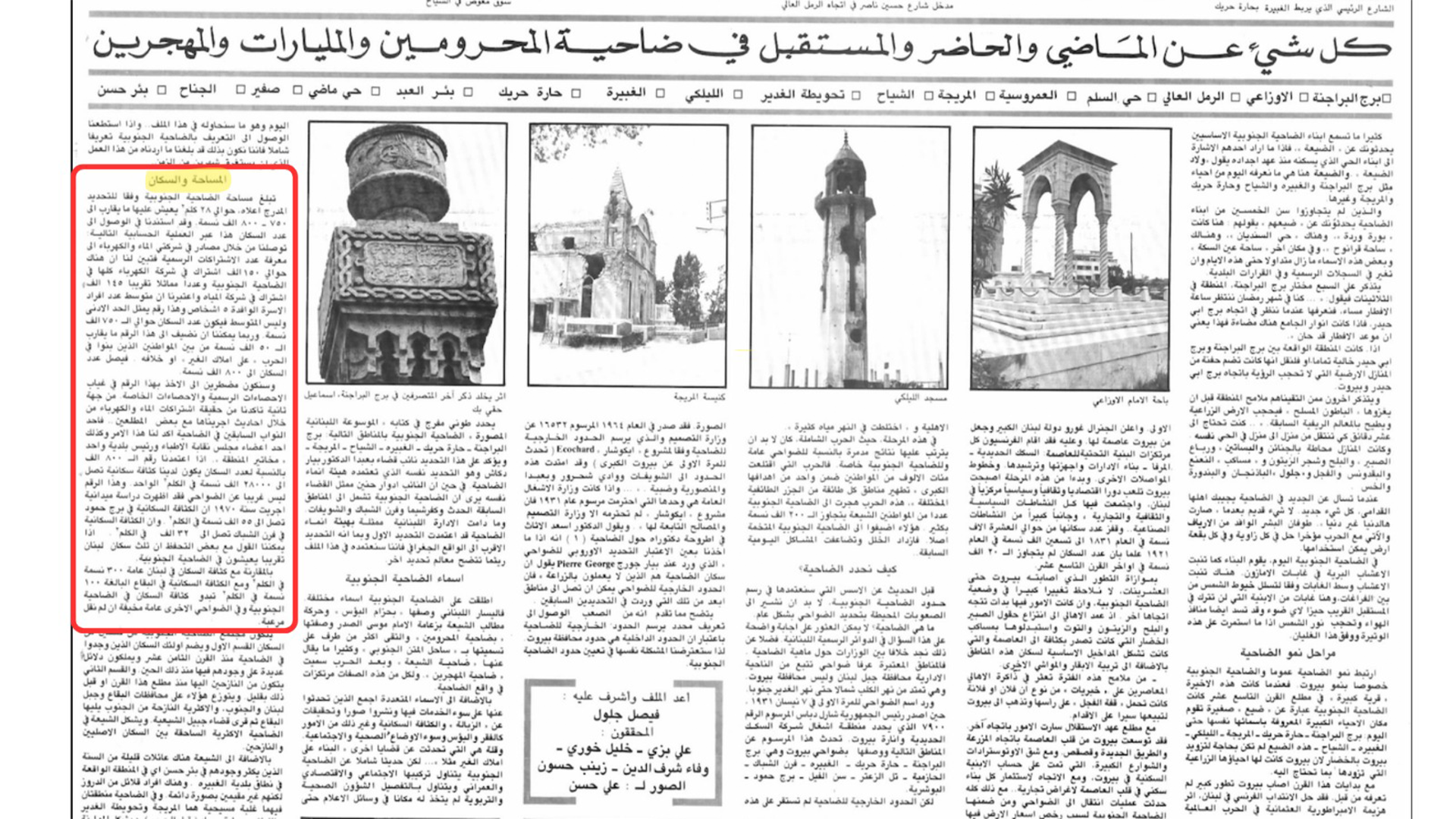
“Area and population,” from As-Safir’s 1983 dossier on Beirut’s southern suburbs. Archival material from UMAM D&R’s 2007 exhibition, “Collecting Dahiyeh.”
The physical expansion was accompanied by a rush into land and construction. As-Safir described “rapid urban growth” as apartment buildings and commercial activity spread across former agricultural land. Under “Economic activities,” it traced part of that growth to Lebanese working in Africa and the Gulf investing their savings in property and construction. With capital flowing alongside poverty and wartime displacement, Dahiyeh was, As-Safir declared, “the suburb of the deprived, the billions and the displaced.”
The political forces competing for influence over its population were changing, too
Amal remained the leading Shiite political movement, but Hezbollah was taking form as an armed militia following Israel's 1982 invasion, bringing together Shiite clerics and militants financed, trained, and supported by Iran's Revolutionary Guards.
Two years after the dossier appeared, Hezbollah issued its 1985 “Open Letter” addressed to what it called “the downtrodden in Lebanon and the world,” publicly setting out its allegiance to Ayatollah Ruhollah Khomeini, its opposition to Israel, and its vision of Islamic political authority.
A new center of political power
Hezbollah’s rise in Dahiyeh was neither immediate nor uncontested.
Over the following two decades, its role grew beyond armed activity. In her 2010 study Le Hezbollah à Beyrouth (1985–2005): De la banlieue à la ville, Lebanese urban scholar Mona Harb traces how Hezbollah used urban planning, health, and social services to build political power across the southern suburbs.
That influence extended into the state itself. Hezbollah entered Parliament in 1992, the same year Hassan Nasrallah became secretary-general after Israel killed his predecessor, Abbas al-Musawi. When municipal elections resumed in 1998, Hezbollah-backed lists won across much of Dahiyeh, giving the party greater authority over local planning, services, and development.
After Israel withdrew from most of southern Lebanon in May 2000, Hezbollah claimed the withdrawal as a victory for its armed campaign and used it to justify retaining its weapons outside state control.
By then, Dahiyeh had become a principal urban center of Hezbollah's political project without becoming politically synonymous with it.
That distinction would become much harder to see after the summer of 2006.
Dahiyeh becomes a military term
The 34-day war between Hezbollah and Israel in 2006 brought some of the heaviest destruction Dahiyeh had experienced. After Hezbollah fighters crossed the Israeli border on July 12, killing Israeli soldiers and capturing two, Israel responded with an air and ground campaign across Lebanon. In Beirut, the bombardment concentrated heavily on the southern suburbs, where Hezbollah's leadership and institutions had become embedded within a densely inhabited urban district.
The scale of destruction altered Dahiyeh physically. Urban scholar Mona Fawaz recorded 1,332 severely damaged multistory buildings across the southern suburbs, including 281 destroyed completely. About 30,000 families could not immediately return home, with Haret Hreik sustaining particularly extensive damage.
The bombardment did not fall neatly along the boundaries of Hezbollah's presence. Haret Hreik was a dense residential and commercial district, where apartments, shops and offices stood alongside party facilities.
When the fighting ended, Hezbollah consolidated its role in Dahiyeh through reconstruction, channeling compensation and housing assistance through institutions affiliated with the party. In Haret Hreik, the rebuilding was eventually organized through Waad, or “the Promise,” established by the Hezbollah-affiliated Jihad al-Bina association.
The process placed Hezbollah at the center of decisions over the reconstruction of territory in which its political power was concentrated. Fawaz and Harb have documented how Waad coordinated owners, planners and reconstruction while working within, and sometimes around, existing state and municipal systems.
Outside Lebanon, meanwhile, the destruction of Dahiyeh was entering an entirely different vocabulary.
Two years after the war, Israeli Northern Command chief Gadi Eisenkot described how Israel intended to respond in a future conflict with Hezbollah. What had happened in Dahiyeh, he said, would happen to villages from which Israel came under fire. Israel would apply “disproportionate force” and cause extensive destruction, treating such areas as military bases rather than civilian villages.
The approach became widely known as the “Dahiya doctrine.”
Whether the “Dahiya doctrine” constituted a formal Israeli military doctrine has remained contested. But its linguistic origin is unusually clear: a place name once lacking fixed geographic boundaries had become shorthand for overwhelming force against territory where an armed organization operated among civilian infrastructure.
The wars return to Dahiyeh
Nearly two decades after the 2006 war, Dahiyeh again became a principal target in a conflict between Hezbollah and Israel.
Hezbollah opened a front with Israel in support of Gaza following Hamas' Oct. 7, 2023, attack, beginning nearly a year of cross-border fighting that escalated sharply in September 2024. This time, some of Hezbollah's military infrastructure in Dahiyeh was underground, although its extent remains difficult to establish independently and Israeli claims about facilities beneath civilian sites have been disputed.
What happened beneath Haret Hreik on Sept. 27, 2024, was less ambiguous.
Israeli aircraft struck what Israel said was Hezbollah's underground central headquarters beneath residential buildings in the neighborhood. The attack killed Hassan Nasrallah, Hezbollah's secretary-general of 32 years, along with other senior figures, and destroyed several buildings above the subterranean complex.
The strike was followed by weeks of bombardment across Dahiyeh. Israeli evacuation warnings repeatedly identified buildings and surrounding blocks before attacks that Israel said targeted Hezbollah commanders, weapons facilities, financial institutions and other infrastructure. On one morning in November alone, Reuters reported roughly a dozen strikes across the southern suburbs. Thousands of residents fled, some sleeping in cars, public squares and along Beirut's seafront.
A ceasefire in November allowed many to return, but the reprieve lasted little more than a year.
When Hezbollah entered the widening U.S.-Iran conflict on March 2, 2026, Israel again struck the southern suburbs. Three days later, the Israeli military ordered residents across large sections of Dahiyeh to leave, posting a map encompassing four districts and prompting a mass exodus.
Israeli warnings and attacks continued across Haret Hreik, Burj al-Barajneh and other parts of the suburbs. On March 9, strikes hit branches of Hezbollah-linked Al-Qard al-Hassan, while other attacks struck buildings associated with Al-Manar and sites Israel identified as Hezbollah infrastructure.
The campaign continued through the spring. A June 1 evacuation order sent residents fleeing again, part of a war that by then had displaced more than 1 million people across Lebanon.
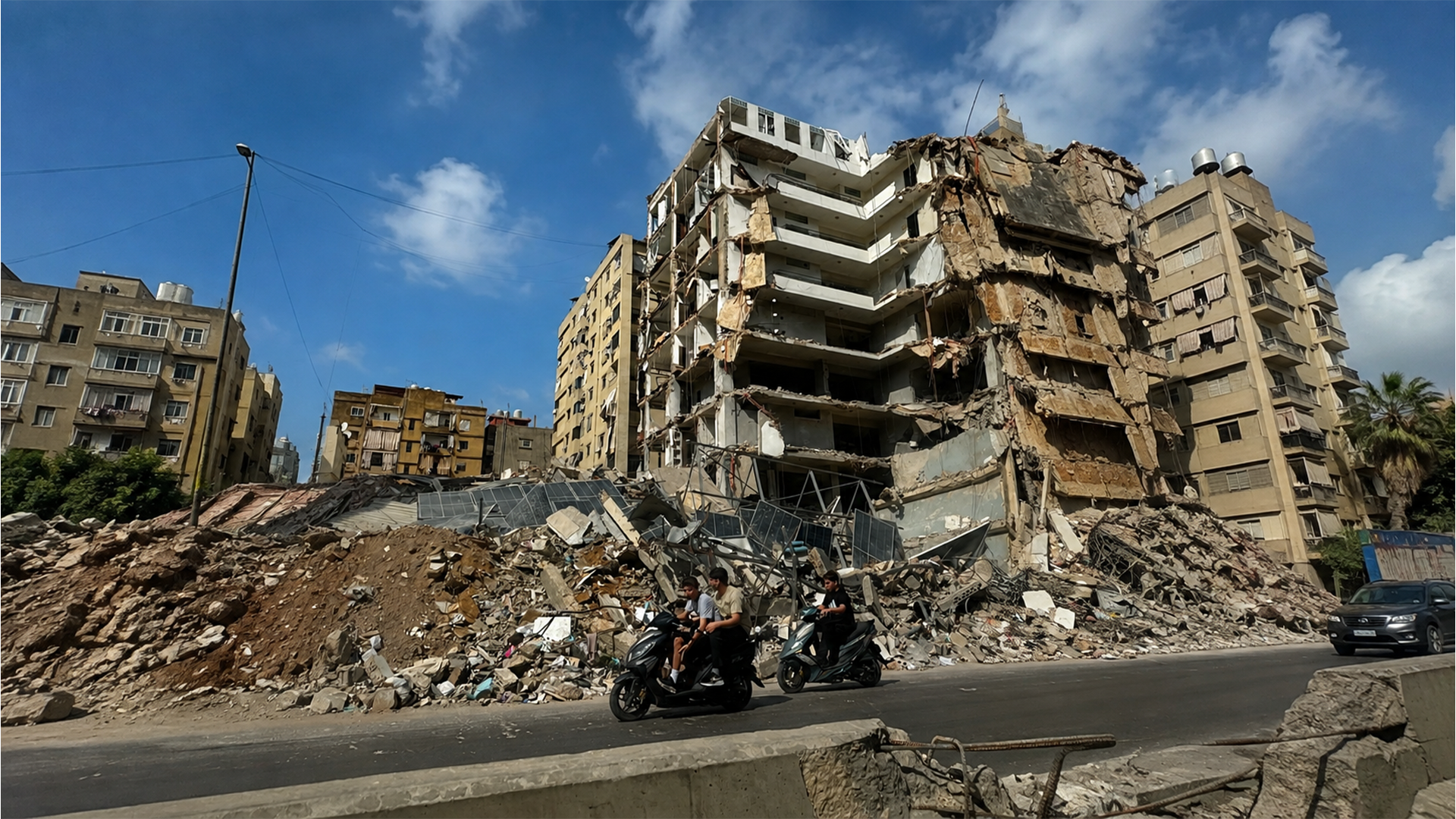
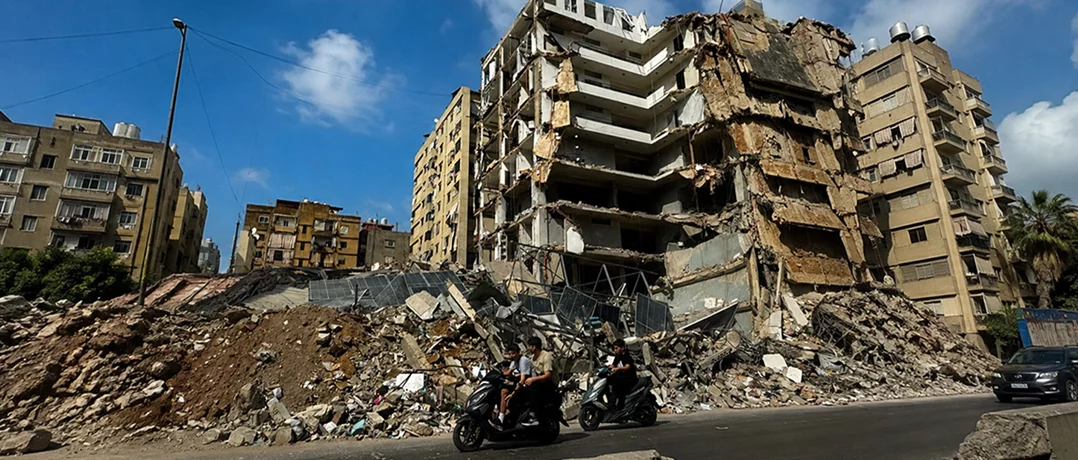
Buildings damaged during the 2026 war in Beirut’s southern suburbs, May 2026. Photo: The Beiruter.
The latest ceasefire has left Dahiyeh rebuilding once again, carrying a very different political significance from the place described in Lebanon's newspapers half a century ago.
In the 1970s, Lebanese newspapers had begun using it to gather a collection of municipalities under a common geographic name. By 1983, As-Safir could call the same territory “one quarter of the nation.” At the end of the 1990s, it identified the principal urban center of Hezbollah's political project. After 2006, it described not only a place, but a way of war. And in 2024 and 2026, Dahiyeh again became one of the principal arenas of war between Israel and Hezbollah.
The Dahiyeh captured by As-Safir in 1983 was already decades in the making. The Dahiyeh that followed would bear the imprint of Hezbollah’s rise to power.
Yet another history survives in the land itself. Property deeds, church, and waqf holdings preserve claims to land that predated Dahiyeh itself, including the holdings of Christian communities with deep roots in the area.
Those records open the next chapter of The Dahiyeh Dossier: not what the area was called or who came to dominate it politically, but who owned the land beneath it, and what became of that ownership.
-
-
-
Katharine SorensenReporterSpecializing in global affairs, technology and economics, with a focus on on-the-ground investigative reporting.
-
