



Halloween brings together children, families and partygoers across Lebanon, blending global trends with the country’s appetite for collective celebration.
Beirut gets a little spooky on Halloween

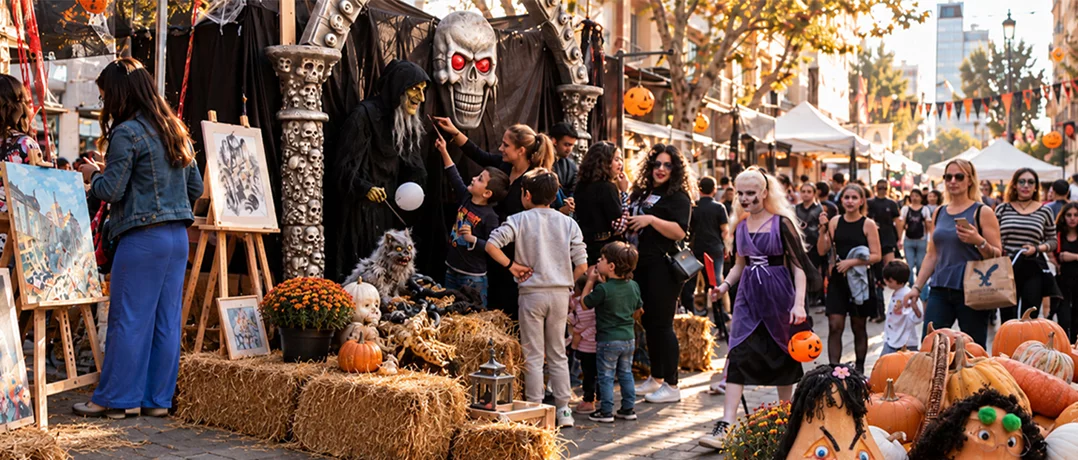
A woman dressed in black, her face hidden beneath wild hair and flowers, leads a small dog through Hamra. Beside her, two children in pointed witches’ hats and orange-and-black dresses carry a pink balloon. Ghosts dangle from the trees, while a crowd gathers around a skull-framed entrance, where children approach a figure dressed as Death.
For Imane Assaf, founder and executive director of Ahla Fawda, these scenes recall the Halloween parades that once transformed Hamra into a haunted playground. The idea began with neighborhood trick-or-treating, when she would take friends around local shops to distribute sweets. The number of children grew from around 20 to more than 120, prompting her to take the celebration into the street.
“Our first event at Ahla Fawda was a street Halloween parade,” she recalls. “We closed the whole street of Hamra. We put haunted houses, ghosts hanging from the trees, pumpkins everywhere.”
The parades later reached downtown Beirut, where abandoned buildings became haunted houses. Children came from across the city, mothers dressed up alongside them and dance performances brought crowds into the streets.
“I had people who would come dressed in the same costumes every year just to be part of it,” Assaf tells The Beiruter. “What's great about Halloween is that it's not controlled by which people come and which people don't come.”
Everyone wants a costume
That expanding audience has also changed what happens inside costume shops.
Yammine Halloween, a family business with more than 50 years of experience in costumes, party supplies and events, has watched Halloween grow beyond its traditional focus on children.
“Today, the celebration has expanded to include teenagers, adults and families, with much greater attention paid to full costumes, accessories and themed experiences,” says Gaelle Yammine.
“Costumes have become a more creative form of self-expression, with people increasingly putting together complete looks rather than simply wearing a mask.”
The inspiration often comes from screens. Yammine recalls the influence of “K-pop Demon Hunters” on last year's demand and points to interest in Spider-Man this year. Inflatable outfits, plush costumes, wigs, capes and masks give customers more ways to build a character from head to toe.
“Social media, international entertainment and popular films and series have helped shape this evolution, inspiring people to recreate characters and trends they see around the world,” she says.
Assaf remembers a similar anticipation surrounding her own costumes at the Hamra parades. One year, she wore a white dress marked with blood and scars; another time, snakes emerged from her head.
“The scarier I am, the more entertaining for the kids it was,” she says. “Every year I had to create a costume that was scarier than the year before.”
A borrowed celebration, a local audience
Halloween's growing popularity raises questions about how international customs settle into local life. Dr. Atef Attieh, a professor at the Lebanese University whose research includes customs and traditions in Lebanon, sees the celebration as an example of cultural influence spreading through globalization and American popular culture.
“Because folk traditions are societal products, every society has its own customs and traditions,” he explains. “And because society is open to other societies, traditions and customs inevitably transfer from one society to another and from one culture to another.”
Yet Attieh distinguishes Halloween from Eid el Barbara, the Christian feast celebrated on Dec. 4, when children dress up, visit homes and collect sweets.
“It is clear that there is no connection between the Feast of Saint Barbara and Halloween in terms of both traditions belonging to religion,” he says. In his account, Eid el Barbara commemorates the story of Saint Barbara through local religious and folkloric practices, while Halloween's modern form reflects Western popular culture and consumerism.
Assaf also sees differences between the celebrations, even as she recognizes their shared appeal to children.
“They're celebrated in different ways and they represent different things,” she says. “But they both are for the joy for the kids. I think it's the message that you're bringing across rather than what is the event that counts.”
For Attieh, the question is how imported customs interact with what a society already holds dear. “The fundamental issue is that the influence of other cultures must remain confined to refining our own cultural awareness,” he says, arguing that societies can welcome new influences while preserving their living heritage.
The price of a fright
Halloween has also become a business opportunity, with schools, restaurants and event organizers offering themed activities throughout October.
At Yammine Halloween, the season typically picks up around mid-September, although costumes sell year-round for birthdays, school events and other celebrations.
Lebanon's economic difficulties have affected spending as well. “Customers are increasingly mindful of value,” Yammine says. “Accessories can also help customers create different looks without necessarily purchasing an entirely new costume.”
Assaf believes the commercial side of the celebration risks overshadowing what made the parades special in the first place.
“For me, Halloween is the haunted house, the pumpkins, the simple carving of pumpkins on the street, or cookie decorations on the street,” she says. “These simple little things spread joy, give the youth these joyful kids' activities.”
Her large street parades ended years ago, although she organized a smaller celebration in 2022. Families still ask whether the events will return. She remembers the crowds bringing customers to neighborhood shops and giving local artisans and food vendors a place in the festivities.
“It's life and it's much needed,” she says of such gatherings. “Kids need to celebrate some normalities.”
Whether it is a homemade costume, a superhero mask or a street transformed into a haunted house, Halloween now offers Lebanese families another occasion to dress up and gather.
-
-
-
Rayanne TawilCultural writer
-
