



The story behind Enrico Macias’s rise in Beirut and how politics turned admiration into distance and exclusion.
Beirut, through the memory of Enrico Macias

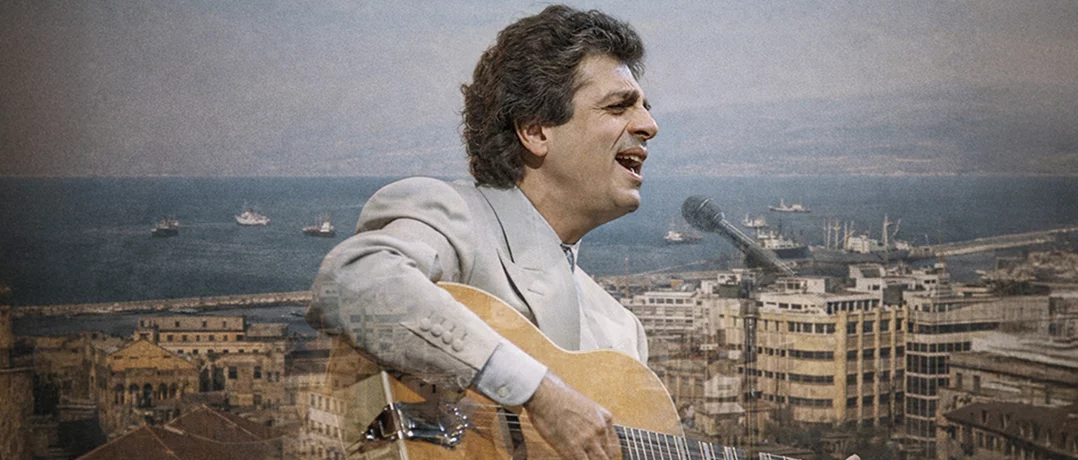
In recent days, social media has been circulating television clips of Algerian-French singer Enrico Macias performing part of his famous song “Beyrouth” during his appearance on the program “Quelle Époque!,” hosted by Lebanese-French journalist Léa Salamé (daughter of Culture Minister Ghassan Salamé) on France 2 every Saturday night.
Macias appeared alongside other guests on the variety show to discuss aspects of his 65-year career in music, during which he sold 50 million records, toured extensively around the world, appeared in the television series “Maison De Retraite,” and spoke about upcoming concerts scheduled in the coming months.
“I’m not finished yet”
At the end of the segment, where Macias responded to Salamé’s questions by performing excerpts of his songs while playing the guitar, the singer asked his host to pause before concluding the interview, saying: “I’m not finished yet… There’s a song I wrote in 1963, and today I want to sing it again so that it ‘explodes’ in the Arab world more powerfully than the shells falling across the Middle East.” He then performed part of the song “Beyrouth,” written by Mohamed Jamoussi and Irène Frandot, and composed by Macias and Maurice.
But what is the story behind this song, and why did the Algerian-French artist sing about Lebanon’s capital?
The story dates back to the early 1960s, when the late Armenian-Lebanese concert promoter Toros Siranossian traveled to Paris to sign artists and bring them to perform at the “Epi Club,” which he had opened in 1961 on Phoenicia Street in Beirut.
In France, Siranossian met, as he recounts in his memoirs, Claude Ebrard, sales director at Pathé Marconi, who introduced him to several singers, including a young French artist of Algerian origin named Enrico Macias (whose real name is Gaston Ghrenassia), who had recorded his first two songs ahead of their release. Ebrard told Siranossian he could sign the young singer for $50 per night. The promoter ignored the proposal, considering that Macias had not yet launched his career and was still unknown to the public. Although $50 per night was modest, bringing a new artist to Beirut would also involve additional costs, including promotion and accommodation, without any guarantee of success.
Siranossian dropped the idea, but on the night before his return to Beirut, he received a call from Macias himself requesting a meeting after learning that Ebrard had mentioned his name. They met, Siranossian listened to him sing, and promised to follow up after returning to Beirut.
Back in Beirut, the owner of the “Epi Club” completely forgot about the matter, until months later when his brother Jean told him about a young singer whose songs were gaining popularity among nightlife audiences in Lebanon and advised him to bring him to perform at his club. When Siranossian asked about the artist, he realized it was Enrico Macias. He then sent a contract at the agreed price to Claude Ebrard, but by then the rising star refused to perform for $50 per night, as his fee per concert had significantly increased after gaining recognition.
Ebrard intervened and convinced Macias that the agreement had been discussed before he became widely famous. Siranossian ultimately secured the deal after adding minor incentives related to travel, accommodation, and the inclusion of a musician in the Beirut tour.
At Beirut airport, Enrico Macias received a large press and public welcome organized by Siranossian. Once promotion for his performances at the “Epi Club” began, reservations poured in for all thirty nights. The rising star also performed two additional concerts at Cinema Dunia in downtown Beirut, earning $3,000, according to Siranossian.
“I take pride in my religion”
During his stay in Beirut, Siranossian once took Macias to Byblos Castle, accompanied by journalist Salem al-Jisr, for an interview and a photo session at the historic site. During the visit, al-Jisr noticed that Macias was wearing a gold necklace with a Jewish symbol. When asked if he was Jewish, Macias replied: “We are all children of God!”
A year later, Siranossian attended a concert by Macias in Lyon, followed by a dinner held in his honor, to which Siranossian was invited. During the dinner, Macias recalled his visit to Beirut and told Siranossian that after returning from Lebanon, he had written a song titled “Beyrouth” in appreciation of the country where he had achieved his first major successes. In a speech, Macias welcomed Siranossian and performed the song as a tribute to “a great guest and friend who was the first to sign a contract with me in my life,” as Siranossian noted in his memoirs.
When Macias returned to his seat, Siranossian asked him about the possibility of returning to Beirut for a month of performances. Macias replied: “I want to tell you, Toros, that I am Jewish, and I take pride in my religion. The last time, I had to hide it from you and from people because I was in an Arab country and needed work and money to launch my career. But today, after achieving all that, I am not willing to travel to Lebanon because I will not deny my religion if asked, and that could cause problems for both of us.”
The blacklist
Thus ended the project of Enrico Macias’s return to Beirut, although at the time he was not yet banned from entering the country. However, after the 1967 Six-Day War between Israel on one side and Egypt, Syria, and Jordan on the other, Macias’s name was placed on the list of artists banned from entering, distributing, or broadcasting their work in several Arab countries, including Lebanon, by the Arab boycott office, following statements, activities, and positions he had taken in support of Israel.
Around 13 years later, in 1980, singer Sabah paid the price for appearing alongside Enrico Macias on the French variety program “Le Grand Échiquier,” hosted by Jacques Chancel on French television. She faced an Arab boycott for sharing a performance with him during that episode. Her name was only removed from the blacklist, and the accusation of “betrayal” lifted, years after that appearance. But that is another story.
