



Beneath Lebanon lies a hidden military world: Hezbollah’s vast tunnel network reveals the scale of an underground infrastructure built beyond the state’s reach.
Beneath Lebanon: The underground state Hezbollah built
Beneath Lebanon: The underground state Hezbollah built
By Joanne Naoum | August 19, 2026

Reading time: 7 min
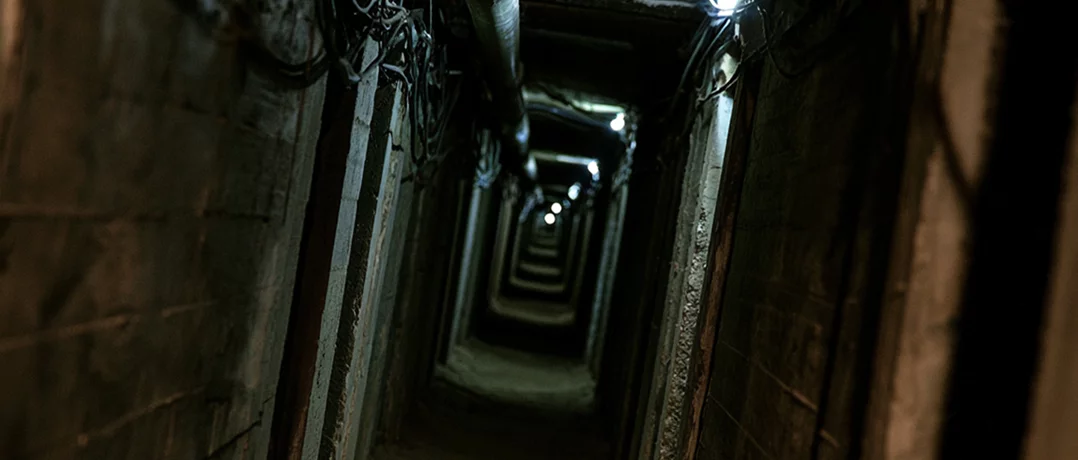
One of the two bunker exits explored in the Bint Jbeil area. This vertical exit was lined with steel plates painted matte black to prevent sunlight reflections from alerting Israeli drones overhead. Photo credit: Nicholas Blanford.
Never did the Lebanese imagine that the saying “a state within the state” could be taken so literally. Hezbollah has exercised a level of control over parts of Lebanon where even movement through its strongholds can be subject to scrutiny. But what has emerged beneath the surface reveals a far deeper reality.
Hezbollah’s tunnel network appears to extend far beyond what many could have imagined -from narrow, human-sized passages to sprawling underground corridors, bunkers and military complexes designed to store weapons, move fighters and prepare for war.
How were these networks built, who covered and uncovered them, what was detected and reported, and how could such a vast military infrastructure take root without the state stopping it?
Nicholas Blanford: The secrecy behind Hezbollah’s tunnel network
Nicholas Blanford, a political and security analyst at the Atlantic Council, told The Beiruter that Hezbollah’s underground infrastructure evolved significantly after the 2006 war, from relatively simple, human-sized tunnels to sophisticated networks capable of accommodating vehicles, weapons and large numbers of fighters.
Before 2006, Hezbollah had potentially built more than 1,000 small tunnels across southern Lebanon. “They were people-sized tunnels, narrow corridors, not something where you could drive vehicles, trucks and so on as we saw later on.”
Drawing on his own exploration of abandoned Hezbollah bunkers after the 2006 war, Blanford described relatively simple but remarkably well-equipped structures. The tunnels were reinforced with steel girders and sheets, with entrances designed to avoid detection from Israeli aircraft and drones. Inside, they featured ventilation systems, electricity, kitchens, bathrooms with hot water and sleeping areas. Some had separate vertical and horizontal entrances and multiple underground rooms.
Their concealment was equally meticulous. Metal entrances were painted matte black to prevent sunlight from revealing them from the air, while interior walls were painted glossy white to reflect artificial light. Excavated rock was reportedly carried away in sacks and scattered beneath trees to conceal evidence. For Blanford, the real achievement was the secrecy surrounding the construction.
A striking example was a large bunker network near Labboune, close to Naqoura and around 100 meters from the border. It included underground medical facilities, dormitories, kitchens and weapons storage, and reportedly went undetected despite its proximity to Israeli and UNIFIL positions.
 Part of the Hezbollah bunker at Labboune near the Blue Line, destroyed by Israel at the end of the 2006 war. Photo credit: Nicholas Blanford.
Post-2006
After the 2006 war, Hezbollah’s underground infrastructure became considerably more sophisticated. Blanford pointed to the group’s publicly released footage of the Imad-4 complex, which showed extensive networks capable of accommodating trucks carrying missiles and other military equipment.
It was no longer simple passageways running through a mountain. These were massive, complex bunker tunnel networks, and were not confined to southern Lebanon, but were also built in the Beqaa Valley and areas north of the Litani River.
Blanford also cast doubt on reports of extensive Hezbollah tunnel networks in predominantly Christian or Druze areas, arguing that the group generally built its underground infrastructure in areas where it had a strong presence and could maintain secrecy. “They wouldn't go into Druze areas, for example, in the south, or Christian areas in the south,” he said. He pointed instead to predominantly Shiite areas of southern Lebanon and the northern Beqaa, including around Baalbek, where Hezbollah had greater control and could operate more securely.
Regarding reports of the rediscovery of a tunnel network in Jbeil and Keserwan, a security source told The Beiruter that there is currently no information that can be confirmed, adding that any reports on the matter remain subject to verification.
 A 50–60-metre Hezbollah tunnel explored in the Bint Jbeil area in April 2007. It had two entrances and glossy white walls designed to reflect light. The tunnel was never discovered by Israel. Photo credit: Nicholas Blanford.
The full extent of the network
The full extent and cost of Hezbollah’s tunnel network remain unknown, but the infrastructure is clearly extensive and “it can't be cheap,” Blanford noted. “These are major, major engineering works across the country.”
The investment reflects the strategic value of underground infrastructure “clearly these tunnels had a great utility for Hezbollah and were worth the investment from their perspective and the Iranian perspective.”
On whether Lebanese authorities were aware of the full extent of the network, Blanford was skeptical. “They may have been aware that something was going on, but I don't think they would have been able to determine exactly what was going on and exactly where it was going on.”
As tunnels are now being discovered, control is divided among three actors: Israel, Hezbollah and the Lebanese Army. Israel controls and is destroying tunnels in areas it occupies; Hezbollah retains control of some networks, while the Lebanese Army has entered and taken control of others. “The Lebanese army has deployed into some of these tunnels and taken them over and placed them under their control,” Blanford concluded.
The settlement
While Blanford questions whether Lebanese authorities could have known the full extent and precise location of Hezbollah's underground network, journalist Tony Boulos takes a broader view, arguing that the group's military infrastructure was enabled by Lebanon's political and institutional system.
This power did not emerge in a vacuum, but was built on a political settlement with the system that governed Lebanon from 1990 onward. The Syrian regime exempted Hezbollah from the Taif Agreement’s requirement to disband militias, instead redefining it as a “resistance” movement. Political cover was provided at various stages by key figures, including Rafic Hariri, Nabih Berri and Walid Jumblatt, before the Free Patriotic Movement joined them following its 2006 understanding with Hezbollah.
According to Boulos, successive governments legitimized Hezbollah’s weapons through ministerial statements and political formulas, while the ruling establishment allowed it to influence sovereign and strategic decisions in exchange for political protection and shielding its system of patronage and corruption.
He pointed to reports indicating that Hezbollah used state-owned facilities, equipment and projects to build parts of its infrastructure, particularly through the Ministry of Public Works and Transport. Among the questions requiring investigation, he noted, whether parts of the tunnel network were built under the cover of public projects in southern Lebanon, whose total cost is estimated at between $5 billion and $6 billion.”
Boulos also highlighted the use of public land, facilities, telecommunications and energy networks, including the possible diversion of electricity to underground facilities from networks linked to the Jezzine, Litani and Awali areas.
A network of such magnitude could not have been built without the knowledge of official and security authorities.
The project, he argued, went far beyond defensive tunnels, encompassing an integrated underground military infrastructure with passageways for movement and resupply, weapons and missile storage, command and communications rooms, and energy and logistical facilities.
“The objective was to establish a parallel army to the state, with its own independent infrastructure, capable of moving, waging wars and making strategic decisions away from the institutions of the republic.”
Boulos described Hezbollah’s arsenal as among the most dangerous held by a non-state actor, making it a regional threat and its military infrastructure expanded north of the Litani under the watch of the Lebanese Army, intelligence and security agencies, and south of the river in an area where UNIFIL is deployed under international mandates to monitor the situation and help prevent illegal weapons.
The situation, he argued, raises serious questions about UNIFIL’s performance: whether it was constrained and ineffective, or whether some of its components turned a blind eye to Hezbollah’s activities. For Boulos, ultimate responsibility lies with Lebanon’s political establishment, which provided Hezbollah with the cover to build a military state within the state, in return for political protection.
What has been uncovered is not merely a network of tunnels, but evidence of the state being hijacked and Lebanese money, institutions and land being used to build a military project outside the authority of the state, turning Lebanon into a military base.
UNIFIL.. what it detected and what it reported
UNIFIL spokesperson Kandice Ardiel told The Beiruter that its mandate is to “monitor and report violations of Resolution 1701,” adding that it refers “locations or activities of concern to the Lebanese authorities and the Security Council.”
"While peacekeepers had detected and reported suspected tunnel infrastructure prior to the escalation of conflict in late 2023, we are not able to access private property without authorization, which was not forthcoming. UNIFIL does not have a mandate to carry out investigations by force."
Ardiel also said the escalation of violence in southern Lebanon had made its monitoring and reporting work more difficult. Nevertheless, since Nov. 27, 2024, its peacekeepers have identified more than 400 weapons caches in various locations across southern Lebanon and reported them to the Lebanese Army. The UNIFIL spokesperson said it has supported the army in addressing unauthorized weapons and that its peacekeepers remain on the ground to support the implementation of Resolution 1701, which it considers “the only viable path toward a return to stability for civilians on both sides of the Blue Line.”
Networks... across multiple locations
A security source told The Beiruter that it is not possible to confirm or deny reports concerning the location or nature of specific tunnels, stressing that any such information remains subject to verification and assessment by the relevant authorities.
The security source said that once tunnels are discovered, the competent military and security authorities handle them according to established procedures.
The IDF claimed to have uncovered Hezbollah tunnel networks across southern Lebanon, including in Beaufort Ridge, Majdal Zoun, Khiam, Qantara, Rab El Thalathine and Srebbine. The networks reportedly contained command centers, weapons caches, drone facilities and living quarters. In August 2025, UNIFIL and the Lebanese Army also reported discovering fortified tunnels near Tayr Harfa, Zibqine and Naqoura, containing shelters, artillery, rocket launchers, missiles, anti-tank mines and explosives.
The dismantling of this military maze will require more than political declarations, but Lebanon has now taken steps that were once unthinkable - from dropping the reference to “armed resistance” from the February 2025 ministerial statement, to tasking the Lebanese Army in August with a plan to place all weapons under state control and endorsing the objectives of the U.S. disarmament proposal. The will to dismantle this parallel military infrastructure now exists; what remains is the capacity to act and, above all, the full knowledge of the map beneath Lebanon.
-
-

-
Joanne NaoumHead of Political Desk
-
