



Discover Bikfaya, Lebanon's historic mountain village, where centuries of heritage, stone architecture, religious landmarks, and the beloved Peach Festival come together amid the cool pine-covered slopes of Mount Lebanon.
Bikfaya: A mountain escape steeped in history

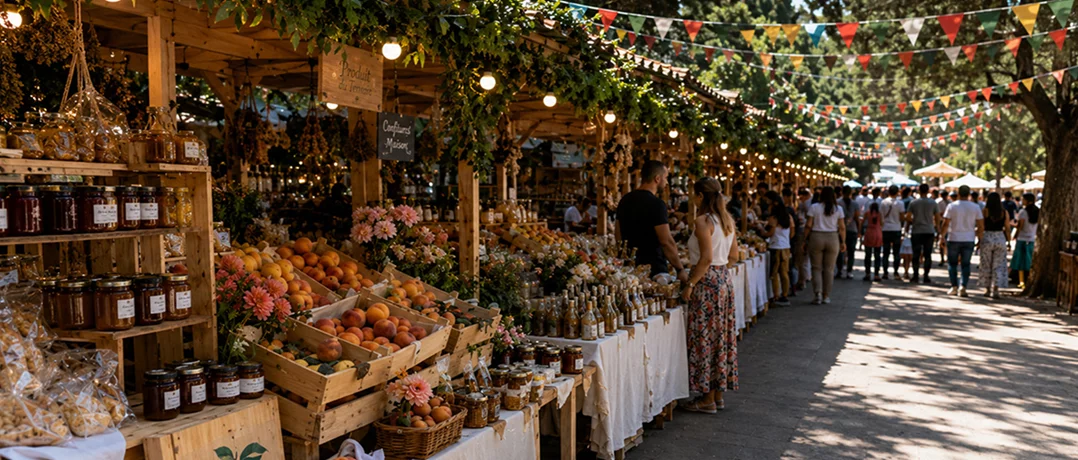
Perched between 900 and 1,000 meters above sea level in the Metn district of Mount Lebanon, Bikfaya has spent more than a century as one of the country's favorite escapes from the summer heat of Beirut. Its red-tiled roofs and stone houses sit among pine and oak forests overlooking the Mediterranean, and its name itself tells part of its story: Bikfaya is a contraction of the Aramaic "Beit Keifayya," roughly "house of stone" or "the rocky place", a fitting description for a village that has been quarrying a life out of these mountains for centuries.
The story of a notable village
Bikfaya's past stretches back further than most visitors realize. It is believed the site once held a shrine to the Phoenician god Baal, and church historians have traced Christian communities in the area, to as early as the year 679, when they helped establish Bikfaya alongside the nearby villages of Baskinta and Bhersaf. By the 11th century, Bikfaya and Bhersaf served as headquarters for Maronite emirs and bishops, with Emir Semaan among the most prominent to reside there.
That continuity was violently interrupted. After Crusader forces withdrew from the region at the end of the 13th century, Mamluk troops swept through the Keserwan area, which then included the Metn, in a campaign of reprisal that left Bikfaya largely depopulated. The village stood empty for over two centuries. It was only in 1540, under the rule of Emir Mansour al-Assafy, that families began returning. Among them was the Gemayel family, who arrived from the village of Jaj in 1545 and were granted authority over Bikfaya and its surrounding areas, the beginning of an association between the Gemayels and Bikfaya that continues in Lebanese political life today. The Gemayels built the church of Mar Abda in 1587, and other churches followed in the centuries after: Saint Michel in 1592, the Greek Catholic Saint George in 1750, and the convent and church of Saydet El Najat in 1836 and 1858.
The 19th century brought Bikfaya political weight as well as spiritual significance. In 1840, under the Emirs Abillamaa, the village became the capital of the Christian qaemmaqamiya, the Ottoman-era administrative district, and Emir Haidar Abillamaa built a grand seraglio there to serve as the seat of government. That building would later be restored under President Amine Gemayel in 1982 and repurposed as a presidential palace, eventually earning recognition as a protected piece of cultural heritage.
The 20th century tested the village severely. The First World War brought devastation: Ottoman forces killed a significant number of residents, and the survivors then faced a famine caused by locust swarms that stripped the mountains of crops, killing thousands more across Lebanon from starvation. It was only under the French Mandate that Bikfaya began to recover, rebuilding its houses and drawing new businesses and industries that revived the local economy. Tourism grew rapidly in this period, and Bikfaya reestablished itself as a cultural hub, a status confirmed in 1942, when General Charles de Gaulle himself attended the village's flower festival.
Culture and community today
Today Bikfaya is home to roughly 20,000 residents, most of them Christian and predominantly Maronite Catholic, alongside Greek Orthodox, Greek Catholic, Armenian Orthodox, Baptist, and other communities. It also holds the distinction of being the summer seat of the Armenian Catholicos of Cilicia, adding another layer to its religious significance. Visitors will find the village dotted with restaurants specializing in Lebanese cuisine, along with hotels, amusement centers, and public gardens that cater to both locals escaping the coastal heat and tourists drawn by the mountain scenery.
Among Bikfaya's landmarks, the Naas spring stands out as one of its most visited destinations, long believed to have curative properties that draw health-seeking travelers each year. Nearby, the Grand Hotel Naas and the Locanda Corsini guesthouse offer visitors a place to stay amid the pine forests, while the historic Mar Abda church and the Saydet El Najat convent give a glimpse into the village's centuries-old religious architecture. The restored presidential palace, once an Ottoman-era seraglio, remains one of the more striking pieces of the village's built heritage.
The Peach Festival
No account of Bikfaya's culture would be complete without its Peach Festival, now one of three annual festivals, alongside a winter Christmas Market and a spring Flower Market, that the village has run since 2010. Roula Chikhani, press representative for the festival's organizers, explained that the Peach Festival itself began in 2012, growing out of a simple gesture: "we started by distributing peaches on the roads, we would give peaches to everyone passing by at night so people would get to know Bikfaya's peaches."
The timing is dictated entirely by nature. As Chikhani put it, the festival is held only in July "because that is when peaches reach their peak," with organizers consulting local farmers each year to pin down the harvest window, since Bikfaya's peaches owe their signature sweetness to the mountain climate itself.
The festival has grown considerably since its early roadside giveaways. Chikhani noted that organizers now receive far more requests to exhibit than they can accommodate, capping participation at around 70 stands featuring food, homemade products, and peach-based goods, with a deliberate policy of favoring small businesses over established brands, several of which, she said, have gone on to open their own stores after starting out at the festival.
Beyond commerce, Chikhani frames the festival as a piece of cultural preservation. Despite its elevation of 950 meters, she said Bikfaya "still has the spirit of a village," one that draws visitors from across Lebanon, including, she noted, a group that traveled from Tripoli specifically for the event. With free entry, a children's playground and kids' club, and evening programs featuring traditional dabke and live music, the Peach Festival has become, in Chikhani's words, a celebration of both Bikfaya's agricultural identity and its enduring sense of community.
The house of stone and the taste of summer
Bikfaya has endured war, famine, political change, and the passage of time without losing the character that defines it. Today, its stone houses, mountain landscapes, and traditions continue to draw visitors, while festivals like the Peach Festival celebrate a community determined to preserve its heritage. In Bikfaya, history is lived through the rhythms of village life, season after season.
-
-

-
Jenna GeageaReporter/Writer
-
