



Bint Jbeil stands as a frontline town where history, symbolism, and strategy converge, making it one of the most consequential battlegrounds in the Israel-Lebanon conflict.
Bint Jbeil ground zero

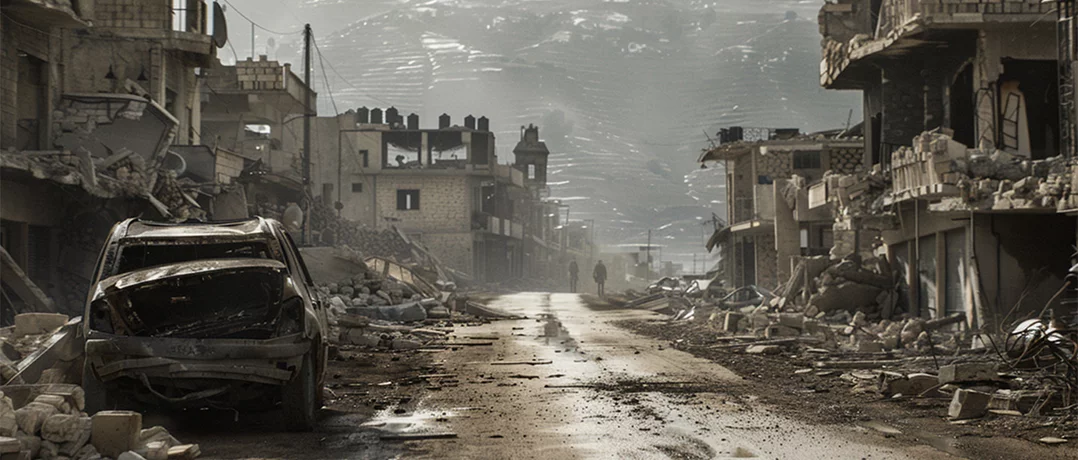
Bint Jbeil, Arabic for "daughter of the little mountain" or, in some interpretations, "daughter of Byblos", is the second largest municipality in the Nabatiye Governorate in southern Lebanon. Less than four kilometers from the Israeli border, this modest urban center has been transformed by decades of conflict into something far larger than its geography suggests: a living emblem of resistance, sacrifice, and contested sovereignty.
History of a “Capital of Resistance”
In 1920, amid unrest following the declaration of Greater Lebanon, sectarian clashes erupted in the south, particularly between Bint Jbeil and nearby Ain Ebel. The violence led to the displacement of many residents to Palestine.
During the 1930s, young men from Bint Jbeil joined anti-colonial armed movements in Haifa and Jenin under Izz al-Din al-Qassam. In 1936, Bint Jbeil became the epicenter of a "tobacco revolt" against French Mandate rule, sparked by the killing of three protesters by gendarmes. The town, politically divided between pro-French landowners and merchant families, was a significant tobacco producer. By the late 1960s, economic migration began, particularly after international attention to its shoemaking industry.
The town’s trajectory continued to oscillate between displacement and militarization, especially after the Cairo Agreement of 1969, which turned southern Lebanon into a base for armed activity and exposed Bint Jbeil to repeated Israeli attacks and further waves of forced evacuation.
This dynamic deepened dramatically in 1978, when Israel launched Operation Litani, invading South Lebanon in response to Palestinian attacks and occupying a strip of territory along the border. Four years later, the full-scale invasion of 1982 extended Israeli military control deep into Lebanese territory, eventually leading to the establishment of a self-declared "Security Zone" in the south, a strip of land that Israel held, through its proxy the South Lebanon Army, for the next 18 years.
In May 2000, Prime Minister Ehud Barak ordered a unilateral Israeli withdrawal. The city’s modern mythology was sealed on May 26, 2000, when Hassan Nasrallah stood before tens of thousands of supporters and delivered what became known as the "victory speech,". From that podium, he declared it the "capital of resistance", a title that has since functioned less as administrative designation and more as ideological covenant.
Six years later, the 2006 summer war put that title to a brutal test. In late July, Israeli ground forces launched a major offensive into Bint Jbeil. The 34-day conflict, initiated after Hezbollah captured two Israeli soldiers, resulted in roughly 1,200 Lebanese and 160 Israeli deaths, and ended under UN Security Council Resolution 1701, which called for the disarmament of southern Lebanon and a strengthened UNIFIL presence.
Strategic escalation: Israel's current offensive
The Israeli military's renewed ground operations in South Lebanon have placed Bint Jbeil once again at the center of a major offensive. Israeli military statements have described the city as effectively "encircled" by forces of the 98th Division, an elite formation that was redeployed from Gaza operations, signaling the seriousness with which this particular urban objective is being approached.
At under four kilometers from the border, Bint Jbeil is one of the most exposed urban centers in the Lebanese south. Its proximity makes it both a potential launching ground for anti-tank missiles and short-range rockets into northern Israel, and a natural first major objective in any ground push designed to establish a buffer zone. Israeli military planners have spoken openly about attempting to "settle unfinished battles" with Hezbollah, language that is as historical as it is operational, a direct echo of 2006's unresolved outcome.
The operation reflects a broader Israeli strategic aim: to prevent Hezbollah from re-establishing the kind of fortified presence in border towns that made 2006 so costly, and that has persisted in various forms in the years since. Bint Jbeil, given its symbolism and its geography, cannot be bypassed if that aim is to be taken seriously.
But military encirclement does not occur in a civilian vacuum. The city has a population of around 30,000 residents, a mix of those who have remained through previous conflicts and those displaced from surrounding villages seeking temporary refuge. The humanitarian pressure on those who cannot or will not leave is acute. Infrastructure has been struck repeatedly. Access to medical care, food, and basic services has become increasingly precarious. Civilians in Bint Jbeil are living the gap between the city's symbolic grandeur and its very fragile, very human reality.
Symbolic political weight
What makes Bint Jbeil different from other contested towns in South Lebanon is the degree to which military operations there carry meaning that far exceeds territorial gain or loss. Capturing, holding, or destroying Bint Jbeil is a statement.
For Hezbollah, the city is central to a carefully constructed narrative of resilience that has sustained the organization's political legitimacy in Lebanon for decades. That narrative is not merely for internal consumption. It reaches across sectarian lines, into the broader Arab public sphere, and into the international discourse around resistance and occupation. A broken Bint Jbeil would represent a fracture in that narrative, which is precisely why the city remains a high-value target beyond its physical dimensions.
For Lebanon as a whole, the battle over Bint Jbeil activates deep sectarian and political fault lines. The city is predominantly Shia and strongly identified with Hezbollah's constituency. Any large-scale military operation there is felt not only as an attack on a community and an identity. This generates political reverberations in Beirut that complicate any government response, paralyze consensus, and deepen existing divisions between those who view Hezbollah's "resistance" as a national shield and those who see it as the primary driver of Lebanon's recurring devastation.
Israel frames its operations there as necessary counter-terrorism; Hezbollah frames any survival there as victory. Both framings are designed for audiences far beyond the hills of South Lebanon.
-
-

-
Jenna GeageaReporter/Writer
-
