



Inside the student-led project that transformed a forgotten wall near the old city into a contemporary tribute to Byblos’ maritime heritage, guided by AUT’s Graphic Design Department.
Byblos’ history reborn through student art

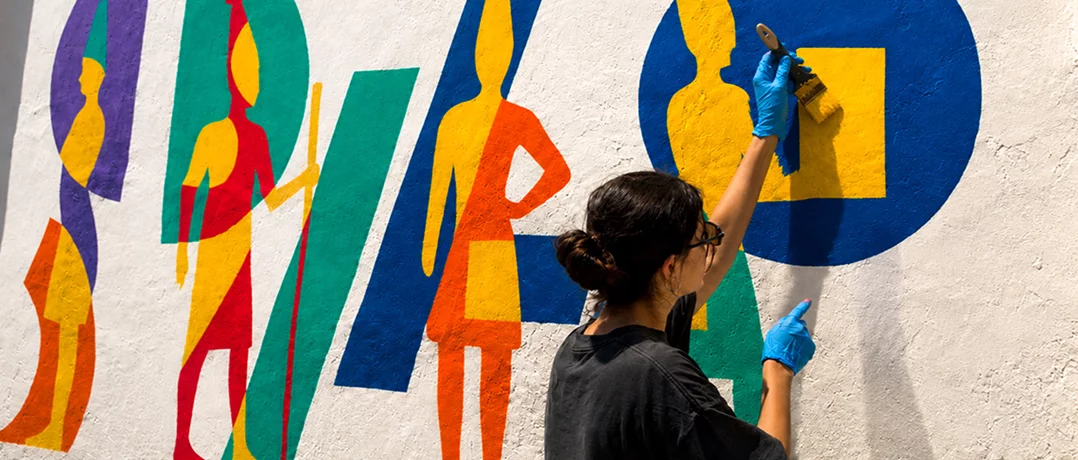
On a sunny day in Byblos, brushes moved across an old stone wall, as shades of blue, turquoise, purple and terracotta slowly started to replace what used to be emptiness on a forgotten surface. Students from the American University of Technology (AUT) stood out in the street beside the historic Byblos castle near St. Aquilina Church, flipping sketches and research, turning it into an expansive mural inspired by the city’s Phoenician history.
The project, created by AUT’s Fundamentals of Design II students under the supervision of Maroun Abboud, Acting Chairperson of the Graphic Design Department and Stephanie Saliba-Sacroix, Full-Time Faculty Member of the Graphic Design Department, brought the classroom into the streets of Byblos.
Located near the public beach and the path leading toward Byblos’ market, the mural became a meeting point between history, design and everyday life. For Dr. Joseph Chami, Mayor of Byblos, the artwork represents a reminder of the city’s living heritage through the hands of its younger generation. He described the mural as a student-driven contribution that reflects the spirit of the world’s oldest city.
From a municipal idea to a student creation
The project began when the municipality of Byblos approached AUT with the idea of revitalizing public spaces across the city. The question became how graphic design students could connect Byblos's ancient identity with a contemporary visual language.
Maroun Abboud explained that the team started exploring ways to merge the city’s history with modern art. “The idea started when the municipality of Byblos reached out to the university that they have a lot of spaces in Byblos that need some beautification,” he said. From there, the Phoenician theme became the foundation of the project.
Together with Stephanie, the students researched the cultural symbols, materials and colors connected to the Phoenician civilization. The final palette carried layers of meaning: purple reflected the legendary Phoenician dye associated with trade and cultural influence, deep blue represented the Mediterranean Sea and maritime identity, while turquoise captured the movement and freshness of the coastal city. Yellow connected to Byblos’ sunlight, limestone architecture, and archaeological remains, while terracotta and burgundy echoed craftsmanship, memory and continuity.
Learning history through design
For AUT, the mural became more than a design exercise. It became a chance for students to engage directly with their surroundings and understand how creativity can interact with communities.
“Our mission is to create civically engaged students, where students can be integrated more into the community,” Maroun explained. The project reflected AUT’s approach of preparing students through experiences beyond traditional classroom assignments.
Stephanie added that real-world projects give students a different kind of learning experience. “We don't limit them to the borders of the classroom. We try as much as possible to integrate them with real field work, and murals and graffiti is one of them,” she said.
The students spent time researching Byblos and the Phoenician period before beginning the design process. The research became essential to understanding the people behind the symbols they were recreating.
“Whenever we give students any project, they should do a very deep research about the topic itself and the scenario or where this project will be done,” Maroun said. Working directly inside the historic city allowed them to see the connection between the artwork and the place it was designed for.
A Phoenician story told through colors and characters
The mural shows Phoenician figures doing all kinds of tasks, engaging in different movements and forms of work. It lets the person see the civilization through craftsmanship and daily life. During the research process, the students noticed details that were beyond the “usual” familiar scenes tied to Phoenician history.
Stephanie explained that many students were surprised to learn about the variety of Phoenician skills, from trade and fishing to clay work and craftsmanship. “They discovered a lot of things that for them were a discovery,” she said.
Maroun described how the students began seeing Phoenician figurines differently. Instead of viewing them as static historical objects, they imagined them in action, connected to the work and creativity of the people who created them.
Graphic design became the bridge between historical knowledge and public understanding. “Graphic design is always a visual representation of a certain message or a communication,” Maroun said. Through the mural, the students translated history into images that anyone passing by could understand.
One day, one wall, one community
The execution of the mural happened in a single day. After weeks of research, preparation and design development, the students painted from 8 a.m. until 8 p.m. to finish the work, while the street was temporarily closed.
For many of them, it was their first mural experience.
Stephanie remembered how the students trusted the process step by step, eventually seeing their sketches become part of the city itself. Maroun recalled that when the work was finished, some students wanted to keep painting even after the team needed to clear the street.
“They were like, we are enjoying it. Can we stay? Can we continue working?” he shared.
Throughout the day, locals stopped to watch, encourage, and support the students. Some residents brought drinks and snacks, while others expressed their happiness at seeing the wall transformed. The project became personal for many people living nearby, especially those who felt connected to Byblos’ Phoenician roots.
“They feel they belong more,” Stephanie said, describing the reaction from the community.
A future written on city walls
The response to the mural has already sparked interest from other communities looking for similar collaborations. For AUT, projects like this represent the continuing role of design as a tool for storytelling and connection.
The students left behind more than a painted wall. They created a public artwork where history, research, and imagination meet on the same surface.
The final brush strokes dried under the Byblos sun, with the Phoenician figures standing beside the road that leads visitors from the sea toward the old market.
-
-

-
Rayanne TawilCultural writer
-
