

The Byblos International Film Festival returns to the Jardin des Artisans from Aug. 21 to 23, bringing Lebanese and international films, emerging directors and three nights of screenings into the historic Old Souk.
Cinema returns to the old souk for BIFF’s second edition
Cinema returns to the old souk for BIFF’s second edition
By Rayanne Tawil | August 25, 2026

Reading time: 5 min
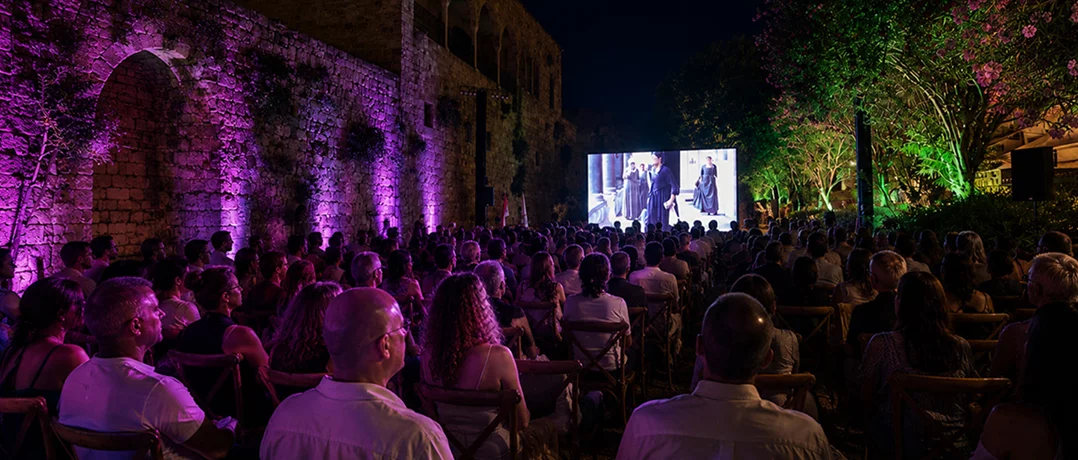
For three nights, the Jardin des Artisans in Byblos will once again turn into an open-air cinema. The Byblos International Film Festival (BIFF) returns for its second edition from Aug. 21 to 23, keeping the same setting that shaped its first year: the Old Souk, where screenings sit alongside the city’s centuries-old streets, shops and stone walls.
The festival opens on Aug. 21 with a 6 p.m. red-carpet and opening ceremony, followed at 8 p.m. by a special screening of “Primavera,” presented in collaboration with the Italian Cultural Institute of Beirut, alongside a short-film screening. The following nights continue with short films, including Nicolas Khoury’s “Souraya Mon Amour,” while Aug. 23 closes with Marie Surae’s “Take My Sun With You” and the awards distribution.
For Antoine Sfeir, vice president of BIFF, returning to the Old Souk was an easy decision. “Byblos is not simply where the festival takes place, it is part of its identity,” he tells The Beiruter. “There is something very special about watching films in a city carrying thousands of years of history.”
Same stones, a bigger screen
The second edition comes after a first year that gave the organizers a clearer sense of what BIFF could become. Alexandra Karam, co-founder and president of the festival, says the responses helped shape this year’s direction.
“The first edition taught us a lot, especially about understanding our audience and what we wanted BIFF to become,” she says. This year, the team focused on “the quality and diversity of the program, the experience of the audience and creating stronger connections between Lebanese and international cinema.”
Sfeir describes the new edition as “a natural evolution” of the first, with a selection ranging from emerging filmmakers to established voices. Films were received from countries around the world, with the selection built around works that had “a strong voice and something meaningful to communicate,” he says.
There is no single theme running through the program, though Sfeir points to recurring questions of “identity, memory, relationships, resilience and the way people experience the world around them.”
Four Lebanese stories, four ways in
Among the Lebanese filmmakers featured are Giovanni Bassil, Nicolas Khoury, Daniel Daher and Jorj Abou Mhaya, each arriving at the festival with a very different story.
Bassil’s animated short “The Money Keeper” began with an unusual image: an ATM that made him wonder what could be happening inside it. From there came a story about an elderly man, fatherhood and Lebanon’s relationship with money and banks.
“I wanted to tell a story that's about Lebanon, about the money problems we have, but at the same time, to be something very humane,” Bassil says. With no budget or crew, he drew the characters and locations himself and built the film frame by frame, eventually spending two and a half years to complete it. “Everything, everything, from scratch, from zero to a hundred,” he says, referring to the animation, sound effects, music, mixing, distribution and poster design.
For Bassil, a festival screening gives that work a different kind of life. “It gives us a voice. It gives us a platform. It gives us a spotlight,” he says. “Ten minutes means a lot, because 10 minutes is years of hard work.”
Khoury arrives with “Souraya Mon Amour,” a film that grew from a chance encounter with its central character. “Soraya was the one who wanted to do it. She wanted to talk and I wanted to listen,” he says. The film developed over a year and a half, eventually becoming a personal story about love, relationships, women, death and the choices people make.
For Khoury, screening the film in Byblos carries a particular excitement. It is his first time presenting work there, and he says he feels as if he is “having Soraya at home, since she's from Byblos.”
Turning difficult experiences into film
Daniel Daher’s “Dissolve” comes from somewhere more personal. “I wanted to translate something that is very difficult to explain with words, the feeling of losing your connection to yourself and to reality, into something visual and cinematic,” Daher says. “I wanted the audience to experience, even for a few minutes, what it feels like.”
Making the film came with its own strange overlap. “I was actually experiencing dissociation while making a film about dissociation,” he says, describing moments spent directing a crew while feeling disconnected himself. “In a strange way, the production itself became part of the experience I was trying to portray.”
Jorj Abou Mhaya’s animated short “JEEM 1983” travels back to another Lebanese experience: childhood during the Lebanese Civil War. The film grew from a producer’s personal loss, whose father was killed in 1983, and from a shared desire to explore the generation that grew up during the war.
“We are the generation that were born during the civil war,” Abou Mhaya says. “There were no social media. We can only watch TV at the time.” The film brings back the childhood heroes of that era, including the animated character Goldorak Grendizer, while exploring how drawing and imagination offered children their own space during a violent reality.
“I just hope it resonates with them,” he says of the Lebanese audience. “The civil war was like a daily life for us.”
A festival people can walk into
Accessibility remains central to BIFF. All screenings are free and open to the public, allowing filmmakers, students, families and people simply passing through Byblos to enter the festival without a ticket.
“We wanted BIFF to feel open and welcoming,” Sfeir says. “Films and culture should not feel exclusive or limited to a certain audience.”
Karam sees the festival as a platform that can grow alongside the city and its filmmakers. “Lebanese cinema deserves to be part of that international conversation,” she says, adding that she hopes emerging filmmakers feel there is “a platform here that takes their work seriously and gives it a place to be seen.”
Where the formula stays familiar: August nights, films on a screen, and the old stones of Byblos surrounding the audience.
-
-
-
Rayanne TawilCultural writer
-
