



Once a beacon of modernity and collective memory, Tripoli’s Colorado Cinema is being dismantled, seat by seat, story by story.
Colorado Cinema: Tripoli loses a star

The first thing anyone notices inside Colorado Cinema is the ceiling.
Standing inside the space in 2022, during a walking tour of Tripoli’s old cinemas led by archivist and writer Nathalie Rosa Bucher, the gaze instinctively lifts upward. A star-shaped light spreads across the ceiling, glowing in faded retro colors. Around it, paint peels from the walls and ceiling, humidity has left its mark, and clumsy plastic repairs try and fail to hold things together. And yet, it remains beautiful. Quietly, stubbornly beautiful.
That is the thing about Colorado. Even in decay, it maintained its dignity.
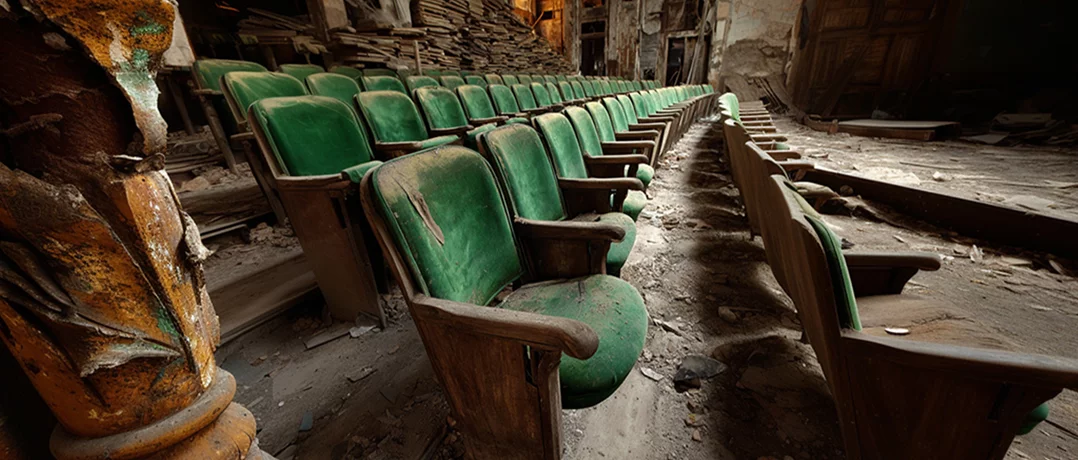
Now, it is being taken apart. The seats have been removed. The space is being gutted. Another cultural landmark erased not by war, but by neglect and indifference.
A cinema built to impress
When Colorado Cinema opened in January 1955, it represented something entirely different for Tripoli. “By the time the Colorado opened, there were over a dozen cinemas in the center of Tripoli,” Bucher explains, placing it in a city that was already alive with film culture. The heart of it all was Tripoli’s Tal district, but Colorado deliberately stretched beyond it, built near what is now Al Nour Square, helping expand the city’s cultural axis.
It wasn’t just a cinema; it was a carefully composed experience. Commissioned by Dr. Wahib Nini and designed by architect Georges Doumani, the building was part of a two-floor commercial and office complex opening onto the Boulevard. Glass display cases flanked the entrance, showcasing studio photos sent by distributors to lure audiences inside. Inside, marble floors echoed patterns which followed the wall designs. The left side of the room contained a salon which included upholstered chairs for seating. The right side of the room had a box office which provided access to the balcony area where the top-rated seats could be found.
And presiding over it all was the red star light at the entrance. “The most iconic element,” Bucher says. Colorado was modern, elegant, and intentional. While other cinemas of the era leaned toward Art Nouveau influences, this one stood apart. “It’s an exceptional example of mid-century modernism,” she says, part of the same ambitious architectural moment as the Opera or Metropole, but with a distinct identity of its own.
Doumani’s vision didn’t stop at the building. As the southernmost cinema on the Boulevard, Colorado helped push Tripoli’s cultural life closer to Abdul-Hamid Karami Square and the Karami Palace. That momentum later accelerated with the Oscar Niemeyer Fair, another project Doumani was closely involved in. It was a period when Tripoli was confidently growing outward, culturally and architecturally.
From collective memory to quiet dismantling
Over time, Colorado became deeply embedded in Tripoli’s collective memory. Bucher has witnessed it repeatedly while leading cinema walks through the city. “From the moment people were in the foyer, the response was a collective ‘wow,’” she recalls. This was years after the cinema had lost electricity, after dust caked the seats and posters disappeared from the walls. The power of the space remained.
That, she says, is what collective memory really is. The shared experience of watching films together with others who experienced the same film as you, along with your choice of seat partners and your post-movie argument partners and your dark theater love interests, creates a shared experience that exists beyond the actual movies. “Collective memory is collective experience,” she says. “Family, friends, flames.”
The decline, though, was gradual and global. Television, VHS, the Civil War all played their role. In Tripoli, the Syrian occupation further altered audiences and habits. Cinemas are businesses, and keeping them alive became increasingly difficult. By the time Bucher first visited Colorado in 2013, “for sale” signs were already hanging on its walls.
Still, dismantling was not inevitable. “Absolutely, it could have been saved,” Bucher insists. Cinema Empire has been reactivated. Rumman Association revived Cinema Radio in Mina. Cinema Rif in Tangier found new life. It isn’t easy, but it’s possible.
Founder and director of Marsah, Nadine Alidib, who worked on the cinema as co-director of Allo Trablos, agrees that alternatives existed, but argues that the failure was structural. “There is no national campaign, no sustained framework to protect places like this,” she says, noting that Colorado follows the same fate as Tripoli’s Inja and Rivoli cinemas. “These spaces become visible only when they are threatened.”
A concrete attempt was made. Through Allo Trablos, the team gained access to the cinema for six months, cleaning the space, restoring electricity, and working with artists and researchers inside. The project proposed rehabilitating Colorado into a museum and public cultural space rooted in the city’s memory. “We wanted it in the heart of Tripoli,” says Delphine Abirached Darmency, co-founder of Allo Trablos. “For everyone, not just people who already go to cultural spaces.”
The initiative stalled at the conceptual phase due to a lack of funding. In October 2024, the owners informed the team that the cinema would be closed to any future projects, likely in preparation for a sale.
What stopped Colorado, Bucher says, was ultimately a lack of interest from its owners. Attempts by a local NGO to rent and revive the space as a cultural hub were categorically refused, followed instead by an offer to sell at an exorbitant price.
When news broke that the cinema was being gutted, the reaction was raw. “With pain,” Bucher says. “I didn’t sleep for two nights.” Architects, heritage advocates, and especially, the Doumani family felt the loss acutely.
Beyond the building, the closure carries a heavier meaning. Bucher points to the absence of young voices in the city, the steady migration of Tripolitans under 50, and the missed opportunities of a city once named Arab Capital of Culture. Tripoli fascinates visitors with its Mamluk architecture, modernist gems, and the Niemeyer Fair, things Beirut no longer has. And yet, they continue to disappear.
-
-

-
Rayanne TawilCultural writer
-
