



From a vital farm worker to a symbol of Lebanon’s rural heritage, donkeys continue to connect the country’s villages, people and traditions.
Donkeys, the guides of the mountain

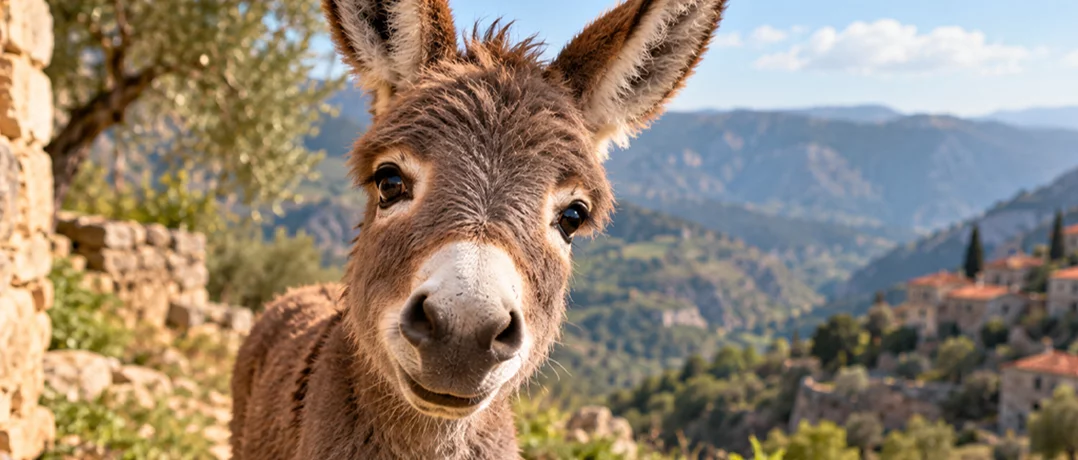
The donkey is Lebanon’s most trusted worker, hauling harvests, firewood and water between villages. Villagers traveled between settlements on foot or on horses and donkeys, and the old paths still exist, and the Lebanon Mountain Trail now passes through more than 75 towns and villages.
Research is now confirming what villagers always sensed. In a study published in Scientific Reports 2026 brief interactions with miniature horses and donkeys left 61 adolescents calmer and less nervous, sad and lonely. For World Animal Day, two Lebanese voices show what that partnership looks like at home.
Rescue and rebuild: the Donkey Farm at Maaser
Chibli Abou Assi's farm began as his father's dream of self-sufficiency, with goats, chickens, grapes, figs, walnuts and pines. Weekends with borrowed donkeys became a way of life, and when the family tried to buy three of their own, they found almost none worth buying.
"I noticed that many of them were being badly mistreated and were in extremely poor condition," Abou Assi recalled. He gathered five from across the north and the Bekaa. "We brought them in a truck. They were in such bad shape that they could not even stand." Today the farm shelters 18. He sells or gives away surplus animals only to people who "genuinely care about them," and buyers must prove they have space, food and proper care.
Even racing has been reinvented. Traditional Lebanese races involved adults riding and hitting the animals. "We do it differently," he explained to The Beiruter. "Nobody rides on their backs and nobody hits them." Guests jog with a rope in hand while the donkey runs alongside.
The farm also makes its donkey milk soap through a simple, hands-on process that guests can experience themselves. They begin by milking the donkey, which takes around 20 minutes, before mixing the fresh milk with olive oil and sodium hydroxide (NaOH) in carefully measured proportions. The ingredients are mixed at a specific speed until the mixture forms soap, which is then poured into molds. Guests can keep the soap simple or personalize it by adding essential oils, natural colors, herbs and other ingredients.
Abou Assi pointed out that only six farms worldwide offer this experience, with theirs being the only one in Lebanon. The farm adds beekeeping lessons, molasses workshops and a farm-to-table lunch under grape arbors, with everything built by hand from reclaimed wood and scrap metal. "This was my father's dream when he started it," he said, "and now we have continued it."
The path-makers: donkeys in village memory
In Bcharre, the donkey's story runs through the routes themselves. A nineteenth-century travel survey of the Lebanon crossing contrasts the donkey or camel toiling over the rough old mountain trail with carriages on the new road, and notes that locals unable or unwilling to pay the company's tax kept using the old path. The donkey's route was the free route. Chawki Keyrouz, a farmer and donkey owner in Bcharre, remembered when the animal was central to farm life.
"In the past, the donkey was part of almost every farm here. It was not just an animal that you kept; it was part of the work. When we went to the fields, the donkey would carry the things we needed, whether it was wood, grain, the harvest or tools. You could load it and take it through paths where a car could never go." What made the animal so valuable was its memory of the ground.
The remarkable thing about a donkey is that it learns the paths. “You could take it along the same mountain route so many times that it would almost know the road by itself. There are paths that are steep, rocky and difficult to walk on, but the donkey knows where to put its feet,” Keyrouz told The Beiruter.
Today, things have changed completely. There are roads where there used to be only paths, and there are machines that can do in an hour what would once have taken a donkey and a person an entire day. “But when you grow up around these animals, you do not simply stop seeing them as useful because technology has arrived. They are part of the history of the village, and for me, keeping them is also keeping a small part of that history alive,” he explained.
He worries that younger villagers, raised on cars and paved roads, may not grasp what these animals once meant. "For the older generation, seeing a donkey would immediately bring back memories of how the village used to be. For younger people, it is different because they grew up with cars and modern roads.”
The donkey as a guide
The donkey is an animal shaped by the mountains themselves, capable of navigating terrain that once connected villages, farms and families when roads and machines did not exist. It carried the necessities of daily life, followed paths across difficult landscapes and became intertwined with the rhythm of rural communities.
Even as its practical role has diminished, its value has not disappeared. The donkey remains a reminder of a slower relationship with the land, of work done by hand and of an animal whose strength, memory and patience made it indispensable. To preserve the donkey is therefore to keep alive a piece of Lebanon’s landscape, memory and rural heritage.
-
-

-
Jenna GeageaReporter/Writer
-
