



Washington’s renewed focus on the Americas is transforming regional politics, reviving spheres of influence, and redefining US power in the Western Hemisphere.
Donroe Doctrine vs. Monroe Doctrine

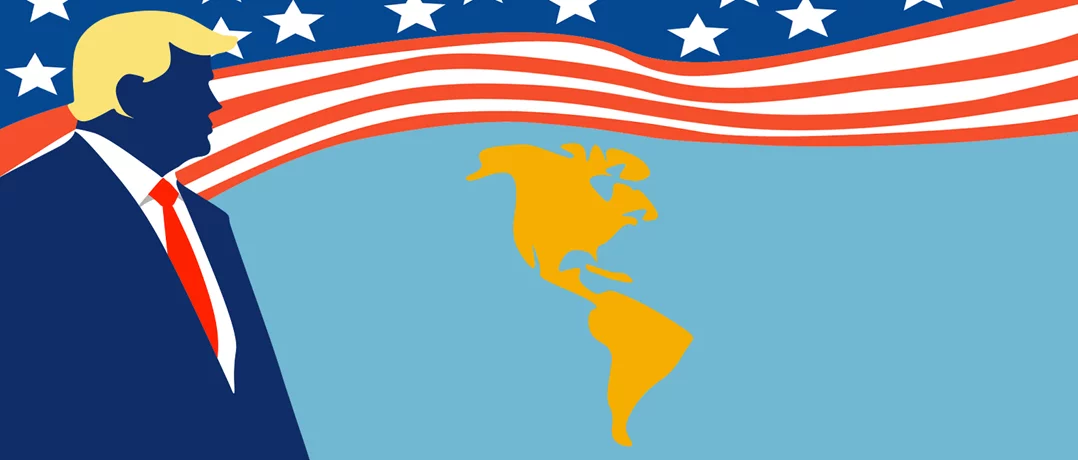
For much of the post-Cold War era, the Western Hemisphere drifted to the margins of United States (US) foreign policy, overshadowed by wars in the Middle East, strategic competition in Southeast Asia and crises in Europe.
Under US President Donald Trump’s second term, that hierarchy has been decisively reordered. The Americas have become Washington’s primary geopolitical theater, marked by unprecedented military posture, economic coercion and overt political pressure.
Observers have increasingly described this approach as the “Donroe Doctrine;” a Trump-era reinterpretation of the 19th-century Monroe Doctrine that replaces defensive hemispheric protection with assertive dominance. This shift has not only reshaped US-Latin American relations but also upended the region’s political balance and raised fundamental questions about sovereignty, international law and long-term stability.
What is the Monroe Doctrine?
The Monroe Doctrine was articulated in 1823 by US President James Monroe during his annual address to Congress. At its core, it warned European powers against further colonization or political interference in the Americas, declaring such actions a strategic and direct threat to US security. In exchange, the United States pledged not to interfere in existing European colonies or in European internal affairs.
While initially defensive and aspirational, given the limited power of the young republic, the doctrine gradually evolved into a framework for US hemispheric primacy. The most consequential expansion came with President Theodore Roosevelt’s 1904 Roosevelt Corollary (in response to the 1902-1903 Venezuelan crisis, when European powers blockaded Caracas to collect debts), which asserted the US right to intervene militarily in Latin American countries deemed unstable or incapable of managing their affairs. Over the following century, this logic was repeatedly invoked to justify interventions, covert operations and regime changes across the region, embedding the Monroe Doctrine deeply into the architecture of American power in the Western Hemisphere. This included orchestrated coups in Guatemala (1954) and Chile (1973) as well as invasions, such as Operation Just Cause in Panama (1989) and Bay of Pigs Invasion in Cuba (1961).
What is the “Donroe Doctrine”?
The “Donroe Doctrine” is a term coined by various commentators and media outlets in 2025 to describe President Trump’s contemporary reimagining of hemispheric dominance. However, just recently, the doctrine gained headlines after Washington captured Venezuelan President Nicolás Maduro along with his wife on 3 January 2026 as well as following Trump’s adoption of the term in a subsequent news conference in early January 2026, stating that “the Monroe Doctrine is a big deal, but we’ve superseded it by a lot, by a real lot. They now call it the Donroe Doctrine.”
Named after Trump, it reflects an explicit claim that the Western Hemisphere constitutes America’s exclusive “sphere of influence.” Unlike earlier versions of the doctrine, which were often framed in ideological terms (anti-colonialism, anti-communism or democracy promotion) the “Donroe Doctrine” is overtly transactional and power-centric; meaning that it represents a much more aggressive policy than the former Monroe Doctrine, permitting Washington to intervene in any country in the Western Hemisphere without invoking past justifications (as mentioned earlier).
Under this approach, sovereignty is conditional, alliances are rewarded materially and defiance is met with coercion. Trump administration officials have repeatedly framed the hemisphere as America’s “neighborhood,” emphasizing that global leadership is impossible without uncontested regional supremacy. The doctrine does not merely warn external powers to stay out, but rather seeks to actively restructure political and economic alignments within the Americas to favor US interests.
This approach clearly aligns with Professor John J. Mearsheimer’s Offensive Realism Theory, which asserts that states (which are the primary actors in the international system) are inherently driven by the desire to maximize their power and achieve dominance over others (especially in their regions).
Why did this strategic shift occur?
Several converging factors explain the re-centering of the Western Hemisphere in US strategy.
First is the growing presence of China, which has expanded its economic, diplomatic and infrastructural footprint across Latin America through trade, investment and energy partnerships. Iran and Russia, although more limited, have also cultivated strategic ties, particularly with sanctioned or authoritarian governments such as Venezuela (under captured President Nicolás Maduro) and Cuba.
Second, domestic priorities (especially migration, narcotics trafficking and countering the left) have driven a more forceful regional posture. The Trump administration has argued that instability and permissive left-wing governance in Latin America directly fuel US security challenges, necessitating stronger intervention. Indeed, in the 2025 National Security Strategy, Washington asserted that “strength is the best deterrent.”
Finally, Trump’s personal worldview plays a significant role. Influenced by a transactional, zero-sum conception of power, he views international politics through the lens of territorial control and leverage. In this framework, allowing rivals influence in the Americas represents strategic negligence rather than diplomatic pluralism.
How has the “Donroe Doctrine” been implemented so far?
The implementation of the “Donroe Doctrine” has combined military, economic and political instruments in unusually direct ways.
Militarily, the US has expanded its footprint in the Caribbean, deploying tens of thousands of troops and positioning major naval assets near Venezuela. Targeted strikes against alleged drug-smuggling vessels and the recent direct action against Maduro’s “hostile” regime signal a readiness to use force as a tool of regional management.
Economically, Washington has relied heavily on tariffs, sanctions and selective bailouts. Friendly governments (especially right-wing ones, such as Argentina under President Javier Milei or El Salvador under Nayib Bukele) have received financial assistance, trade concessions and diplomatic support. In contrast, “hostile” and unfriendly governments (notably left-wing ones) have faced punitive measures, including sanctions, aid suspensions and public threats.
Politically, the administration has shown a willingness to openly influence domestic politics in the region, endorsing favored candidates and applying pressure during electoral cycles. This marks a departure from the more discreet methods of influence characteristic of recent decades.
The significance of the shift
The “Donroe Doctrine” represents a return to Realism (Realpolitik) and covert hemispheric interventionism, with profound implications.
Regionally, it has accelerated political polarization, contributing to a rightward drift in several countries while deepening resentment among others. Governments now face a stark choice: align with Washington’s demands or risk economic and political isolation.
Globally, the doctrine challenges prevailing norms of sovereignty and multilateralism. By framing international relations in terms of exclusive “spheres of influence,” it echoes the logic used by other great powers to justify coercive actions elsewhere, potentially weakening the international order the United States once championed (ever since President Woodrow Wilson’s advocacy and key role in establishing the League of Nations in 1919 following World War I). However, it could well be eroding Chinese and Iranian influence in the region, while simultaneously granting the needed justifications and pretexts for Russia and China to dominate their own regions (notably Ukraine and Taiwan, respectively).
As for the United States itself, the approach carries both opportunities and risks. While it may deter external rivals and extract short-term concessions, it also risks long-term backlash, fostering nationalism and anti-American sentiment that could undermine US influence for generations.
In conclusion, the “Donroe Doctrine” prioritizes Realism (Realpolitik) over Liberalism, dominance over partnership and leverage over legitimacy. By reviving and reshaping the Monroe Doctrine for the 21st century, President Trump has reasserted the Western Hemisphere as America’s strategic core, ending decades of relative neglect. Whether this approach will secure lasting stability, curb rival influence or ultimately provoke resistance remains uncertain. What is clear, however, is that the legacy of the “Donroe Doctrine” will extend far beyond Trump’s presidency, forcing future administrations (along with the nations of the Americas) to grapple with its consequences.
-
-

-
The Beiruter
-
