



US President Donald Trump authorized Operation Epic Fury, a joint US-Israel military strike on Iran, killing Supreme Leader Ayatollah Ali Khamenei and targeting nuclear, missile, and military sites.
Drawing the Red line: The aftermath of Epic Fury
Drawing the Red line: The aftermath of Epic Fury
By Marwan El Amine | March 01, 2026

Reading time: 5 min
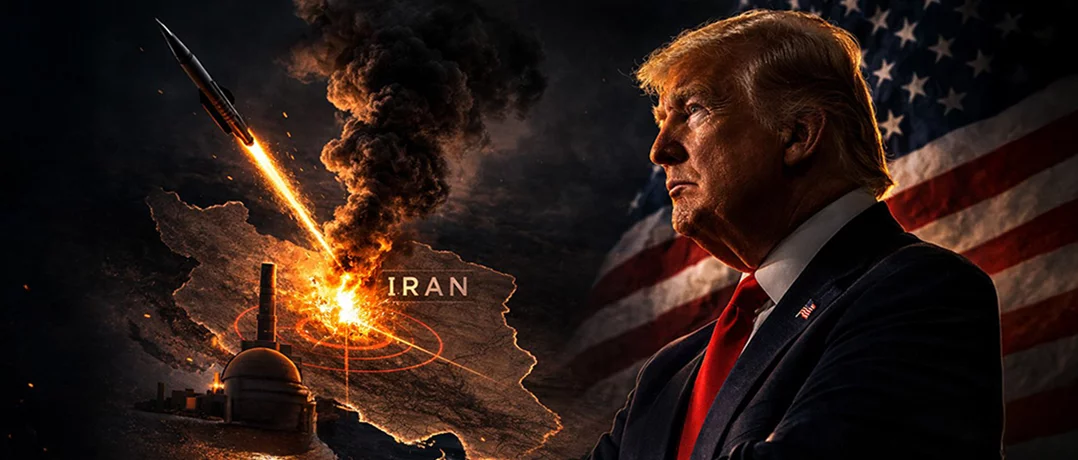
Every time tensions flare between Washington and Tehran, the same question resurfaces: will the President of the United States opt for military action, or retreat to another round of calibrated brinkmanship? With renewed speculation that President Donald Trump may this time authorize a decisive strike against the Iranian regime, one far more consequential than the limited blow delivered in June 2025, the moment appears to test a long history of American hesitation in confronting the Iranian conundrum.
No occupant of the Oval Office has found the decision easy. Targeting Iran is not a conventional Middle Eastern intervention. The risks are layered and volatile, resistant to neat containment. Tehran commands not only regular armed forces but an intricate web of regional proxies capable of igniting multiple fronts simultaneously. It wields strategic leverage that ranges from threatening to close the Strait of Hormuz to deploying ballistic missiles and armed drones, alongside the demonstrated capacity to strike U.S. interests well beyond the region.
For these reasons, many initially interpreted the American military buildup in the Middle East as a pressure tactic rather than a prelude to full-scale war. Trump, who campaigned on ending “endless wars,” understood that an open-ended confrontation with Iran would create friction within the Republican Party and the MAGA movement even before inviting Democratic opposition. The show of force, in that reading, was a negotiating instrument, designed to strengthen Washington’s hand at the bargaining table. Military mobilization as leverage; escalation as a bridge to a better deal.
Yet events suggest that Trump does not read from the same playbook as his predecessors. His political career points to a preference for shock and finality over incrementalism and crisis management. To supporters, he is a president who goes straight to the heart of the problem and seeks a decisive solution, even at the cost of calculated escalation. To critics, he is a risk-taker who pushes the boundaries of power to their limits. Either way, he stands apart from the traditional school of crisis management.
As developments unfolded, the equation appeared inverted. The military buildup was not a bridge to improve negotiations; rather, negotiations became a bridge to justify military action before American and international public opinion. In this sense, diplomacy was not an alternative to force but part of the architecture of its deployment. In politics, battles are fought not only on the battlefield but in the realm of narrative, how an action is framed, defended, and presented as the last resort after every other avenue has been exhausted.
Negotiations, then, were not an end in themselves but a stage within a broader escalatory trajectory. Once the diplomatic cards were played, recourse to force could be cast as the natural extension of having offered a final opportunity for peaceful resolution.
The more sensitive question remains: what drove Trump to approve military action against Iran?
The first factor was the reported success of the initial strike in decapitating the regime’s core leadership. When a system built on centralized authority loses its supreme leader and a significant cohort of senior political, military, and security officials in a single blow, the shock reverberates through its foundations. A strike that creates a leadership vacuum can paralyze decision-making circles and deny the regime the ability to regroup quickly. Highly centralized systems are often most vulnerable when the apex is removed.
From this perspective, the objective was to avoid the nightmare of a prolonged war of attrition, precisely the scenario Trump fears for its domestic political cost. The first strike, by this account, delivered a strategic shock of rare magnitude, eliminating the supreme leader alongside dozens of top officials from the political establishment, security apparatus, and Revolutionary Guard leadership. The subsequent erratic retaliation against Gulf states, supporters argue, underscored the degree of disarray and strain within Tehran’s power structure.
A second factor was time. Wars that appear swift at the outset can quickly become political liabilities if they drag on. Trump’s early statements emphasized speed and mission completion. He does not appear interested in managing a drawn-out conflict but in executing a concentrated operation with defined objectives: dismantling the nuclear program, degrading the ballistic missile infrastructure, eliminating stockpiles of enriched uranium, and severing the network of regional proxies that has underpinned Iranian influence for decades.
The larger ambition is to redefine Iran in the post-war order, so that it no longer resembles the state that has shaped regional dynamics since 1979, either in structure or in reach. Success in such a compressed timeline would allow Trump to craft a narrative of historic victory: a president who did more than contain or sanction, but altered the balance of power and resolved a challenge that eluded his predecessors. The achievement would be not only military but geopolitical, reshaping the Middle East and neutralizing what is viewed in Washington as a persistent source of instability and transnational militancy.
Diminishing Tehran’s regional influence, moreover, could accelerate diplomatic normalization tracks, particularly under the framework of the Abraham Accords, by removing what many consider a principal obstacle to broader settlement and peace initiatives.
In the final analysis, it is true that Donald Trump pledged to end wars, not open new fronts. Yet that promise has never stood alone. He also vowed to restore the stature of the United States and reassert its credibility as a power willing to defend its interests after years in which American deterrence was perceived to have eroded. Alongside ending wars, he championed the notion of imposing peace, even throughstrength.
Viewed through that prism, a strike on the Iranian regime would not be merely a military operation but a multidimensional strategic message: restoring America’s image as a decisive power, toppling a regime long accused of sponsoring extremism, and removing a major impediment to regional stabilization. The overriding challenge, however, lies in achieving those aims through a rapid, tightly bounded campaign, without sliding into the very war of attrition Trump is determined to avoid.
