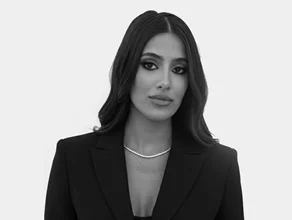
Lebanese artist Fadi Balhawan transforms pain, literature, and sacred texts into layered visual works that merge Arabic calligraphy with contemporary art.




Lebanese artist Fadi Balhawan transforms pain, literature, and sacred texts into layered visual works that merge Arabic calligraphy with contemporary art.

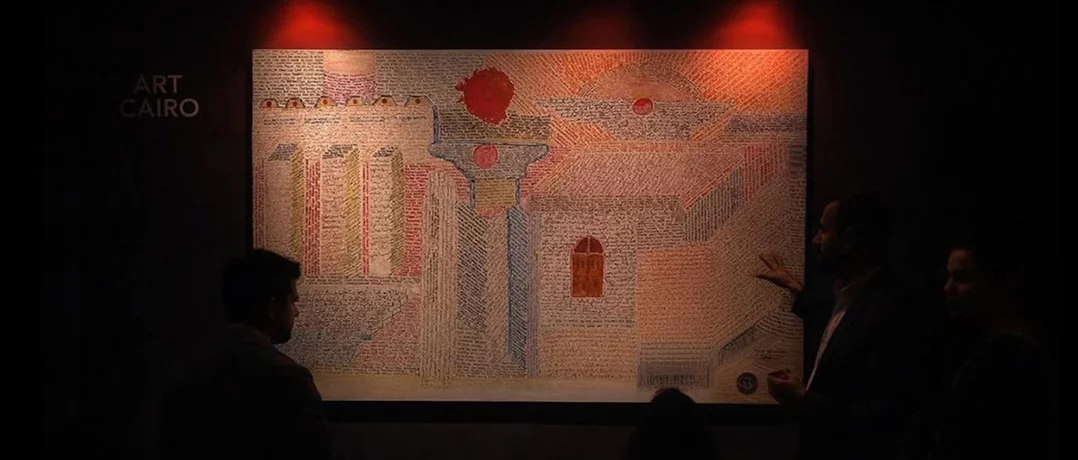
Fadi Balhawan, a Lebanese artist, transforms written words into visual compositions. His work blends painting with written text, often inspired by literature and poetry. Drawing inspiration from religious texts, classical writers, and contemporary poets, Balhawan creates layered pieces that merge color, form, and language, artworks that reveal hidden messages upon closer inspection.
From a distance, his paintings appear abstract and vibrant; up close, they unfold into text-based narratives and emotional messages. The Beiruter spoke with the artist, delving into his life and philosophy.
Balhawan's relationship with art did not begin by choice. In 1976, he was severely injured in a bomb explosion and spent close to a year hospitalized. His father, desperate to keep his young son's spirit intact, brought him pens and paper. "This is where I fell in love with writing," Balhawan recalls.
Decades would pass before that love found its fullest expression. It was not until he was fifty, visiting a stationery shop in Venice, that he picked up the same kind of pen he had used as a child. Something unlocked. He began writing regularly. Then COVID arrived, he opened an Instagram account, and the response to his Arabic calligraphy changed everything.
"I started receiving a lot of comments about the Arabic calligraphy," he says. "To do it more artistically." Confined at home with nowhere to go and nothing to prove, he began refining his work, and a practice was born.
His philosophy is direct and unadorned: "I turn the pain into ink." He is most productive, he says, during wars and periods of personal anguish. When he is happy, he goes out, sees friends, looks for life. But when he is upset, he sits and writes. "Art is pain," he says matter-of-factly, then repeats the line that seems to be his creed: "I turn pain into ink."
Balhawan's process begins with the book. He gravitates toward the devotional and the visionary, Kahlil Gibran's The Prophet and Broken Wings, St. Augustine's Confessions, the Quran, the New Testament, the Old Testament. He reads deeply, then extracts the passages that speak to him most directly, and renders them in Arabic script that operates simultaneously as language and as visual composition. "Sometimes when I'm writing in Arabic, it gives a more artistic effect," he says.
His turn toward Lebanese literature came through an unexpected route. A curator friend at Oxford urged him to stop writing Shakespeare and Alexander Dumas and look closer to home, suggesting Amin al-Rihani. Before he could act on that advice, the Italian luxury pen company Montegrappa reached out, offering to sponsor his work in exchange for featuring their pens alongside it. The special edition pen they proposed was engraved with the name Kahlil Gibran. "This is where I started writing the Gibran series," he says. "As a kind of gratitude."
Balhawan is represented by Maya Art Space, and his exhibition record now spans continents. He has shown in New York, first through a Lebanese American University fundraiser, then Milan, Cairo, Abu Dhabi, Dubai, Basel, and Paris. He has lectured at AUB, LAU, NDU, and Antonine University, walking students through the technique and demonstrating how traditional Arabic calligraphy can be animated and brought into conversation with contemporary visual art.
The reaction abroad, he notes, is different from the reception at home. "When they see the Arabic letters, they are fascinated. They don't understand, but they think that this is too mystical, too spiritual.” Foreigners often feel the form before they can access the content. Lebanese audiences arrive already inside the language, already familiar with the texts. The experience is entirely different, and he seems to appreciate both.
Looking ahead, the calendar is filling up, Istanbul in September, Paris in October, and, if all goes well, Frieze Abu Dhabi in November. "If all goes well," he says, pausing. "Of course, there's no war. There's no hostility." He laughs, and the laughter carries the full weight of what it means to plan anything in Lebanon.
What Balhawan most wants people to know about him is, perhaps, what people least expect. He runs a family business he has managed for thirty-five years. Art is not his career. It is his passion, and the distinction matters deeply to him.
"I'm a simple salesman, honestly," he says. "I like to sell things. I like to communicate with people, talking to strangers. I come from a very humble family." He is a father of four. He does not plan five years ahead. "I live day by day. It's not a plan. It's just slowly. It's flowing, taking me to a lot of nice places."
A self-described simple man, ink-stained and unhurried, carries the weight of sacred texts across galleries from Basel to Beirut. History arrives uninvited, and he finds a way to turn it into something beautiful.