



St. Maron Church glows as Fayha Choir blends Christmas hymns with heartfelt Arabic a cappella melodies.
Fayha in the vaulted Christmas glow

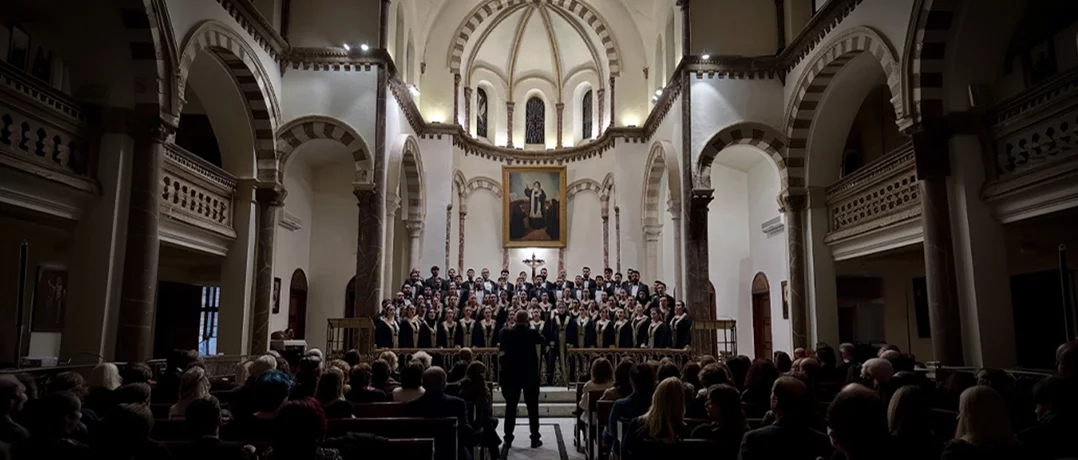
St. Maron Church, located in Gemmayzeh, was radiant long before any singing began. The focal point of the room was a crystal chandelier, which gave off an aurora of blinding rays and threw a prism of light over the white-and-gold arches and vaulted ceilings. The pews were packed with people to such an extent that more chairs had to be brought out. It was a mixture of families, old couples, students, musicians, and neighbors, who were even shouting at each other while searching for the seats in the crowd that literally seemed like all of Lebanon had come to this one holy place.
Then, all of a sudden, the total silence was broken.
A soloist from the Fayha National Choir, a young lady, entered the stage, and literally, “Joy to the World” was raised onto the heavens. It was like the instant of her singing was so strong that the chandelier and the light beams coming through it were actually suspended. The moment after that, the choir erupted in, ladies dressed in black and gold, gentlemen in tuxedos, forming a deep layer of sounds that were falling over the rocky walls.
Then, they performed an Arabic a cappella piece where a male soloist was leading. His verses were so penetrating that they made many people in the church cry, me included.
Songs that moved through stone
The program unfolded like a slow and intentional journey, shaped not as a fixed concert list but as something living. “We don’t work for concerts,” Maestro and conductor Barkev Taslakian later explained. “We work, and we always add songs. The program changes according to the audience, the acoustics, the mood of the conductor.”
From the snowfall softness of Fairuz’s “Talj Talj” to a soaring “Ave Maria” that reverberated through the vaults, each piece seemed to breathe with the space. “Law Bagi Leila,” tuned by Oussama Charafeddine, carried an ache so deep it silenced even the restless. The solo male vocal was the start of the Al-Andalusi piece. Then the choir softly enveloped him. The next piece was "Carol of the Bells" which was first sung in Ukrainian and then in English, after which the slow, heartbeat-like rise of "Little Drummer Boy" was heard.
In the intervals between songs, Taslakian communicated with the public directly, not only illuminating the music but also the thought process that went behind it. “In Arabic, we have strict conditions,” he said. “We have to pronounce the word correctly. If the pronunciation changes, it stops being Arabic.”
He smiled as he demonstrated the physical difference. “Europeans open their mouths vertically. In Arabic, we open horizontally. That makes harmony much harder, especially when there are no instruments. But we found a way. We pronounce in Arabic, and the sounds blend together.”
He laughed at one moment and remarked, "Sometimes it is harder than it appears," which made the whole congregation laugh. He was with his hands not only leading the choir but also the atmosphere of the entire church.
The audience held its breath.
A gentle surprise followed when Taslakian invited Mahmoud, a choir member, to conduct one piece, a quiet gesture of trust that earned smiles from both choir and audience.
The school of Arabic a cappella
For Taslakian, Fayha is not simply a choir but a philosophy, and as he insists, a global musical movement. “This is a new school,” he said firmly to The Beiruter in an earlier conversation. “It was officially announced twelve years ago in Europe. There is a new school in the world: Arabic a cappella.”
What makes it radical, he explained, is the use of Arabic maqams and microtones. “Three-quarters of our sound are microtones. Europeans removed microtones from their music because they couldn’t use them in harmony. We were able to use them in harmony.”
The difficulty goes even deeper into the Arabic alphabet itself. “We have letters that are not musical,” he said. “The lips are closed; the sound stops. But we still have to pronounce them correctly without losing the soul of the music.”
It took years of experimentation, trust, and precision to reach this balance, one that allows Fayha to sing Bach and Beethoven alongside Fairuz, maqams beside Christmas hymns. “If you listen to the same song every time,” Taslakian said,
“you hear it differently each time. Like Christmas songs, we sing them every year, and every year we have the same joy.”
Composer and oud player Ziad El Ahmadi later joined the choir, performing pieces including one he specially composed and arranged for them. “We asked him to distribute it for the choir,” Taslakian said, noting that collaboration is a long-term project, not a one-night event. The audience erupted in laughter during El Ahmadi’s famously humorous song about an annoying neighbor, the warmth in the room deepening.
A Dabkeh to close the night
With the concert coming to a close, Taslakian’s voice became gentler yet still powerful. “To inspire the crowd and give a chance to love is our mission,” he stated. “If we are together, then nothing is impossible for us.”
That message came home in the final piece: a tribute to the Lebanese Dabkeh. “Whatever happens, whatever you do,” he said before the last notes, “we will continue to sing.”
The audience rose with him.
The church slowly emptied, and the choir gave one final present, a gentle and happy reprise of “Jingle Bells,” which resonated in the stone and spread into the chilly Gemmayzeh streets, thus making people go home with softer steps and warmer hearts.
-
-

-
Rayanne TawilCultural writer
-
