



Lebanon’s constitutional framework, shaped by Taëf, now fuels paralysis, exposing the urgent need for structural reform.
From constitutional promise to institutional paralysis: Lebanon’s unfinished state
From constitutional promise to institutional paralysis: Lebanon’s unfinished state
By Dr. Elie Elias | January 30, 2026

Reading time: 5 min
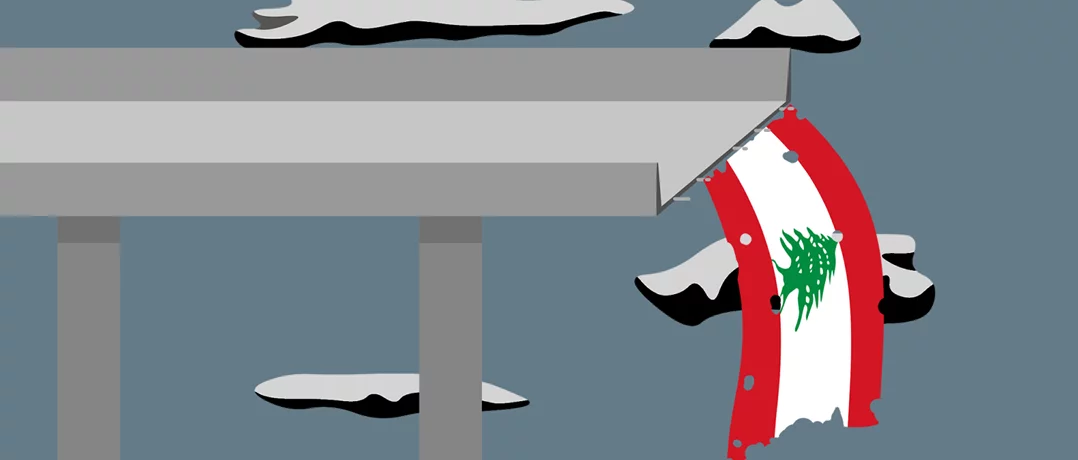
A constitution is more than a legal framework. It is a political contract that reflects a society’s understanding of authority, citizenship, and representation. In Lebanon, the Constitution has always carried a dual burden: it seeks to establish a modern state governed by law while simultaneously managing a deeply plural and confessional society. Since its promulgation in 1926, the Lebanese Constitution has undergone several amendments, the most consequential of which followed the Taëf Agreement in 1989. While these changes intended to end a devastating war, they also produced a fragile and ambiguous system whose limits are now fully exposed. Today, constitutional renewal has become not a theoretical debate but a political necessity.
The Lebanese Constitution was adopted on 23 May 1926 during the French Mandate. It was, by the standards of the region at the time, an advanced and liberal document. Inspired largely by the founding fathers’ political culture and by the French constitutional models, it established a republican regime based on the separation of powers, parliamentary representation, and fundamental freedoms.
The Constitution guaranteed equality before the law, freedom of expression, protection of private property, and respect for individual rights. It also established a parliamentary system with a strong executive presidency, reflecting the political culture of the interwar period.
Yet from its inception, the Constitution was shaped by Lebanon’s religious diversity. Article 9 guaranteed freedom of belief and worship, while Article 95 recognized confessional representation in public offices as “a temporary measure”. This provision was intended to reassure religious communities during the early years of state-building, not to entrench sectarianism permanently. However, what was described as provisional soon became structural. The tension between civic principles and communal balance became a defining feature of Lebanese constitutional life.
The first significant amendments to the Constitution were adopted in 1927 and 1929. These amendments reinforced the powers of the President of the Republic, consolidating executive authority. The President acquired wide prerogatives, including appointing and dismissing governments and dissolving Parliament. Parliamentary oversight remained weak, and executive dominance became a central feature of governance. This arrangement reflected demographic realities and French political support at the time that would later fuel political grievances.
Following independence in 1943, Lebanon did not adopt a new constitution. Instead, political balance was redefined through an unwritten agreement known as the National Pact. This pact established a confessional distribution of top political offices, assigning the presidency to a Maronite Christian, the prime ministership to a Sunni Muslim, and the speakership of Parliament to a Shiite Muslim. Although not formally codified, this arrangement became binding constitutional practice. It reinforced sectarian power-sharing, with condition to have a real statemen leaders, while postponing the implementation of Article 95, which had promised a gradual move toward non-confessional governance.
Between independence and the outbreak of the war in 1975, the Constitution functioned within this framework. Lebanon experienced periods of stability and economic growth. Muslim communities increasingly viewed the constitutional order as favoring Christian dominance, while state institutions failed to adapt to demographic and social change. The Constitution, rather than serving as a neutral arbiter, became a source of political contention.
The Lebanese Civil War marked a profound constitutional rupture. From 1975 to 1990, foreign actors played decisive roles in shaping political outcomes: state institutions collapsed, militias replaced public authority. The constitutional order ceased to function in any meaningful sense. By the late 1980s, it was clear that the pre-war constitutional system could not be restored without major structural change.
The Taëf Agreement, reached in 1989 under Saudi-US and international sponsorship, sought to end the war and rebuild the state. It introduced the most extensive constitutional amendments since 1926 and fundamentally altered the balance of power within the system. One of its central objectives was to redress what was perceived as Christian overrepresentation by strengthening Muslim participation in governance but on the other hand, it definitively ended any political aspirations for unity with Syria or any other Arab state, and gave hope for decentralization.
The Taëf amendments in practical, reduced the powers of the President of the Republic and transferred executive authority to the Council of Ministers collectively. The President remained head of state, but decision-making became dependent on cabinet consensus. Parliamentary representation was restructured to establish equal parity between Christians and Muslims, regardless of demographic evolution. The role of the Speaker of Parliament was strengthened, and Parliament itself gained greater political weight.
Taëf also reaffirmed the principle of abolishing political sectarianism, calling for the creation of a national committee tasked with proposing steps toward this goal. In theory, the agreement was designed as a transitional framework, guiding Lebanon from wartime fragmentation toward a more civic and unified state. In practice, many of its most important reform mechanisms were never implemented.
In the post-Taëf period, Lebanon did not evolve into a coherent parliamentary democracy. Nor did it retain the characteristics of a presidential system. Instead, it developed into a hybrid regime marked by overlapping authorities, diffuse responsibility, and permanent negotiation among sectarian leaders. Executive power became fragmented, accountability weakened, and institutional paralysis became routine. The Constitution, rather than organizing political competition, became hostage to it.
The principal factor that rendered the transitional period ineffective and profoundly distorted constitutional practice was the fait accompli imposed by the Syrian occupation. Following 1990, Syria consolidated its control over Lebanon through a systematic strategy that subordinated constitutional mechanisms to political tutelage. This domination, reinforced by shifting regional power dynamics, hollowed out constitutional governance by transforming legal norms into instruments of external control. Political actors increasingly interpreted the Constitution through sectarian and geopolitical calculations rather than through binding legal principles. In this context, the judiciary remained structurally weak and politically constrained, eroding the rule of law and undermining public confidence in constitutional authority.
This model of domination did not end with the Syrian withdrawal on April 2005, but was subsequently replicated by Iran through Hezbollah, albeit in a more indirect and institutionalized form. Rather than overt occupation, this strategy relied on the internal paralysis of the constitutional system. By asserting exclusive representation of the Shiite community and translating it into institutional control, Hezbollah effectively neutralized constitutional checks and balances from within. This approach culminated in the events of May 2008, marked by the armed occupation of downtown Beirut and the violent assault on previously secure neighborhoods. These actions imposed de facto constitutional modifications without formal amendment, establishing coercion as a determinant of constitutional outcomes.
As a consequence, constitutional deadlines became subject to political veto rather than legal obligation. The most consequential manifestation of this dynamic was the three-year presidential vacuum, which ended in 2018 with the election of Michel Aoun, a president aligned with Iranian strategic interests. This outcome did not represent constitutional consensus but rather the consolidation of a power structure capable of suspending constitutional processes until political conditions were forcibly reshaped. Such coercive constitutional distortion would not have been sustainable without the regional escalation following the events of 7 October and the subsequent involvement of Iran’s proxy, Hezbollah, in the war, which further entrenched the subordination of constitutional legality to armed power.
Today, Lebanon’s multidimensional crisis has exposed the limits of this constitutional arrangement. Economic collapse, political deadlock, and institutional decay cannot be separated from a system that disperses power without ensuring responsibility, particularly in the absence of the state’s exclusive authority over armed force. Without the unification of armed power under state control, no constitutional order can assert effective dominance. In its current form, the Constitution neither guarantees effective governance nor protects citizens from state failure.
Updating the Lebanese Constitution does not mean abandoning coexistence or denying Lebanon’s plural identity. On the contrary, meaningful reform is necessary to preserve coexistence by grounding it in functional institutions rather than sectarian bargaining.
A constitution is a living contract. It must evolve with society or risk losing its relevance. The Lebanese Constitution has survived nearly a century of upheaval, but endurance alone is not a measure of success. Without reform, it risks becoming a symbolic text disconnected from political reality. Renewing the Constitution is not a threat to Lebanon’s diversity. It is the only path toward a state capable of governing, protecting its citizens, and restoring sovereignty.
-
-
-
Dr. Elie EliasUniversity Lecturer & Political Historian
-
