

The third round of US-Iran nuclear talks, mediated by Oman, centers on uranium enrichment and comes amid rising tensions and military buildup, with Lebanon at risk as a potential regional escalation looms.
Geneva at a breaking point: Agreement or escalation?
Geneva at a breaking point: Agreement or escalation?
By The Beiruter | February 26, 2026

Reading time: 6 min
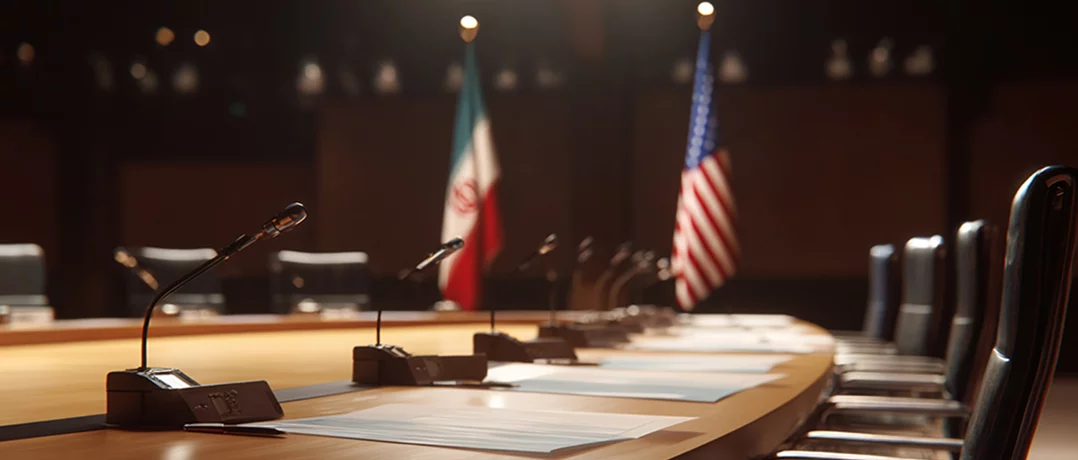
The United States (US) and Iran are set to hold a 3rd round of indirect nuclear talks in Geneva, Switzerland, mediated by Oman, at a moment of acute regional tension.
President Donald Trump has coupled renewed diplomacy with explicit threats of military action should negotiations fail. Meanwhile, Tehran has warned that any attack would be met with force against American assets in the region and against Israel.
The talks come amid the largest US military deployment to the Middle East since the 2003 invasion of Iraq, raising the stakes well beyond the negotiating table. Whether Geneva produces a breakthrough or collapses into a devastating confrontation may determine not only the trajectory of US-Iran relations but also the stability of a region already strained by overlapping conflicts.
What are the American and Iranian demands?
At the core of the dispute lies uranium enrichment. Washington is pressing for a halt, or at minimum severe and permanent restrictions, on Iran’s ability to enrich uranium on its soil as well as on their levels to 3%. American officials have also signaled that any future agreement should have no “sunset clauses,” meaning restrictions would not expire over time, as they did under the 2015 nuclear deal; officially referred to as the Joint Comprehensive Plan of Action (JCPOA).
The US position, articulated by Secretary of State Marco Rubio and Vice President (VP) JD Vance, frames Iran’s nuclear and ballistic missile programs as direct threats not only to regional allies but potentially to the US mainland. From here, Washington also wants future discussions to address Iran’s ballistic missile development and its support for regional armed groups, including Hezbollah in Lebanon, Hamas in Gaza, Houthis in Yemen, as well as Iraqi non-state armed groups linked to Tehran.
Iran, represented in Geneva by Foreign Minister (FM) Abbas Araghchi, rejects a complete ban on enrichment as a violation of its sovereign rights under the 1968 Nuclear Non-Proliferation Treaty (NPT). Article IV specifically permits the “use of nuclear energy for peaceful purposes,” a provision Tehran relies on to justify its own nuclear program. It insists its nuclear program is strictly peaceful and has reiterated that it will “under no circumstances” develop a nuclear weapon. However, Iran has enriched uranium to near weapons-grade levels of 90% in the past (the enrichment exceeded 60%) and has restricted access to some nuclear sites following last year’s strikes.
Iran is reportedly prepared to consider measures such as diluting its stockpile of highly enriched uranium (estimated at roughly 400 kilograms) or participating in a regional enrichment consortium (which would include key Gulf States). In return, it demands meaningful sanctions relief to revive an economy battered by years of US pressure as well as a lasting agreement which would not be simply overturned by a new US administration (similar to Trump’s pullback in 2018).
What did the previous rounds of talks achieve?
The current Geneva meeting follows 2 earlier rounds: one in Oman and another in Switzerland. While both sides described the initial contacts as “constructive,” they produced no tangible breakthrough.
The first round helped reopen communication channels after last year’s 12-Day War, during which the US struck 3 Iranian nuclear sites. The second round reportedly clarified the “main principles” of a possible agreement but left core disputes unresolved; particularly enrichment and the scope of negotiations.
Crucially, mutual distrust remains high. Iran views the US strikes and military buildup as evidence that Washington may use diplomacy as cover for coercion. The Iranian Foreign Ministry even stated that “contradictory US positions do not help advance the diplomatic process and increase doubts about their intentions;” highlighting persistent and deep mistrust between the two (a major issue when conducting negotiations). American officials, for their part, argue that Tehran continues to test the limits of international tolerance by advancing its missile capabilities, rebuilding aspects of its nuclear infrastructure, and persisting in its support for regional proxies that destabilize the Middle East.
Rising threats and military buildup
Parallel to the talks, Washington has executed a sweeping military buildup. 2 aircraft carrier strike groups, refueling aircraft, and advanced fighter jets (including F-22s) have been deployed to the region. The stealth jets’ deployment, considered the world’s most advanced air superiority fighter, marks the first time Washington has deployed combat aircraft to the country for a potential wartime scenario. Likewise, the USS Gerald R. Ford, one of the world’s largest warships, has been positioned in the eastern Mediterranean. Satellite imagery has shown US naval vessels dispersing from ports such as Bahrain into open waters.
In addition, the US Department of the Treasury has imposed new sanctions targeting vessels and entities accused of facilitating Iranian oil sales and weapons procurement. The measures are intended to increase leverage ahead of negotiations.
Meanwhile, Iran has responded with military drills along its southern coast (including joint exercises with Russia) and explicit warnings that Israel and American bases in the Middle East would become “legitimate targets” in the event of an attack. For his part, Israeli Prime Minister (PM) Benjamin Netanyahu has repeatedly cautioned against any deal that excludes Iran’s missile program and regional network of allies, often referred to as the “Axis of Resistance.”
The final test before regional escalation
Much hinges on whether the 2 sides can bridge the enrichment gap. There are indications that Washington might tolerate a strictly limited or “symbolic” level of enrichment under intense verification mechanisms. Iran, meanwhile, appears willing to provide assurances about non-weaponization and to modify its enriched stockpile.
Yet the political context complicates compromise. Iran is unlikely to yield to American demands of a complete ban as well as halting its ballistic missiles program or its support for its regional proxies. Additionally, President Trump faces domestic pressure to demonstrate resolve, particularly after last year’s strikes and skepticism regarding their success. Iranian leaders, including President Masoud Pezeshkian and Supreme Leader Ayatollah Ali Khamenei, are also pressured to avoid appearing to capitulate under military threats.
If talks collapse, scenarios range from a limited US strike targeting Islamic Revolutionary Guard Corps (IRGC) assets to a broader campaign aimed at crippling Iran’s nuclear infrastructure or even toppling the entire regime itself. Senior US military officials have reportedly cautioned that even a “limited” strike could spiral into a prolonged regional conflict.
From here, the consequences of failure would ripple across the Middle East, with Lebanon standing at particular risk. Hezbollah has signaled that it would not necessarily intervene in the event of limited US strikes but has described any attempt to topple Iran’s leadership (particularly Khamenei) as a “red line.” In turn, Israel has warned Beirut that it would respond forcefully to any Hezbollah involvement, including targeting its infrastructure (such as the Beirut Rafic Hariri International Airport), according to Lebanese FM Youssef Raggi.
Ultimately, although Lebanese PM Nawaf Salam has stressed that Lebanon will not be drawn into foreign conflicts, a chain reaction (US strike, Iran-Hezbollah retaliation, Israeli counterstrike) remains a plausible and deeply feared scenario. For a country already grappling with economic collapse and reconstruction costs estimated in the billions, another war would prove to be catastrophic. Geneva may thus represent the last viable diplomatic opportunity before escalation becomes difficult to contain.
-
-

-
The Beiruter
-
