From genocide survivors to master craftsmen, Bourj Hammoud's Armenian jewelers transformed loss into legacy, preserving generations of artistry, resilience, and entrepreneurship that continue to shape Lebanon's jewelry industry.




From genocide survivors to master craftsmen, Bourj Hammoud's Armenian jewelers transformed loss into legacy, preserving generations of artistry, resilience, and entrepreneurship that continue to shape Lebanon's jewelry industry.

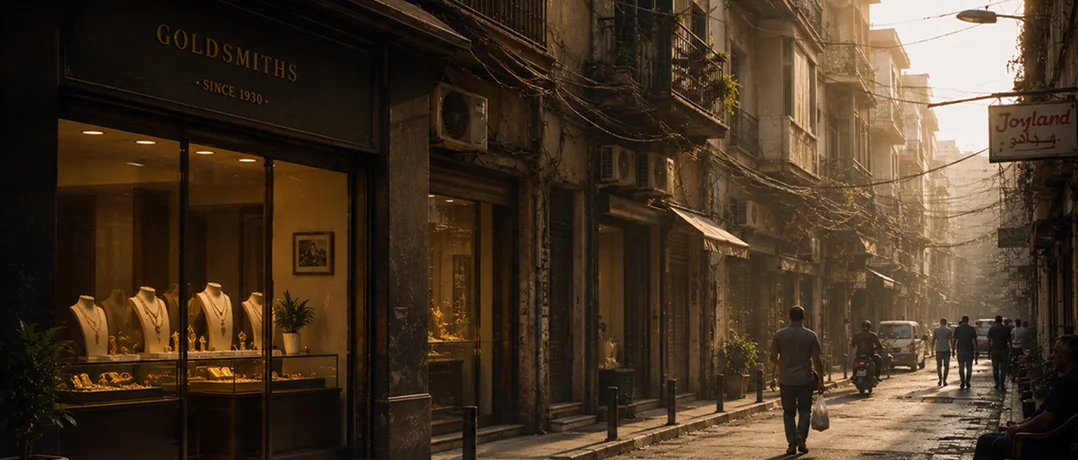
A century ago, Armenian survivors of the 1915 Genocide arrived in Lebanon after being uprooted from their ancestral homeland. They arrived with few possessions, but carried generations of craftsmanship, resilience, and an unwavering determination to begin again. In the decades that followed, they transformed Bourj Hammoud from a refugee settlement into one of Lebanon’s most important centers of trade and artistry, laying the foundations of industries that still define the neighborhood today. Among them were goldsmiths and jewelers whose workshops became emblems of both survival and success. Their stories are not simply about gold, but about rebuilding a life from loss, preserving a heritage through skilled hands, and leaving a mark on the country they came to call home.
The Hadidian story begins in 1937, when brothers Antranik and Sarkis arrived in Lebanon from Aleppo, Syria. They started small, hand-crafting filigree silver jewelry from their home. Sarkis himself delivered the finished pieces by bicycle to buyers in Sidon and Tripoli.
When the Second World War battered Lebanon's economy, the filigree trade suffered along with it. By 1945, the brothers had saved enough to rent a shop in Beirut's historic souk al-sagha, folding gold jewelry into their filigree work for the first time. Within five years they owned that shop, an adjoining workshop, and a second storefront nearby.
By 1968 the next generation, Mihran, Vahe, Vasken, and Vicken, had joined the business. But tragedy struck twice: Mihran was killed by stray fire during political unrest in 1973, and in 1976, at the height of the civil war, Antranik and Sarkis were shot dead in their own home by guerrillas seeking valuables.
“The family pressed on. Between 1977 and 1979, they traveled to Africa and Cyprus supplying retailers, while also working the bullion trade through longstanding Swiss connections built during their souk years,” Hrag Hadidian, told The Beiruter. In 1978 they rented their first shop in Bourj Hammoud; by 1981 they had moved into the location they still occupy, buying the building outright in 1984 and later dividing it into floors for local and imported jewelry.
He described the art behind his craft, “now, designers model pieces in 3D software before a printer produces the wax original, which is burned away inside a mold so molten gold, alloyed to the desired karat, can be poured in its place. Laser cutting and hollow "tubing" techniques have replaced much of the old handwork, driven partly by gold's soaring cost. “
“It used to be around $40 per ounce," he recalled of his grandfather's era; today it hovers near $4,000. He sees gold as an enduring investment, especially for Lebanese families, even as wholesalers like his family absorb the risk when clients bought on credit can no longer pay. "What matters is being good with the numbers," he said. "The moment you lose control of those numbers, you lose your company."
Khajag Barsoumian’s roots trace to Western Armenia, and to a grandfather who fled the Armenian Genocide and rebuilt as a plexiglass importer in Damascus. His father chose a different path, apprenticing in jewelry-making before the Barsoumian brothers, Sarkis and Aghnes, established the family's Bourj Hammoud workshop in 1987, an era when every piece was still made entirely by hand, long before CAD software existed for jewelry design.
Pegor's own path was even less predictable. He dreamed of robotics, building DIY circuit boards and a homemade power bank as a teenager, and once accidentally interfered with military radio frequencies with a homemade transmitter, an episode that ended with a frightening anonymous warning and the end of his experiments. His school principal and his father both steered him elsewhere: toward marketing, and toward the family business.
“I never felt like an artist the way my father was, but I found my footing in commerce,” he explained. In 2016, when he confessed to his father that he wasn't enjoying the work, his father suggested trying online sales, still a rarity in Lebanon at the time. Khajag built a Facebook page, caught the attention of organizations like UNDP and outlets like Voice of America, and never looked back.
A decade later, the business has shifted. Gold sales haven't stopped, as he is keeping capital in marketing and content rather than locked in a safe. The workshop now even uses AI-generated visuals calibrated to match its real products, letting Pegor stay current without losing the family's identity.
Behind a wooden counter sits 80-year-old Hagop Khatchadourian, polishing a gold ring under a desk lamp in the shop he has run alone for more than five decades. "Some people my age go walking in the park," he said. "I come here."
Born in Beirut in 1946 to Armenian parents, Hagop was learning the trade at his father's side by age twelve. "My father used to tell me that gold remembers the hands that touch it." Over a lifetime he has made engagement rings, wedding bands, and baptism gifts for families now on their third or fourth generation of customers. He has no website, no social media, and no plans to start. "My customers know where to find me. The ones who need me always come."
Hagop never married or had children; the shop became his companion through wars and crises that sometimes made him consider closing. He never did. What kept him going, he says, was never fame or fortune, it was trust, and the old wooden chair in the corner where customers once sat for hours over coffee, buying nothing at all.
Asked what he hopes people remember about him, he did not hesitate:
That I was reliable. Not rich. Not successful. Reliable.
Then he picks up another ring and returns to work, shaping gold the same way he always has.
Across generations, wars, crises, and changing technologies, Bourj Hammoud’s Armenian jewelers have preserved a legacy born from survival, carrying forward the skills, values, and stories brought to Lebanon by those who rebuilt their lives from nothing. Behind every workshop and display case lies a history of perseverance, proof that the community’s greatest inheritance was the determination to create something lasting from loss.