



When emotions and rational thinking pull us in opposite directions, making a decision can feel impossible. Clinical psychologist and psychoanalyst Mario Abboud explains why our past experiences, unconscious reactions, overthinking and fear of loss shape the choices we make and why there may never be a perfectly “right” decision.
Heart or brain? The battle behind every difficult decision
Heart or brain? The battle behind every difficult decision
By Yara Saliba | August 21, 2026

Reading time: 5 min
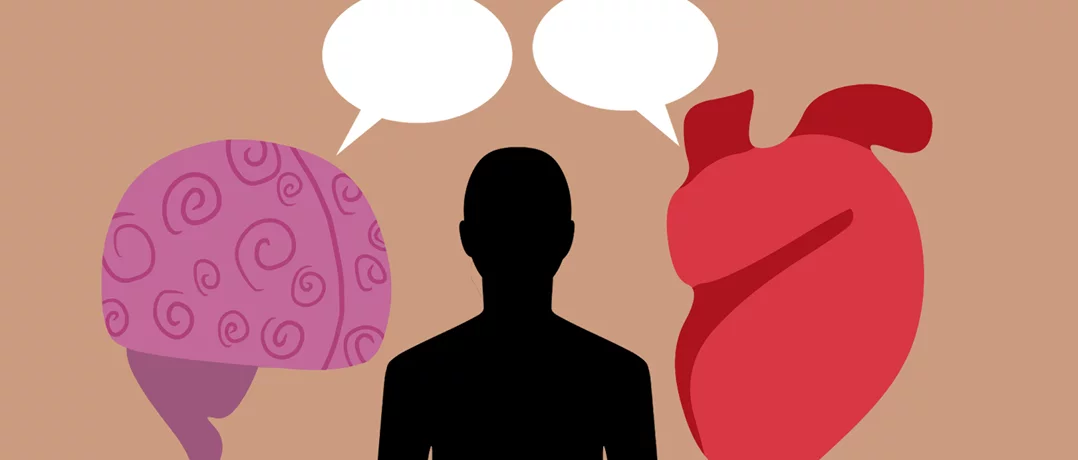
We have all been there: your mind says, “This makes no sense,” while something inside you whispers, “But I want it.” One side has a list of reasons; the other has a feeling it cannot quite explain. So, when emotions and rational thinking pull us in opposite directions, which one should we listen to?
According to clinical psychologist and psychoanalyst Mario Abboud, the answer is not as simple as choosing between the heart and the brain. The real challenge is learning to understand where each is coming from.
When thinking and feeling collide
“When I am thinking one thing but feeling something else,” Abboud explains, a psychological conflict can emerge. And we naturally want that conflict to end. As he puts it, “The body generally does not like this kind of conflict.” We look for a resolution, a middle ground, or some form of balance.
But how we respond to that conflict is not random. Our upbringing, experiences and past events can all shape the way we make decisions. Sometimes we lean toward rational thinking; other times, excitement, emotions or what we feel in the moment takes over. In other words, that voice in your head and that feeling in your stomach did not appear out of nowhere.
Is your “gut feeling” really intuition?
We often describe intuition as a mysterious sixth sense: I just knew. But Abboud says intuition and emotional reactions can be closely connected to our unconscious and past experiences.
Think about meeting someone for the first time and immediately feeling comfortable around them. You might call it a gut feeling. But, according to Abboud, that feeling may also reflect something happening at the unconscious level.
This is why understanding ourselves matters. Our unconscious is not an empty space. It contains our experiences, memories and associations, all of which can influence the choices we make today. So before declaring, “My gut told me to do it,” it may be worth asking: What exactly is my gut responding to?
The answer may not be “heart” or “brain”
For Abboud, healthy decision-making is not about allowing emotions to win or forcing ourselves to be completely rational. It is about understanding our emotions before acting on them.
Where are these feelings coming from? Are they exaggerated? Are they influenced by something that happened in the past? Are we reacting to the present, or to an old experience that has been triggered again?
Therapy, self-reflection and even talking to people we trust can help us understand these patterns. But there is one important limit: other people can support us, but they cannot make the decision for us. “If the decision is based only on emotion, I may regret it later,” Abboud says. The same can happen if we rely exclusively on rational thinking or simply follow someone else’s advice. The goal, then, is not to silence either side. It is to understand both.
Why making a choice can feel so painful?
Sometimes, the hardest part of making a decision is not choosing what we want. It is accepting everything we are not choosing. Every decision closes some doors. And in a world where we are constantly surrounded by choices, that can feel overwhelming. Abboud explains that when we choose one option, we inevitably lose the alternatives. This can create doubt, especially when someone already feels unstable or uncertain.
Then comes overthinking.
What if I had chosen the other option? What if I had waited? What if I had said yes instead of no? One thought becomes another, and another, until the original decision is buried underneath an entire imaginary alternative life. Perfectionism and people-pleasing can make the process even harder. If we are constantly trying to make the “perfect” choice or satisfy everyone around us, we may lose sight of what we actually want.
There is no perfect decision
Perhaps the most comforting part of Abboud’s perspective is that there may never be a decision that is completely and objectively “right.”
“We are human and nothing is ever perfect,” he says. A decision can be appropriate for you today and feel different tomorrow. Circumstances change. New information appear. Sometimes we make mistakes. Sometimes we simply change our minds.
What matters is being conscious of why we made the decision and being willing to commit to it. Abboud describes it simply: “We win some and lose some.” Every choice comes with gains and losses. The challenge is accepting both without getting trapped in endless what ifs.
Trust the version of yourself who made the choice
So, how do we live with a decision once it has been made?
Abboud believes in trusting that, at that particular moment, you made the decision that seemed appropriate for you, provided you made it consciously rather than blindly. That means understanding your triggers, asking yourself why you are choosing something, and recognizing what might be influencing you, whether you are aware of it or not. And if doubt returns? Remember that a different decision might become more appropriate later. That does not automatically make today's decision wrong.
Perhaps good decision-making is not about finding a magical moment when the heart and brain finally agree. It is about knowing yourself well enough to understand why each one is speaking and having the courage to choose anyway.
-
-

-
Yara SalibaJunior Writer/Translator
-
