



Hekmeh basketball club is a symbol of Lebanese sporting pride, national identity and a legacy built on historic victories, fierce rivalries and generations of devoted supporters.
Hekmeh, the pride of Lebanon

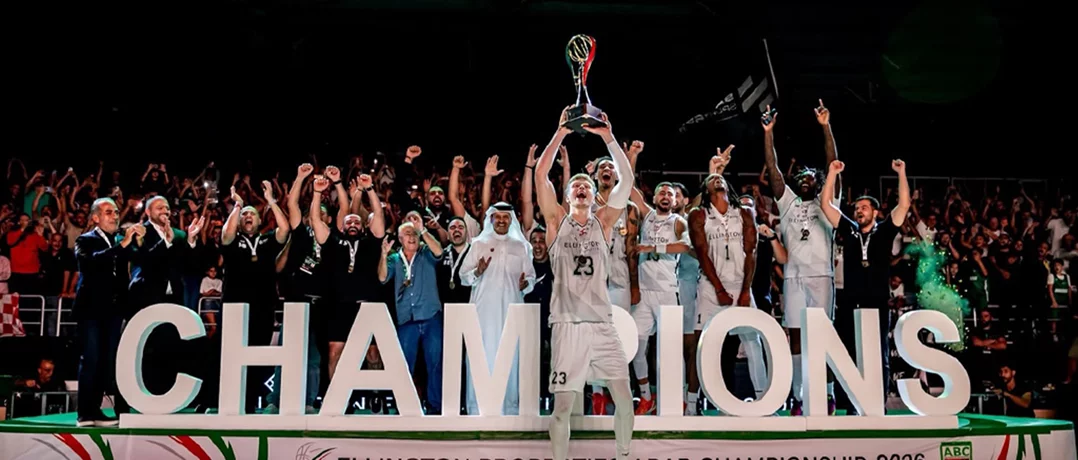
In Lebanon, few sporting institutions carry the weight, history and emotional significance of Hekmeh Beirut. Hekmeh became a symbol of national pride in the years following the civil war, giving a country in search of reasons to celebrate something to believe in.
On the night of October 20, 2026, that feeling filled the arena in Ghazir. A big crowd watched Hekmeh beat Syria’s Ahli Aleppo 84-75 to win the Arab Club Championship, finishing the tournament unbeaten. It was the club’s first Arab title in 27 years.
Part of what that night meant is how long the wait had been. Hekmeh had spent more than twenty years since its last great run, reaching finals and losing them while the club struggled off the court. Mostly though, it was a reminder of what the club had once done for Lebanon. In the late 1990s, the green-and-white team from Beirut became the first Lebanese and Arab club to win Asia’s top club title, then won it again and again. It also reached the NBA’s world club stage in Milan.
Long before the arenas, the Asian crowns and the Beirut derby, Hekmeh was a school project. In 1942, Father Boulos El Kakk, then Director General of the Collège de la Sagesse, set out to build a football team. He had the backing of a circle of doctors, engineers and professionals.
The club received registration certificate No. 1189 on October 14, 1943. After the war it was re-registered on May 22, 1945, as Hakmeh Sporting Club, headquartered in Beirut and licensed for basketball, tennis, volleyball and athletics as well as football.
The first season opened on December 12, 1943, on the school grounds, before Prime Minister Riad Solh and Minister Habib Abou Chahla. Hekmeh beat the visiting Al-Ittihad Al-Dimashqi of Damascus 8-0.
The name means “wisdom” in Arabic, and Sagesse is its French equivalent. The club is tied to a Maronite Catholic school founded in 1875, though it runs under its own independent administration. Its colors are green and white, and fans call it “the Greens.”
Antoine Choueiri and the 1992 revolution
By 1991 Hekmeh was in trouble. Club president Henri Asmar suffered a fatal heart attack after the football team dropped to the second division. Antoine Choueiri, a figure from the advertising world, then took over a club that was struggling.
Basketball arrived at Hekmeh in 1992, when the media tycoon, later called the “Godfather of Lebanese basketball,” took over its leadership and financing. His idea was to build a team that would win and unite Lebanese behind a single banner.
He bought stars. The first roster combined national-team standouts Elie Mechantaf and Fadi El Khatib, who formed one of the best partnerships in Asia at the time, with Boulos Bchara and Elie Fawaz. African stars Assane N’Diaye and Mohammed Acha, plus ex-NBA foreigners, joined them under national coach Ghassan Sarkis.
Results came immediately. Within a few months the team won the 1993 Lebanese Cup while still in the second division. It then won the league title in its first top-flight season, 1994. At the victory dinner, Choueiri announced his next target: the Arab club title, and then Asia.
He financed a company meant to run a professional league of 12 teams from six Arab countries, with shares and profits going to clubs and players. He also brought players to Lebanon from the diaspora in America, Canada and Europe. At the time, the team regularly visited drug-rehabilitation centers and invited people with disabilities to games.
The golden decade
The first big breakthrough came after a painful loss. Hekmeh lost the 1996 Arab Club final in Beirut. In 1998, at the same event held in Beirut again, it won Lebanon’s first Arab club trophy. It defended the title in 1999, with Beirut hosting for the second straight year. Hekmeh beat Saudi side Al-Wahda 41-31, the lowest combined score in the tournament’s history.
In May 1999, Beirut hosted the Asian club championship. Hekmeh won, with N’Diaye named MVP. It was the first Asian title for a Lebanese or Arab club, and the country went wild. The next year, on home floor again, Hekmeh became the first club to defend the title. Mechantaf was MVP in 2000. In 2004 in Sharjah, Hekmeh edged reigning champions Al-Wahda of Syria 72-70 to become the first club with three Asian titles.
As Asian champions, Hekmeh played in Milan at the 1999 McDonald’s Championship, the NBA-FIBA tournament. That was the last edition, and the only time an Asian club took part. Hekmeh finished sixth with two losses. The club was still honored that year as Asia’s best professional team.
Hekmeh won eight league titles (1994, then seven straight from 1998 to 2004) and seven Lebanese Cups (1993 and 1998-2003). It also won WABA championships in 2002, 2004 and 2005.
The Beirut derby
None of this happened in isolation. Al Riyadi, the dominant club in the league, became the foil for Hekmeh’s rise. The rivalry is now considered the biggest in Lebanese basketball, and it intensified in the 1990s when Hekmeh rose to continental prominence while Riyadi kept long-term domestic dominance.
After the 2004 title, Choueiri had resigned as president at the end of the 2003 season, after spending millions of dollars on sport. He died in March 2010 at 69 after a long illness.
What followed was instability. Even with money coming in, the club struggled with consistency and debt, and political and business involvement was seen as part of the problem. Hekmeh kept reaching finals but kept losing them.
In 2019, Elie Yahchouchi, who had been Choueiri’s vice president, became president, with Ghassan Hasbani leading the board of trustees. In October 2023, Jihad Pakradouni became honorary president and Ragheb Haddad president. In 2019, the Ghazir arena was renamed the Antoine Choueiri Stadium in the founder’s honor. The club unveiled a modernized logo in September 2024.
October 2026: the Green Castle returns
Hekmeh hosted the 38th Arab Club Championship in Ghazir, October 9-20, 2026, with 12 clubs. In the final it beat Syria’s Ahli Aleppo 84-75 for its third Arab title, after 1998 and 1999. It led 26-16 after one quarter, 45-35 at the half and 67-55 after three. The team finished the tournament unbeaten, 27 years after its last Arab title. Washington scored 23 points in the final and was named best foreign player, and Ali Mezher was named MVP. Choueiri’s portrait hung in the background at the arena.
Hekmeh’s record is outsized, eight league titles, seven cups, three Arab titles, three Asian titles, and a seat at the world club championship. It is the club that helped put Lebanese basketball on the international map, produced generations of sporting heroes and gave thousands of supporters a shared sense of belonging. Its greatest importance is that it persuaded a country with plenty of reasons for division to fill arenas together.
-
-

-
Jenna GeageaReporter/Writer
-
