



Tracing the evolution of human communication, from the Phoenician alphabet and ancient postal networks to handwritten letters, telegraphs and instant digital messaging, with Lebanon at the heart of the story.
How communication changed the course of history
How communication changed the course of history
By Jenna Geagea | November 11, 2026

Reading time: 4 min
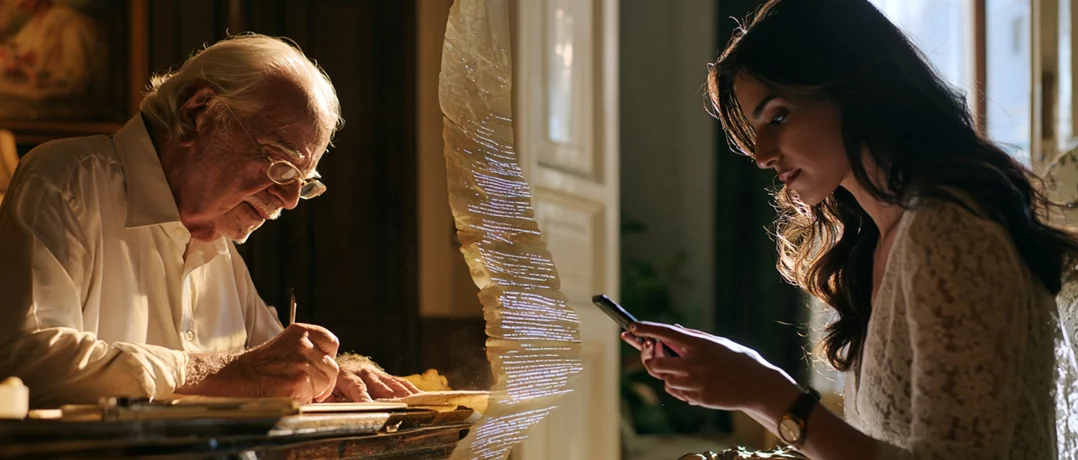
Before anyone dreamed of a “send” button, people faced the same dilemma, how to make a thought travel farther than a voice could carry. The answers they found, from winged messengers to fiber-optic cables, tell the story of civilization itself.
Lebanon sits near the beginning of this story. The Phoenicians of Byblos, Tyre and Sidon spread a simple alphabet of about twenty-two letters across the Mediterranean, and it became the ancestor of the Greek and Latin scripts. Writing became something merchants and ordinary people could master.
Messages then needed a way to move. The Persian Empire built a royal road with relay riders, a system the Romans refined into the cursus publicus. In the medieval Middle East, carrier pigeons joined the network. By the twelfth century, Nur ad-Din in Syria ran a pigeon service, and the Mamluk sultans later built a famous relay of birds and mounted couriers linking Cairo and Damascus. Pigeons were still in commercial use in 1850, when Paul Julius Reuters flew stock prices between Aachen and Brussels to fill a gap in the telegraph line.
For most of Lebanon’s history, mail was an imperial affair. Under Ottoman rule, official couriers served the state while ordinary people relied on caravans, ships and traveling acquaintances. In the nineteenth century, Beirut’s growing port made it a gateway for foreign powers, and several of them opened their own post offices there. French, Austrian, Russian, British and Italian agencies competed for the city’s correspondence, each selling its own stamps. A letter leaving Beirut might carry the marks of an empire that had no authority over the city.
The twentieth century brought a new order. After the First World War, Lebanon came under the French Mandate, and the Ottoman-era stamps gave way to French issues overprinted for the territory, followed by Lebanese designs of cedar trees, ruins and mountain landscapes. Independence in 1943 meant the country could issue stamps as a sovereign state, and Lebanon later took its own seat in the Universal Postal Union. During the civil war of 1975 to 1990, delivery was repeatedly interrupted by checkpoints and shelling, and many families found letters unreliable and turned to the telephone, when the lines worked, or to relatives who happened to be traveling. In the following years, the postal system was modernized, and a private operator, Liban Post, took over its management.
The art of the handwritten letter
Across all these changes, the letter remained a deeply personal object. It carried a person’s handwriting, their pauses, their corrections, sometimes the faint scent of the room where it was written. Writers chose paper, folded it carefully and sealed it with wax. Before envelopes became common in the nineteenth century, many letters were folded into their own covers, a practice historians now call letter locking, which made tampering visible.
Reform made the habit universal. In 1840, Britain introduced the Penny Black, the first adhesive postage stamp, together with a flat rate paid by the sender instead of the recipient. Cheap, prepaid mail turned correspondence from a privilege into an everyday ritual. Lovers, soldiers, emigrants and students filled the mailbags.
Lebanon gave the world one of its most celebrated correspondences. The poet and painter Gibran Khalil Gibran and the writer May Ziadeh exchanged letters from 1912 until his death in 1931, a bond sustained entirely by ink and paper. Their letters, filled with ideas about art, loneliness and the Arab literary renaissance, now serve as a record of an intellectual friendship that distance could not stop.
Letters have always carried more than their words. In 1586, coded letters between Mary, Queen of Scots, and her supporters were intercepted and deciphered by the spies of Elizabeth I, and the evidence helped send Mary to the scaffold. Wartime censors later sliced out lines with razor blades, and soldiers developed their own signals to slip past them. Migrant families in Lebanon, whose sons and daughters crossed the ocean to the Americas and West Africa in great numbers from the late nineteenth century, wrote letters that were read aloud in village squares, passed from house to house and kept in drawers for generations. Today, such bundles tell historians about prices, illnesses, ambitions and homesickness in ways official records never do.
The nineteenth century then sped everything up. Samuel Morse’s telegraph, which sent its famous first message in 1844, allowed words to cross continents in minutes. In 1876, Alexander Graham Bell patented the telephone, and for the first time a voice, with all its warmth and hesitation, could travel along a wire. Radio, television and the fax machine followed.
In 1971, Ray Tomlinson sent the first network email and chose the @ symbol to separate user from machine. In December 1992, the first text message, “Merry Christmas,” crossed a mobile network in Britain. By the late 2000s, messaging apps such as WhatsApp, launched in 2009, had turned conversation into a constant stream of short messages, voice notes and images.
Speed has transformed memory. A handwritten letter is a single object that may survive for centuries in an attic, while a message exists as data that can vanish with a lost phone, a closed account or a failed drive.
Perhaps the lesson of this long journey is that the medium keeps changing while the need stays the same. Whether carried by a pigeon, a postman or a notification, it is the human need to say I am here, and I am thinking of you.
-
-

-
Jenna GeageaReporter/Writer
-
