



The shared ritual from northern lantern-lit skies to southern village square celebrations transforms Ramadan anticipation into a collective experience of remembrance and optimism which unites the community.
How Lebanese cities welcome the holy month together
How Lebanese cities welcome the holy month together
By Rayanne Tawil | February 20, 2026

Rreading time: 3 min
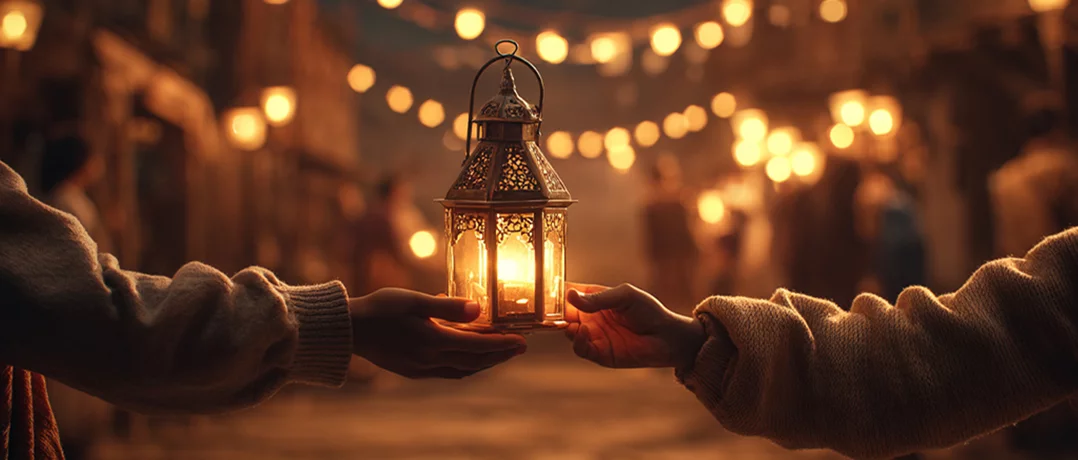
Before the fasting, before the long tables and evening prayers, before the rhythm of days shrinks and nights stretch, there is light.
Across Lebanon, the days leading up to Ramadan are marked not only by calendars and moon sightings, but by something far more tactile: lanterns. Paper or fabric, modest or ornate, sometimes bought, sometimes handmade, sometimes released into the sky and sometimes simply carried through streets by children too excited to stand still. They are not prescribed by scripture, but passed down by memory. A tradition built not on obligation, but on affection.
The Ramadan lantern “fanous” has long been associated with welcome. Historically tied to celebrations in Egypt and the Levant, it became a way of announcing joy before discipline, sweetness before restraint. A child’s first lantern is often their first conscious memory of Ramadan: the light in the dark, the excuse to stay up late, the feeling that something gentle and important is about to begin.
In Lebanon, where rituals are often kept alive by people rather than institutions, the lantern has evolved into a communal act. In recent years, that act has taken on new weight.
Lanterns rising over Tripoli
The northern Lebanese region witnessed its residents assembling outdoors for their Ramadan festivities. Lebanese families and their young members proceeded to celebrate the beginning of the sacred month in Tripoli and Miniyeh and throughout the Sir-Danniyeh hilly areas.
The people of Tripoli gathered at the Rachid Karami International Fair, an exhibition space built to showcase indeterminate possibilities. The night turned into an entirely different experience. The team set up the lanterns on the ground with great attention to detail. Children held the lanterns tightly with both hands while their parents stood close by to protect them and friends took pictures for social media platforms while strangers exchanged their lighters and shared their experiences while they assisted one another in launching their lanterns into the sky.
When the lanterns finally rose, one after the other, the crowd fell briefly silent. Then came applause, laughter, shouted wishes, small, human gestures released upward. For many, it felt like the city was breathing again.
For Ahmad Osman, member and organizer with the North Commission of the Al-Jarrah Scout Association, the moment never gets old. This is the fourth year the scouts have organized the event, but his connection to it runs much deeper.
“I remember coming here as a child,” he said, smiling.
One year, I had broken my leg. I was in pain and could hardly walk but I still insisted on coming. I didn’t want to miss the lanterns.” He paused. “Even then, it meant something to us. It wasn’t just an event. It was Ramadan arriving.
Today, Osman helps organize the very tradition he once limped toward as a child. The symbolic entrance fee LL 200,000 goes directly back into community work: scout activities, food distributions, Eid initiatives for families in need. “Despite everything Lebanon has been through, we insist on doing something positive,” he said. “This night is about joy. About hope. About telling people: we’re still here.”
An injection of joy
That insistence is shared by Hani Chaarani, director of the fairgrounds and one of the organizers. Watching the crowd fill the space, he described the night as “an injection of positive energy” for the city.
“Tripoli needs light,” he said simply. “Not just electricity, light in the emotional sense. When you see families, young people, children all together, you remember what this city can be.”
Everyone participated. Muslims and non-Muslims also gathered along, watching as lanterns floated up. As Chaarani put it: Ramadan, like Christmas, can be shared, It’s a season. A feeling. A moment people can enter together.
Among the crowd, that sentiment resonated. Assile Sahmarani, attending for the third year in a row, said the lanterns symbolize “the light that guides us into Ramadan.” Nearby, Yahya Kebbeh, there for the first time, described the night as “a spark of hope for the city, even if it’s a small one.”
Small villages, big gatherings
Further south, the same impulse took a more intimate form. The village of Mazboud which exists 20 minutes away from Saida dedicated its entire attention to its younger population.
The village square was decorated. Lanterns were lit. Kids dressed in white, ran between their parents and the organizers, clutching toys and sweets. What began as a modest plan for 100 children quickly grew to nearly 270.
“We wanted children to live the Ramadan atmosphere,” said Wassim Tohme, a member of the Mazboud municipality. “The decorations, the joy, the sense that something special is happening.”
But it wasn’t only the children who were transformed. “The parents enjoyed it even more,” he laughed. “For the first time, everyone in the village gathered in one place. People who don’t usually sit together were standing side by side.”
In a country fractured by crisis, that closeness felt radical in its simplicity. “When people see their children happy, their fear disappears,” Tohme said.
By the end of the night in Tripoli, the lanterns had vanished into the dark. The fairgrounds slowly emptied. Children fell asleep in cars. Adults lingered, reluctant to leave.
But the light remained, carried forward into kitchens, mosques, living rooms and memories.
Ramadan, after all, does not begin with fasting. It begins with a glow. With people gathering before the month asks them to turn inward.
As Osman put it, watching the last lantern rise: This light, we give it to each other. And that’s why it lasts.
-
-

-
Rayanne TawilCultural writer
-
