



Under the summer sun on Naji Beach, 150 volunteers came together to sculpt the name of their city into an 80-meter sand artwork, proving that Tripoli’s story can be shaped by the hands of its people.
How Rimaluna turned a beach into the city’s biggest canvas
How Rimaluna turned a beach into the city’s biggest canvas
By Rayanne Tawil | July 05, 2026

Reading time: 6 min
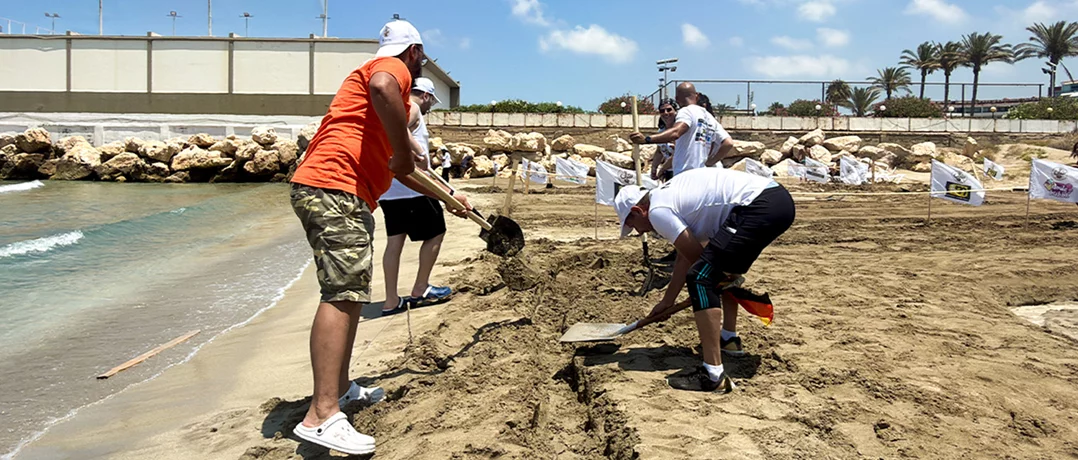
The first thing visible from Naji Beach was the line of people stretching along the shore, shovels in hand, standing between the blue of the sea and the golden sand. Under a bright June sun, volunteers moved across the beach, marking lines, digging the ground and shaping curves that would eventually become something much bigger than a sculpture.
In front of them, the word “Tripoli” slowly began to appear across the sand, a massive creation measuring around 80 meters in length and 15 to 20 meters in width, built entirely by the people who came to give their time, energy and creativity.
As the hours passed, the sculpture became more than lines drawn into the sand. It became a gathering point. Volunteers danced dabkeh between the letters, lifting their shovels high above their heads, holding hands as they moved across the beach. The same tools used to build the sculpture became part of the celebration.
The scene looked almost unreal: families, children, young volunteers and older participants gathered on the same piece of land, each person responsible for a small part of the city’s name. The project was the latest initiative by Rimaluna, a sand art movement founded by Azzam Rifi and Nazih Barakeh, who wanted to transform an unusual hobby into a community experience.
“We are building Tripoli, or sculpting Tripoli, on sand, with the hands of the people of the city,” Azzam explained. “We are proving that Tripoli is a creative city, a city for common living, a city where families and children collaborate together to make the best picture possible.”
From a turtle to a movement
Rimaluna started far away from a grand plan. It began with a simple afternoon on the beach, a few friends and an idea that almost ended before it started.
“I hate sand,” Azzam laughed. “Even when I go to the beach, I don’t like sitting on the sand. My cousin Nazih told me, ‘Let’s make a sculpture.’ We started with a turtle. It was funny, people thought it was amazing, and we saw the reaction.”
That first attempt became the beginning of a journey. The turtle was followed by a shark, then a crocodile, as the two cousins discovered that sand could become a medium for storytelling.
Nazih remembered the moment people started gathering around their work. “We were just having fun, three or four of us. We didn’t expect anything. People started filming, dancing around it, taking pictures. We felt like everyone was connected to it.”
The support encouraged them to take the idea further. Rimaluna was born from combining rimal (sand) with the idea of “us” creating a space where people could participate instead of simply watching.
“People started coming and helping us. Even kids came to help us,” Azzam said. “We said, this should become something for everyone.”
Building Tripoli beyond stereotypes
For the founders, writing the city’s name in sand was never only about creating a large artwork. It was about changing the way people see Tripoli and allowing the city’s own residents to tell their story.
“Tripoli is always talked about through certain images,” Azzam said. “We are not here to prove that Tripoli is something different. We are here to prove that Tripoli has always been this: creative, generous and full of people who want to do something beautiful.”
The event gathered around 150 volunteers, many of whom had never sculpted sand before. They were divided across the seven letters of “Tripoli,” each group responsible for shaping a section of the final piece.
“No one has experience in sculpting,” Azzam explained. “That is the beauty of it. Everyone is equal. The children, families and volunteers, everyone is putting their hands in the sand together.”
Nazih believes sand offers a different kind of connection. “Today, children are surrounded by iPads, phones and games. We wanted them to come back to nature, to use their hands, to create something together.”
Volunteers under the sun
Since early morning, volunteers worked through the heat, shaping the design together.
Wassim, a volunteer, was among them, moving around the beach with the same excitement as everyone else. “We have been working since yesterday,” he said. “The environment is great. We invite everyone to come because Tripoli is the city of love and peace.”
Around him, the atmosphere kept growing. People who arrived separately found themselves working together, sharing tools, helping each other carry sand and cheering every time another part of the sculpture became visible.
For Sarah Succari, one of the organizers and volunteers, the day carried an emotional meaning beyond the sculpture itself.
“We have been here since 8 a.m., with the sun and the heat, and we are still continuing,” she said. “The volunteers did a great job, from the young to the old. Many organizations participated, whether economic, social or humanitarian.”
Sarah added that the event gave people a reason to gather during difficult times. “It makes people happy,” she said. “With everything happening around us, people need something that brings joy.”
A temporary sculpture, a lasting memory
Among the crowd was Mira, a pregnant mother who came with her four-year-old son to be part of the experience. Watching him join the crowd around the sculpture, she saw a moment of connection between people working toward the same goal.
“I am excited to be a part of it,” she said. “This event shows the beautiful side of the city and its culture.”
The founders know the sculpture will eventually disappear. The sea, wind and time will erase the letters carved into the beach, yet for Nazih, that is part of its meaning.
“We know it will disappear, that’s why we film it and keep the pictures,” he said. “The important thing is what happens while we are creating it.”
As the afternoon sun moved across Naji Beach, the letters of Tripoli grew clearer. Volunteers gathered around the DJ area, leaving their shovels aside to dance and celebrate. Music filled the beach as people clapped and moved together, surrounded by the sculpture they had created with their own hands. The national anthem echoed across the shore as volunteers stood facing the giant letters carved into the sand, “Tripoli” written by hundreds of hands.
-
-
-
Rayanne TawilCultural writer
-
